


In 2026 the question of AI content vs. human content is no longer theoretical. Two large-scale studies now give us clear numbers. Semrush’s analysis of 42,000 blog posts found that human-written pages occupy Google’s number-one position roughly 80% of the time, while purely AI-generated pages hold that spot only about 9% of the time. A separate 16-month tracking study of 4,200 articles across 140 domains showed pure AI content ranking 23% lower on average than human-written pieces targeting the same keywords. AI-assisted content that received substantial human editing, original data, and expert attribution performed within 4% of fully human work.
These results do not mean AI is banned. Google’s own guidance is consistent: the search engine evaluates content on helpfulness, originality, accuracy, and trustworthiness, not on whether a human wrote the first draft. What the data actually reveals is a hierarchy. Pure AI content struggles to reach and hold the top positions. Pure human content remains strong but is slow and expensive to scale. The content that consistently performs best combines both: AI for speed and structure and human expertise for experience, originality, and verification.
This article examines exactly what ranks in 2026. You will see the latest ranking data, a practical comparison of pure AI, pure human, and hybrid approaches, and a clear workflow that produces content capable of ranking while meeting Google’s people-first standards. The goal is not to choose sides. It is to understand which combination of human judgment and AI efficiency actually delivers lasting visibility
Table of Contents
The 2026 Data: What the Studies Actually Show
Two independent studies published in 2026 give the clearest picture yet of how AI content and human content perform in Google Search.
The first is Semrush’s analysis of 42,000 blog posts across 20,000 keywords. Using an AI detection tool to classify pages, the study found that human-written content held the number-one position approximately 80% of the time. Purely AI-generated content held that top spot only about 9% of the time making human content roughly eight times more likely to rank first. The gap narrowed further down page one. AI content appeared more frequently in positions 4–10, showing that pure AI can still reach the first page, but it rarely claims the most valuable positions.
Source: Image sourced from reboot
The second major study tracked 4,200 articles across 140 domains for 16 months. Researchers compared three groups: pure AI content (lightly edited), AI-assisted content (at least 30% rewritten with original data and named expert attribution), and fully human-written content. Pure AI ranked 23% lower on average than human-written articles targeting the same keywords. The gap widened over time and became more pronounced after the March 2026 core update. AI-assisted content, however, performed within 4% of fully human content in median ranking position.
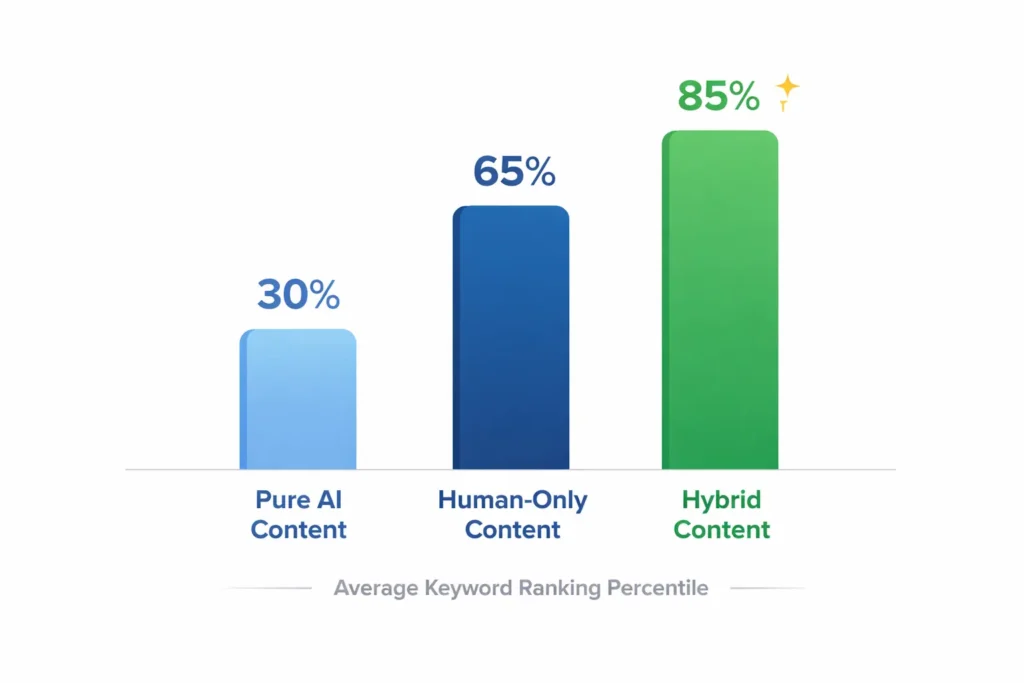
Source: Data has been collected from Indianprompt
Additional findings from the longer study are equally important. Pure AI articles acquired 61% fewer editorial backlinks than human-written pieces on comparable topics. After spam updates during the study period, pure AI content was deindexed at 3.2 times the rate of human-written content. Traffic stability also differed sharply: human-written pages retained 81% of their visibility, AI-assisted ones retained 76%, and pure AI retained only 54%.
A note of caution is required. AI detection tools used in these studies have known error rates of 15–30%. Some well-edited AI content may have been classified as human, and some human content may have been flagged as AI. The directional pattern, however, remains consistent across both large data sets: the higher the quality of human involvement, the stronger the ranking and link performance.
These numbers do not prove that Google penalizes AI. They show that content lacking originality, first-hand experience, and careful verification struggles to compete at the top of competitive results. The data points to the same conclusion Google has stated publicly: quality, usefulness, and trust matter far more than the method used to produce the first draft.
Google’s Official Position in 2026
Google has been consistent and clear on this topic. The company does not rank content based on whether it was written by a human or generated by AI. What matters is whether the content is helpful, reliable, and people-first.
In its official documentation, Google states that the focus remains on the quality of the content rather than how it was produced. Using generative AI tools is acceptable when the resulting work meets the same standards expected of any other content. The problem arises when AI is used to create large volumes of pages that offer little originality, little added value, or little real experience for the reader. That practice falls under Google’s spam policy on scaled content abuse.
The quality systems Google uses continue to look for signals of Experience, Expertise, Authoritativeness, and Trustworthiness (E-E-A-T). Of these, trust is repeatedly described as the most important. Content that demonstrates first-hand experience, clear authorship, accurate information, and original insight is more likely to be treated as helpful. Content that simply rephrases existing material without adding new perspective or verification tends to underperform, regardless of the tool used to create it.
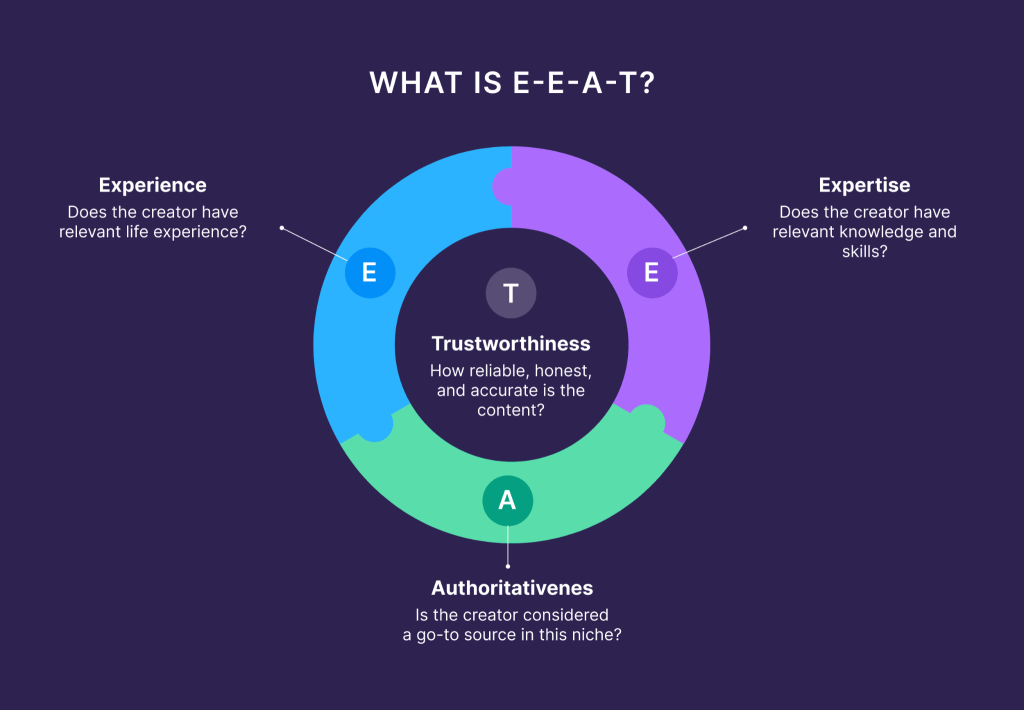
Source: Google’s E-E-A-T framework as illustrated in widely referenced explanations of Search Quality Rater Guidelines and people-first content principles (developers.google.com/search).
Information gain has also become a stronger practical filter. Google’s systems reward pages that provide something useful that is not already widely available on other sites. This can take the form of original data, documented experience, specific examples, or a carefully reasoned point of view. Pure AI output that stays close to the average of its training data rarely delivers meaningful information gain on competitive topics.
AI Content vs Human Content
The practical differences between pure AI content, pure human content, and hybrid content become clearest when viewed side by side. The table below summarizes the most important factors that influence ranking performance, user trust, and long-term results in 2026.
| Factor | Pure AI Content | Pure Human Content | Hybrid (AI-Assisted + Human-Led) |
| Speed & Cost | Extremely fast and low cost | Slow and expensive | Fast with moderate cost |
| Originality & Insight | Low – often repeats existing information | High – draws on lived experience and unique perspective | High when human experts add original data, examples, and judgment |
| E-E-A-T Strength | Weak – limited real experience signals | Strong – clear authorship and firsthand knowledge | Strong when authors are named and credentials are visible |
| Ranking Stability | Lower – more vulnerable after core and spam updates | High – more resilient over time | High – close to pure human performance when editing is substantial |
| AI Overviews Citation | Rare | Frequent | Frequent when content includes original insight and clear authorship |
| Best Use Cases | Simple product descriptions, basic FAQs, internal drafts | Thought leadership, YMYL topics, case studies, original research | Most commercial and educational content that needs both scale and quality |
The pattern is consistent with the ranking studies. Pure AI content wins on speed and cost but loses on the signals Google’s systems value most: originality, experience, and trust. Pure human content delivers the strongest quality signals but is difficult to scale. Hybrid content, when the human contribution is meaningful, captures the advantages of both approaches.
The critical variable is not whether AI is used. It is how much genuine human expertise, verification, and original perspective is added before publication.
Where Pure AI Content Still Fails in 2026
Pure AI content can produce fluent, well-structured text at high speed. That speed, however, does not overcome several persistent weaknesses that affect ranking and trust.
First, AI models remain prone to hallucinations and outdated information. Because they generate text from patterns in their training data, they can present incorrect facts with high confidence. On topics that change quickly or require precise current knowledge, these errors reduce trustworthiness — the most important element of E-E-A-T.
Second, pure AI content rarely demonstrates genuine first-hand experience. Google’s quality systems look for evidence that the creator has actually done the work, used the product, or lived the situation being described. Content that only synthesizes publicly available information lacks this signal. As a result, it struggles to build the experience component of E-E-A-T.
Third, pure AI pages tend to earn fewer editorial backlinks. The 16-month ranking study found that pure AI articles acquired 61% fewer editorial links than human-written pieces on comparable topics. Backlinks remain a strong ranking signal, so this gap compounds over time.
Fourth, pure AI content shows higher vulnerability after core and spam updates. The same study recorded a 3.2 times higher deindexation rate for pure AI pages following spam updates. Traffic stability was also lower: pure AI retained only 54% of its visibility compared with 81% for human-written content.
Finally, pure AI underperforms most clearly on competitive keywords and YMYL (Your Money or Your Life) topics. In finance, health, legal, and safety-related subjects, accuracy and demonstrated expertise carry extra weight. Pages that lack verifiable human judgment and clear authorship are more likely to be filtered out or ranked lower.
These weaknesses do not mean AI is unusable. They mean that content published with little or no human expertise, verification, or original contribution continues to fall short of the quality standards Google rewards in 2026.
Where Does Human Content Still Dominate?
Human-written content continues to hold clear advantages in the areas that matter most for long-term ranking and trust.
The strongest advantage is lived experience. A human author who has actually performed the work, managed the project, or faced the problem can include specific details, unexpected outcomes, and practical lessons that no model can invent from training data alone. This first-hand knowledge directly supports the Experience pillar of E-E-A-T and is difficult for pure AI content to match.
Original insight follows from the same source. Human writers can take a position, challenge common assumptions, or connect ideas in ways that create genuine information gain. Google’s systems reward this kind of originality. Content that simply restates what already exists online, even if fluently written, offers less value and ranks lower on competitive topics.
E-E-A-T signals are naturally stronger when content is clearly authored by a named individual with relevant credentials or demonstrated history. Readers and algorithms can evaluate who is speaking and why their perspective should be trusted. This clarity improves both human trust and the trustworthiness signals Google prioritizes.
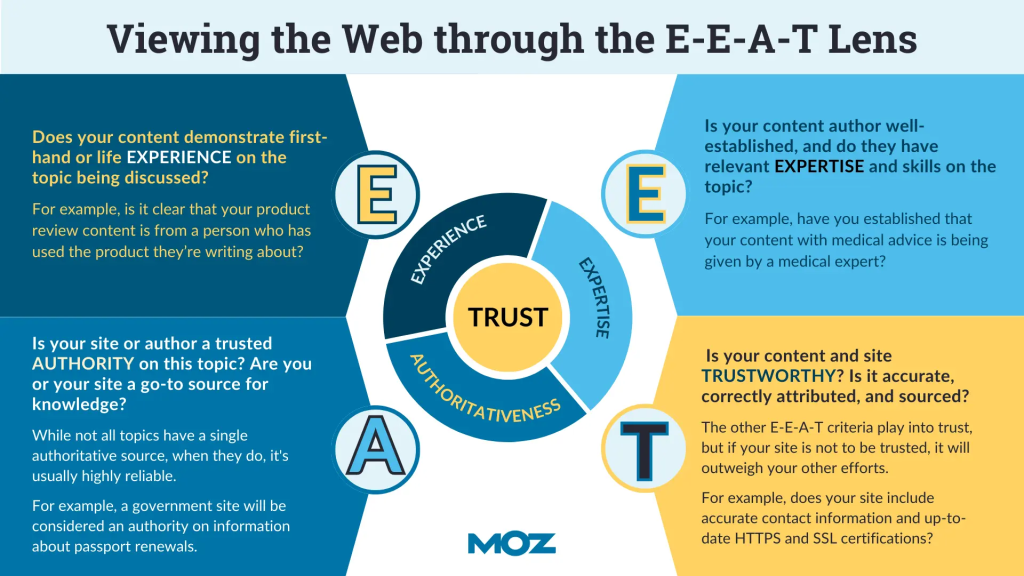
Source: Moz, Viewing the Web through the E-E-A-T Lens
Long-term ranking stability and visibility in AI Overviews also favor human content. The 16-month study showed human-written pages retained higher visibility after core updates and earned more editorial backlinks. Independent analyses of AI Overviews and similar generative results consistently find that content with clear human authorship and original perspective is cited more often than generic AI output.
These strengths make pure human content essential for thought leadership, original research, case studies, and any YMYL topic where accuracy and accountability matter. In these categories, the cost and time of human writing remain justified because the quality signals are harder for competitors to replicate.
Human content does not win every ranking battle. It wins the ones that require depth, trust, and lasting authority.
Want content that actually ranks in 2026? Most teams either publish pure AI content that underperforms or spend too much on pure human writing. We build hybrid content systems that combine AI speed with real human expertise — the exact approach the data shows works best.
→ Get a free content strategy review from NK Marketing Solution
The Real Winner: Hybrid Content That Actually Ranks
The ranking data and Google’s quality standards point to the same practical conclusion. Neither pure AI nor pure human content is the optimal approach for most teams in 2026. Hybrid content — AI-assisted drafts refined by meaningful human expertise — delivers the strongest combination of speed, cost efficiency, and ranking performance.
The 16-month study of 4,200 articles showed that AI-assisted content performed within 4% of fully human-written content on median ranking position when it met three conditions: substantial rewriting (at least 30% of the text), integration of original data or unique examples, and clear attribution to a named expert. Pages that received only light editing fell much closer to pure AI performance and carried the same ranking and backlink disadvantages.
This minimum human layer is what separates ranking content from low-value output. Fact-checking removes hallucinations. Adding first-hand observations or proprietary insights creates information gain. Naming the author and stating relevant credentials strengthens E-E-A-T signals. These steps transform a generic draft into content that demonstrates experience, expertise, and trustworthiness.
The efficiency gains remain significant. AI handles research synthesis, structure, and the first full draft in minutes. A skilled human editor or subject-matter expert can then refine the piece in a fraction of the time required to write from scratch. The result is content that can be produced at higher volume without sacrificing the quality signals Google rewards.
Hybrid content also performs better in AI Overviews and similar generative results when the human contribution is visible. Clear authorship, original perspective, and verified information increase the likelihood that the page will be cited.
The winning formula in 2026 is not “AI or human.” It is AI for scale and structure and human expertise for accuracy, originality, and trust. When the human contribution is real rather than superficial, hybrid content consistently ranks among the strongest performers.
Practical Hybrid Workflow That Beats Both Extremes
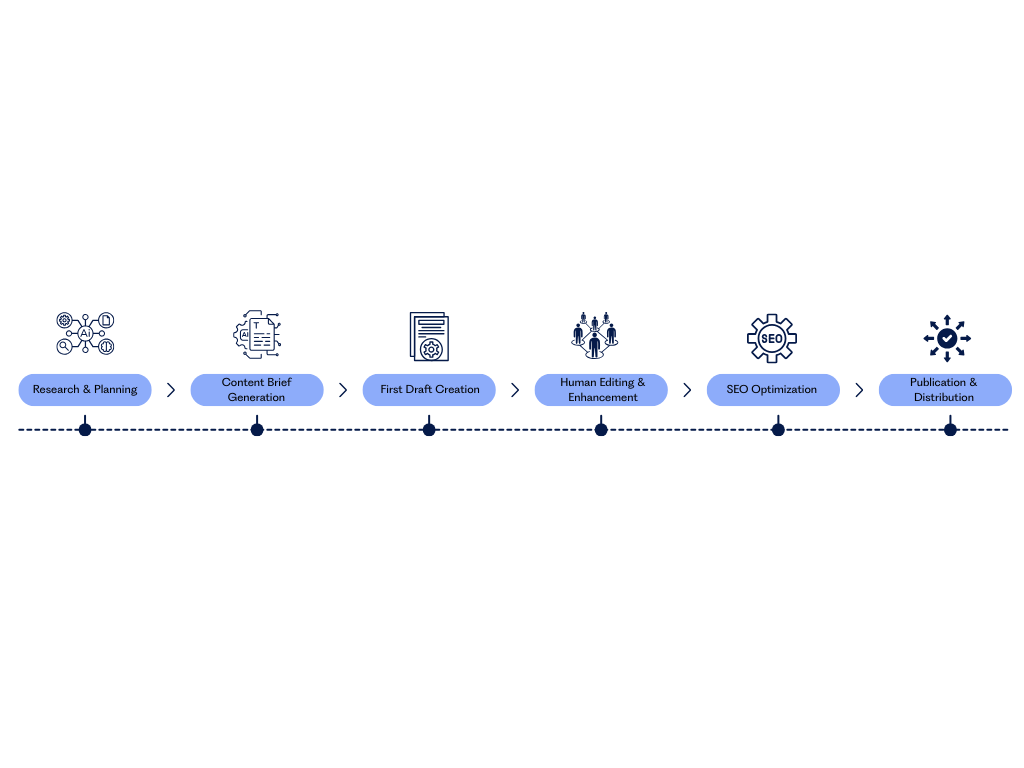
A clear process turns the hybrid advantage into repeatable results. The following six-step workflow is designed to capture AI speed while protecting the quality signals that drive rankings and trust in 2026.
1. Humans set the foundation
A human strategist or subject-matter expert chooses the topic, defines the unique angle, and clarifies search intent. This step ensures the content starts with a real information gap or original perspective rather than a generic keyword list.
2. AI produces the first draft
AI tools handle research synthesis, structure, and the initial full draft. This stage should be treated as raw material only. The goal is speed and comprehensive coverage of the core points, not a finished article.
3. Human expert rewrites for experience and originality
A qualified human rewrites a substantial portion of the draft (typically 30% or more). This is the stage where first-hand observations, specific examples, and original judgment are added. The rewrite should change the voice, deepen the insight, and remove generic phrasing.
4. Fact-check and enrich
Every claim is verified against reliable sources. Proprietary data, client case studies, quotes from practitioners, or original analysis are inserted where they strengthen the content. This step directly builds information gain and trustworthiness.
5. Final editorial and technical polish
The piece receives a final edit for clarity, flow, and brand voice. Author credentials and a clear byline are added. Basic technical elements (schema markup where relevant, internal links, and readable formatting) are completed.
6. Publish and monitor
After publication, track ranking movement, engagement metrics, and appearance in AI Overviews or similar generative results. Use the performance data to refine the next cycle of the workflow.
This process keeps human expertise in control of the decisions that matter most topic selection, originality, accuracy, and trust signals while allowing AI to accelerate the mechanical parts of content production. When followed consistently, it produces content that ranks closer to pure human work at a fraction of the time and cost.
How to Optimize for Both Classic SEO and AI Overviews (GEO)
In 2026, ranking in traditional search results is no longer enough. Content also needs to perform in AI Overviews, Perplexity answers, ChatGPT citations, and similar generative results. The practices that support both environments overlap, but a few signals matter more for AI systems.
Clear structure helps both Google’s ranking systems and large language models. Well-organized headings, concise answers near the top of sections, and logical progression make it easier for algorithms to extract and cite accurate information. Content that buries key points or uses vague language is less likely to be selected.
Originality and information gain remain decisive. AI systems prefer sources that add something not already widely repeated across the web. First-hand experience, proprietary data, specific examples, and reasoned analysis increase the chance of citation. Generic summaries that restate common knowledge are rarely chosen.
Author signals carry extra weight. Pages with a named author, visible credentials, and clear affiliation are treated as more trustworthy by both traditional ranking systems and generative models. Anonymous or poorly attributed content is less likely to be surfaced in AI answers.
Accuracy and verifiability are non-negotiable. AI systems are trained to prefer sources that can be cross-checked. Claims supported by data, expert quotes, or documented experience perform better than unsupported assertions. Fact-checking and transparent sourcing therefore serve both classic SEO and generative visibility.
Finally, content that demonstrates E-E-A-T in a visible way experience, expertise, clear authorship, and trustworthiness is more likely to be selected for AI Overviews. The same quality signals that help a page rank in traditional results also increase its usefulness as a source for generative systems.
Optimizing for both environments does not require a separate strategy. It requires the same foundation: original, accurate, well-structured content created or substantially improved by humans with real expertise. When that foundation is in place, the content is positioned to perform in classic search and in AI-generated answers.
When You Should Still Choose Pure Human or Aggressive AI
Not every piece of content requires the same level of human investment. A simple decision framework based on content type, keyword difficulty, and risk level helps teams allocate resources effectively.
Choose pure human (or heavily human-led) content when:
- The topic is YMYL (Your Money or Your Life) finance, health, legal, safety, or major life decisions. Accuracy and accountability carry higher weight.
- The keyword is highly competitive. Top positions demand strong originality, first-hand experience, and clear E-E-A-T signals.
- The goal is thought leadership, original research, or brand authority. These pieces need a distinctive point of view that only a human expert can provide.
- The content will be used as a primary source for AI Overviews or industry citations. Clear authorship and unique insight increase selection likelihood.
Aggressive AI (with light human review) can be appropriate when:
- The keyword difficulty is low, and search intent is straightforward (definitions, basic how-tos, simple product descriptions).
- The content is supporting or cluster material rather than a primary ranking target.
- Speed and coverage matter more than depth, and the risk of ranking loss is low.
- The output will be heavily filtered through templates or internal guidelines that already enforce accuracy and brand voice.
Hybrid remains the default for most commercial and educational content. It balances speed with the quality signals required for competitive rankings and AI visibility. The decision is not binary. It is a spectrum based on the stakes of the page.
Teams that apply this filter avoid two common mistakes: over-investing human time on low-impact pages and under-investing on high-stakes content where pure AI consistently underperforms. Matching effort to risk and opportunity produces better overall results than treating every article the same way.
Common Mistakes That Kill Rankings in 2026
Even teams that understand the hybrid model still lose rankings by repeating a few predictable errors. These mistakes undermine the quality signals Google rewards and reduce the chance of appearing in AI Overviews.
Publishing unedited or lightly edited AI at scale
This remains the most damaging practice. Large volumes of near-identical, low-originality pages trigger scaled content abuse signals. The ranking studies consistently show that pure or lightly edited AI content underperforms on competitive terms, earns fewer backlinks, and faces higher deindexation risk after updates.
Ignoring information gain
Content that only restates what already exists across the top results adds little value. Google’s systems favor pages that introduce new data, specific examples, first-hand observations, or a clear reasoned perspective. Without this, even well-written hybrid content struggles to stand out.
Weak or missing author signals
Anonymous articles or generic bylines weaken E-E-A-T. When the author is not named, credentials are absent, or the connection between the writer and the topic is unclear, both traditional ranking systems and generative AI models treat the page as less trustworthy. Clear authorship is no longer optional for competitive content.
Treating hybrid as “light editing only”
Many teams generate a draft with AI, make minor wording changes, and publish. This does not meet the threshold shown in the ranking data. Substantial rewriting, fact-checking, addition of original insight, and proper attribution are required for hybrid content to approach pure human performance. Superficial edits leave the content closer to pure AI in the eyes of quality systems.
Failing to match effort to risk
Using aggressive AI on high-stakes or highly competitive pages, or spending full human resources on low-impact supporting content, wastes budget and weakens overall results. The decision framework based on YMYL status, keyword difficulty, and content purpose prevents this mismatch.
Avoiding these five errors protects rankings more effectively than any single tactical change. Quality systems in 2026 continue to reward substance over volume and real expertise over surface-level production.
Frequently Asked Questions
Does Google penalize AI content in 2026?
No. Google does not penalize content simply because it was created with AI. The company evaluates content on quality, usefulness, originality, and trustworthiness. However, large volumes of low-value, unoriginal AI-generated pages can violate Google’s spam policy on scaled content abuse and lose rankings as a result.
Can pure AI content rank #1?
It is possible but uncommon on competitive keywords. Large-scale studies in 2026 show pure AI content holds the number-one position only about 9% of the time, while human-written content holds it roughly 80% of the time. Pure AI performs better on low-competition, straightforward informational queries.
Is hybrid content better for SEO than pure human content?
In most cases, well-executed hybrid content performs at nearly the same level as pure human content while being faster and less expensive to produce. The key requirements are substantial human involvement rewriting, fact-checking, original insight, and clear authorship. Light editing is not enough.
How much human editing is enough?
Research indicates that AI-assisted content needs meaningful human contribution to approach pure human performance. A practical threshold is at least 30% substantial rewriting, plus fact-checking, addition of original examples or data, and named expert attribution. Superficial wording changes do not meet this standard.
Does AI content get cited in AI Overviews?
Pure or lightly edited AI content is cited less often. Content that includes clear human authorship, first-hand experience, original insight, and verifiable information is more likely to be selected by AI Overviews, Perplexity, and similar generative systems. Quality and trust signals matter more than production method.
Conclusion
The debate between AI content and human content in 2026 has a practical answer backed by ranking data and Google’s own quality standards. Pure AI content is fast but consistently underperforms on competitive terms, earns fewer editorial backlinks, and carries higher risk after updates. Pure human content remains strong on trust and originality but is difficult to scale. Hybrid content AI-assisted drafts improved by substantial human expertise deliver the best balance of speed, cost, and ranking performance when the human contribution is real.
Google continues to reward the same core qualities: helpfulness, originality, accuracy, first-hand experience, and clear trustworthiness. The production method is secondary. What matters is whether the finished page demonstrates genuine value and reliable authorship.
Teams that treat AI as a drafting tool under human control, enforce meaningful editing standards, and match effort to the stakes of each page will outperform those that chase volume alone. The content that ranks and gets cited in 2026 is the content that is useful, original, and trustworthy regardless of how the first draft was created.
Focus on quality systems rather than production methods, and the rankings will follow.
Ready to stop guessing and start ranking? If you want content that follows the hybrid model proven to work in 2026 — original, expert-led, and built for both classic search and AI Overviews — our team at NK Marketing Solution can help you implement it.