
Nothing rattles a website owner quite like watching organic traffic tank overnight. Maybe Google slapped your site with a Manual Action. Maybe you got sideswiped by a big Core Update. Either way, a penalty like this means something in your SEO approach broke—badly. Getting back on track isn’t a quick fix. You’ll need to dig deep, figure out exactly what went wrong, and clean things up with real care. And above all, you have to get serious about quality.
This guide cuts through the noise. You’ll get a clear, Google Penalty Recovery technical plan to find the real cause of your penalty, fix it the right way, and earn back your spot in the rankings.
Table of Contents
Step 1: Pinpointing the Problem – Manual Action vs. Algorithmic Penalty
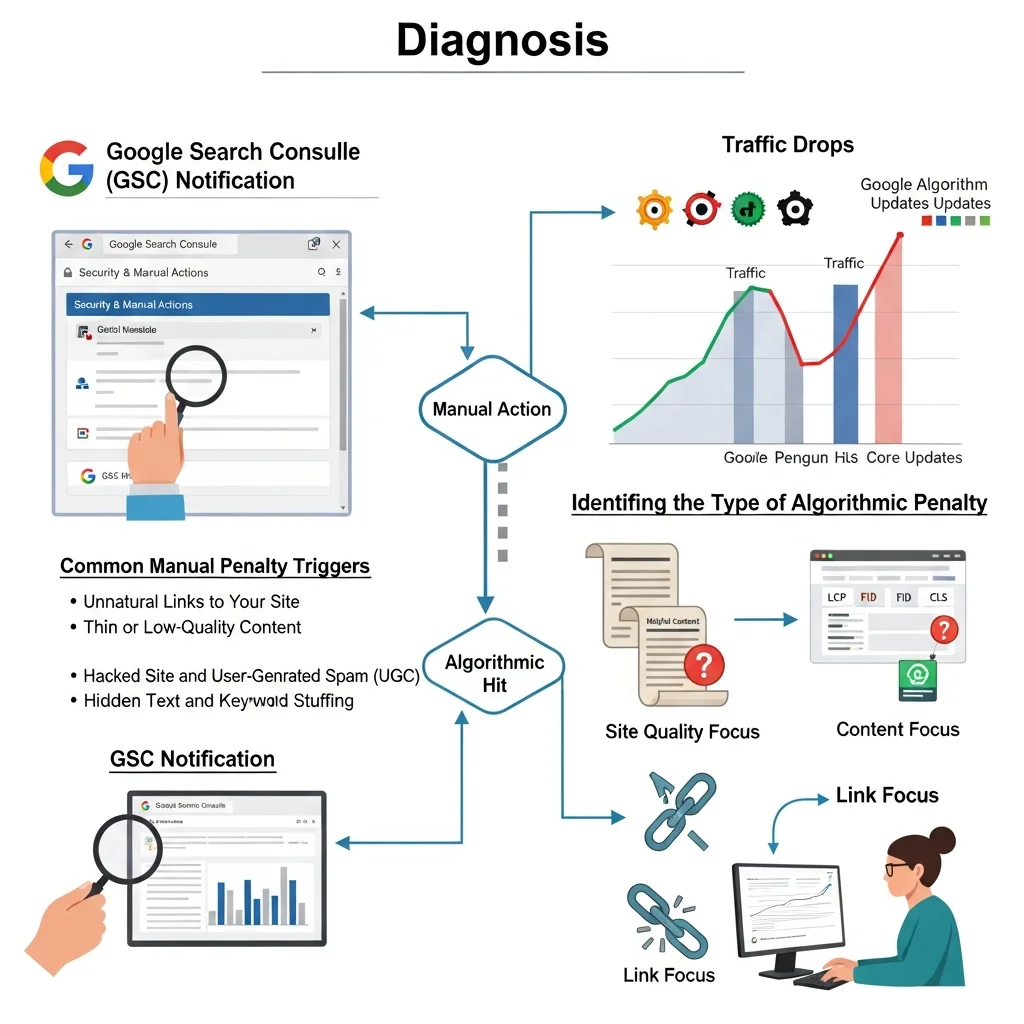
Start with diagnosis—nothing matters more. Traffic can dip for all sorts of reasons: maybe you messed up a site migration, ran into some technical glitch, or a competitor stepped up their game. But if your numbers fall off a cliff overnight, odds are Google hit you with a penalty. Now you’ve got to figure out what kind: did a real person flag your site (Manual Action), or did Google’s algorithms do it automatically (Algorithmic Hit)? That’s the key.
Detecting a Manual Action
A Manual Action is Google’s human team stepping in to issue a penalty after a reviewer finds your site in violation of its quality guidelines.
The process is clear: you will be notified.
- The Google Search Console (GSC) Notification:
- Start with Google Search Console. Head over to the Security & Manual Actions tab. If you’ve got a Manual Action, you’ll see exactly what went wrong—like “Unnatural Links to Your Site” or maybe “Pure Spam.” That’s your playbook for fixing things.
- Common Manual Penalty Triggers:
- Manual actions are often triggered by clear, intentional violations of policy:
- Unnatural Links to Your Site (Link Schemes): The most common trigger, involving buying or selling links that pass PageRank.
- Thin or Low-Quality Content (Pure Spam): Entirely scraped, automatically generated, or cloaked content.
- Hacked Site and User-Generated Spam (UGC): Security breaches that infect your site with spam links or code.
- Hidden Text and Keyword Stuffing (Legacy Violations): Attempting to trick the search engine by making text invisible to users.
Diagnosing an Algorithmic Hit (Panda, Penguin, Core Updates)
If your GSC Manual Actions report shows nothing, you’re probably dealing with an algorithmic hit. Google’s algorithms—think Panda for content, Penguin for links, or those big Core Updates focused on E-E-A-T and overall quality—hand these out automatically.
Correlating Traffic Drops with Algorithm Updates:
Here’s what you do: grab a tool like Penguin or SEMrush Sensor. Overlay your site’s traffic drops on a timeline of Google’s updates. If that dip lines up with a Core Update, you’ve found your culprit. Now, focus on what the update targeted—maybe content quality, helpfulness, or user experience. That’s where you need to dig in.
Identifying the Type of Algorithmic Penalty:
Site Quality Focus (e.g., Core Web Vitals/Experience): Did the drop occur after you failed a Core Web Vitals assessment? This signals technical issues affecting the user experience.
Content Focus (e.g., Helpful Content): Did your informational, review, or non-transactional content pages lose all visibility simultaneously? This point to issues with content utility, expertise, and depth (Panda/Helpful Content Update targets).
Link Focus (e.g., Penguin): Did only pages with aggressively optimized or suspicious link profiles get hit? This requires a backlink quality review.
Step 2: The Cleanup Phase – Addressing the Root Cause
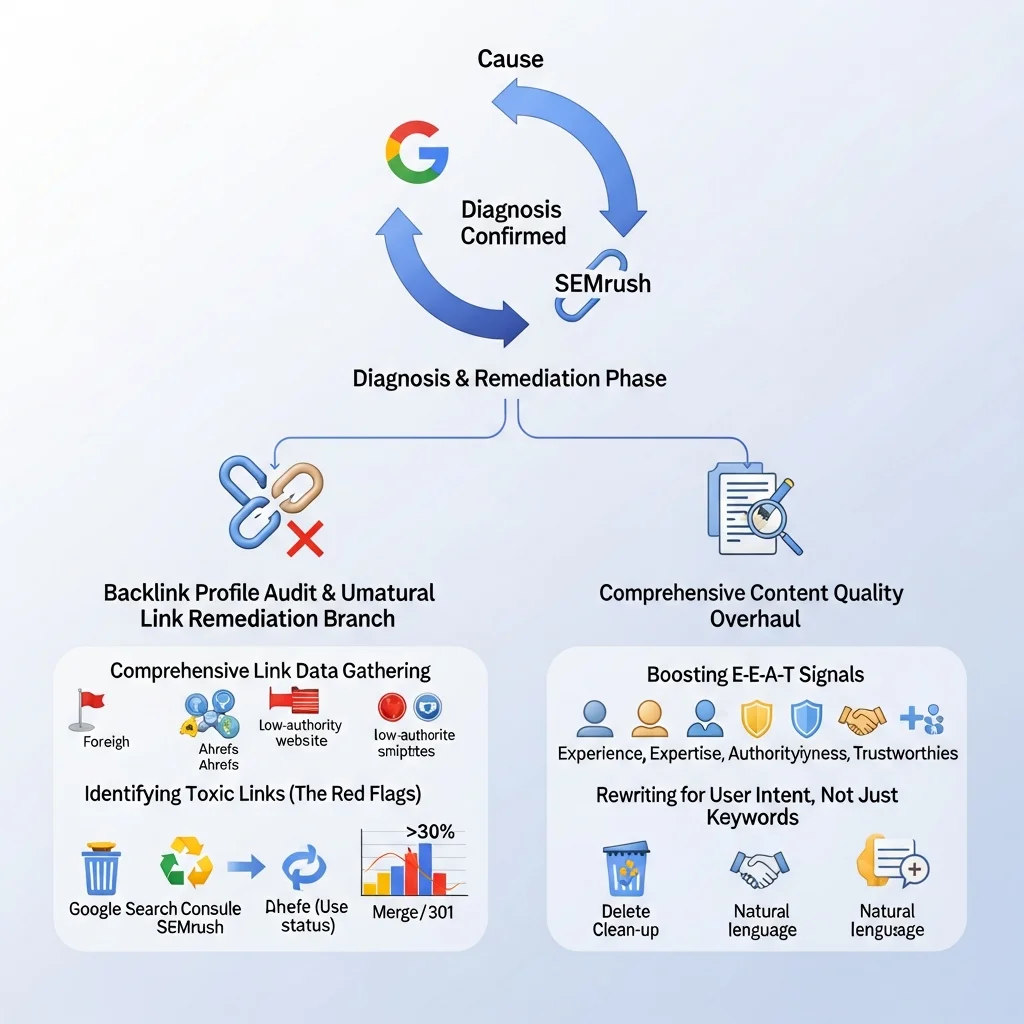
Once the diagnosis is confirmed, the remediation phase requires technical precision. You must reverse-engineer the quality standards that Google’s systems are enforcing.
Backlink Profile Audit & Unnatural Link Remediation
If your penalty is related to unnatural link penalty or the Penguin algorithm, your focus is clearing up toxic backlinks.
Comprehensive Link Data Gathering: Link data in GSC is often incomplete. You must export data from GSC and cross-reference it with at least two high-quality third-party tools (e.g., Ahrefs, SEMrush) to get a full picture of your inbound links.
Identifying Toxic Links (The Red Flags): Toxic links share clear characteristics that violate quality guidelines:
- Links from foreign-language sites irrelevant to your market.
- Links from link networks, blog comment spam, or forums with no moderation.
- Links from sites with drastically low domain authority/trust metrics.
Excessive use of commercial, exact-match anchor text (e.g., “best blue widgets”). While <10% is ideal for exact match anchors, a profile with >30% is considered high risk and a clear signal of link manipulation.
Comprehensive Content Quality Overhaul
If the penalty is content-related (Panda or Helpful Content Update), the goal is to stop creating and maintaining thin content fix issues.
Adopt a Triage Strategy for your content:
Delete (Use 410 status): Pages that are impossible to salvage (e.g., old campaign pages, copied content). Use a 410 (Gone) status instead of 404 (Not Found) to signal to Google that the content is intentionally and permanently removed.
Merge/301: Pages that cover the same basic topic with minimal value. Merge them into one comprehensive, authoritative page and use a 301 redirect to consolidate link authority.
Substantially Improve: Pages that are on-topic but lack depth. This is where you focus on E-E-A-T.
Boosting E-E-A-T Signals (Experience, Expertise, Authoritativeness, Trustworthiness):
Core Updates heavily prioritize E-E-A-T.
Experience & Expertise: Ensure all informational and review content is authored by a qualified person. Add verifiable author bios, credentials, and evidence of first-hand experience (photos, testing results).
Authoritativeness & Trustworthiness: Improve page trustworthiness with clear contact information, comprehensive privacy policies, visible SSL/security signals, and citing highly authoritative sources.
Rewriting for User Intent, Not Just Keywords:
Shift away from old-school keyword stuffing and focus on natural language processing (NLP). The goal is to cover the topic comprehensively and answer all user questions (search intent), not just repeat the primary restore lost rankings keyword.
Step 3: The Reconsideration Request (For Manual Actions ONLY)
If you received a Manual Action, the Reconsideration Request is the required formal step to appeal the penalty.
Documentation is Non-Negotiable
- Creating the “Paper Trail”:
Your recovery depends on convincing a human reviewer that you have genuinely fixed the problem and are committed to compliance. The most crucial part is a detailed spreadsheet documenting the link removal process:
- List every toxic link identified.
- Record the date and contact method used for outreach.
- Record the result.
- The Reconsideration Letter:
- Tone and Structure: The letter should be factual, humble, and transparent.
- Acknowledge: State clearly that you understand the violation (e.g., “Unnatural Links to Your Site”).
- Explain: Detail the exact steps taken for remediation (e.g., “We performed a full audit, disavowed 45 domains, and manually removed 12 links”).
- Commit: Commit to future compliance and explain the new risk management processes you’ve implemented. Do not deflect blame; take full responsibility.
- Submitting the Request and The Waiting Game
Where to Submit: The request is submitted directly via the Manual Actions report in GSC. You will summarize your actions and attach any necessary documents. What to Expect: Google aims to review requests quickly, but the process can take days to several weeks. Possible outcomes include: Revoked (penalty removed), Not Revoked (more work required), or More Information Needed.
Step 3: The Reconsideration Request (For Manual Actions ONLY)
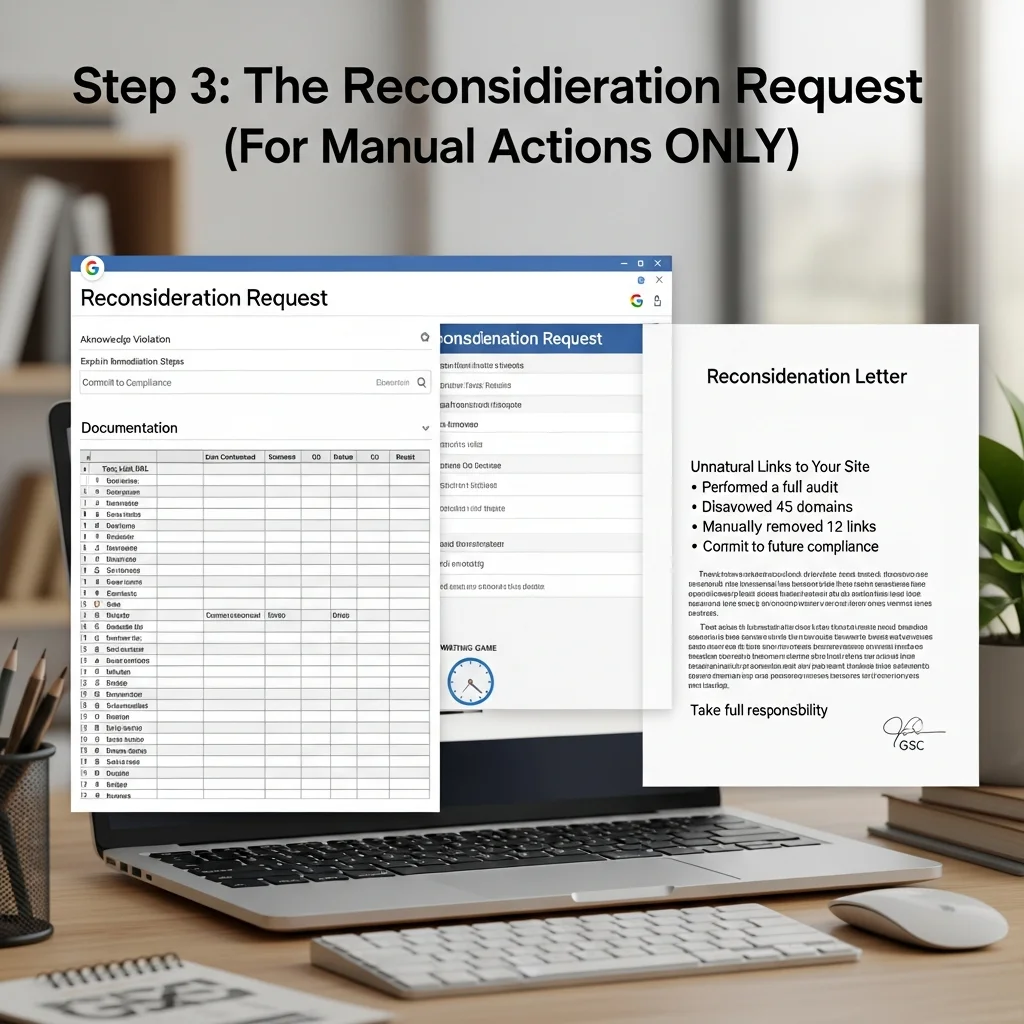
If you received a Manual Action, the Reconsideration Request is the required formal step to appeal the penalty.
Documentation is Non-Negotiable
- Creating the “Paper Trail”:
Your recovery depends on convincing a human reviewer that you have genuinely fixed the problem and are committed to compliance. The most crucial part is a detailed spreadsheet documenting the link removal process:
- List every toxic link identified.
- Record the date and contact method used for outreach.
- Record the result.
- The Reconsideration Letter:
- Tone and Structure: The letter should be factual, humble, and transparent.
- Acknowledge: State clearly that you understand the violation (e.g., “Unnatural Links to Your Site”).
- Explain: Detail the exact steps taken for remediation (e.g., “We performed a full audit, disavowed 45 domains, and manually removed 12 links”).
- Commit: Commit to future compliance and explain the new risk management processes you’ve implemented. Do not deflect blame; take full responsibility.
- Submitting the Request and The Waiting Game
Where to Submit: The request is submitted directly via the Manual Actions report in GSC. You will summarize your actions and attach any necessary documents.
What to Expect: Google aims to review requests quickly, but the process can take days to several weeks. Possible outcomes include: Revoked (penalty removed), Not Revoked (more work required), or More Information Needed.
If you’re looking for expert guidance through this process, NK Marketing Solutions can help you recover from Google penalties and future-proof your SEO strategy.
Step 4: Post-Penalty Restoration and Future-Proofing

Once the Manual Action is revoked, or the Algorithmic quality issues are fixed, you must adopt a sustainable SEO penalty guide that prevents future problems.
- Rebuilding Trust with the Algorithm
The Link-Building Pivot: Permanently abandon any risky link practices. Link acquisition must shift entirely to high-value, white-hat methods:
Digital PR: Earning links through creating newsworthy content and outreach.
Resource Link Building: Creating definitive resources (data, tools, guides) that other sites naturally want to link to.
Focus on Quality, not Quantity. A single link from a high-authority, relevant domain is worth a thousand blog comments.
- Internal Linking Architecture:
Systematically review your internal links. Ensure all valuable pages are strongly linked from within your site structure, improving the flow of authority (PageRank) and making your content easier for crawlers to discover.
- Establishing Permanent Risk Management
- Automated Backlink Monitoring:
Set up daily alerts within your preferred
tool for any suspicious new inbound links. This allows for rapid disavow action before a new link scheme can trigger a penalty.
- Regular Content Audits:
Schedule quarterly reviews to flag underperforming, outdated, or low-engagement pages. This proactive approach helps remove content deemed “unhelpful” before the next Helpful Content Update negatively impacts your site.
Conclusion:
When you’re trying to bounce back from a Google penalty, it’s not just about fixing technical stuff. It’s about making a real promise to your users. Sure, you have to dig into the details, clean up your site, and stay open about what you’re doing. But at the end of the day, Google’s updates all say the same thing: put people first. Focus on what your users want and give them a good experience. Stick to E-E-A-T, keep your quality high, and handle the technical side with care. Do that, and you won’t just recover you’ll set your site up for long-term success.
FAQs
Q1: How long does it take to recover from a Google Penalty?
Manual Actions typically take 2-4 weeks post-request. Algorithmic penalties require fixing the quality issues, then waiting 3-6 months for the next major Core Update.
Q2: What is the single most important metric Google looks for during a recovery review?
Transparency and genuine effort are key. For Manual Actions, it’s link removal documentation; for Algorithmic, it’s improved E-E-A-T and User Engagement Signals.
Q3: Should I remove all my low-quality content, or improve it?
Use a Triage Strategy: Delete/410 content impossible to salvage, Merge/301 duplicate content, and substantially improve pages that are salvageable but lack depth.
Q4: If I am hit by an Algorithmic penalty, should I still submit a Reconsideration Request?
No, absolutely not. The request is only for Manual Actions and will be rejected for algorithmic issues. Recovery for algorithmic hits relies on fixing technical/content issues and waiting for reassessment.
Q5: Is it better to disavow a toxic link immediately or try to get it removed first?
Always try removal first and document your attempts. Disavow should only be used as the last resort for links you could not get taken down, especially in Manual Action cases.