A strong social media advertising strategy is the difference between burning your budget and building a predictable revenue engine. If you want the short version, here it is:
How to build a social media advertising strategy:
- Set clear goals — awareness, leads, conversions, or retention
- Define your audience—use first-party data, lookalike audiences, and behavioral targeting
- Choose the right platforms — Meta for B2C, LinkedIn for B2B, TikTok for younger audiences
- Pick your ad formats—short-form video and Reels dominate in 2026
- Set a realistic budget — start at $500–$1,000/month and scale what works
- Track what matters — ROAS, CPA, and conversion rate over vanity metrics
- Test and optimize — refresh creatives every 2–4 weeks and double down on winners
Social media advertising has changed fast. Global ad spend is projected to hit $350 billion in 2026, and mobile ads now capture over 65% of all digital ad spend. Platforms like Meta, TikTok, and LinkedIn have shifted from simple ad boards to sophisticated, AI-driven ecosystems.
And yet, most small businesses still approach paid social signals the same way they always have — boosting a post here, running a one-off campaign there, and wondering why results are inconsistent.
The problem isn’t the platforms. It’s the lack of a system.
With organic reach tightening across every major network, paid social is no longer optional for brands that want to grow. But spending money without a strategy is just noise. This guide will show you exactly how to build one that works.
The Core Pillars of a Social Media Advertising Strategy
Diving into paid social without a plan is like trying to cook a five-course meal without a recipe—you might get lucky, but you’re more likely to end up with a mess (and a burnt budget). A winning social media advertising strategy is built on several foundational pillars that move you from “guessing” to “growing.”
First, we must talk about SMART goals. These are Specific, Measurable, Attainable, Relevant, and Time-bound. Instead of saying “I want more followers,” a SMART goal is “I want to generate 50 qualified leads from Instagram at a cost of $15 per lead by the end of next month.”
In May 2026, brand trust is the ultimate currency. Research shows that 78% of consumers agree a brand’s social media presence impacts whether they trust that brand. For Gen Z, that number jumps to 88%. If your ads feel like “spam,” you lose. If they feel like value, you win.
To execute this, you need to master How to Build a Winning Social Media Strategy in 8 Simple Steps. This involves picking the right KPIs—like Return on Ad Spend (ROAS) and Customer Acquisition Cost (CAC)—to ensure every dollar you spend is working for you.
Defining Your Social Media Advertising Strategy Goals
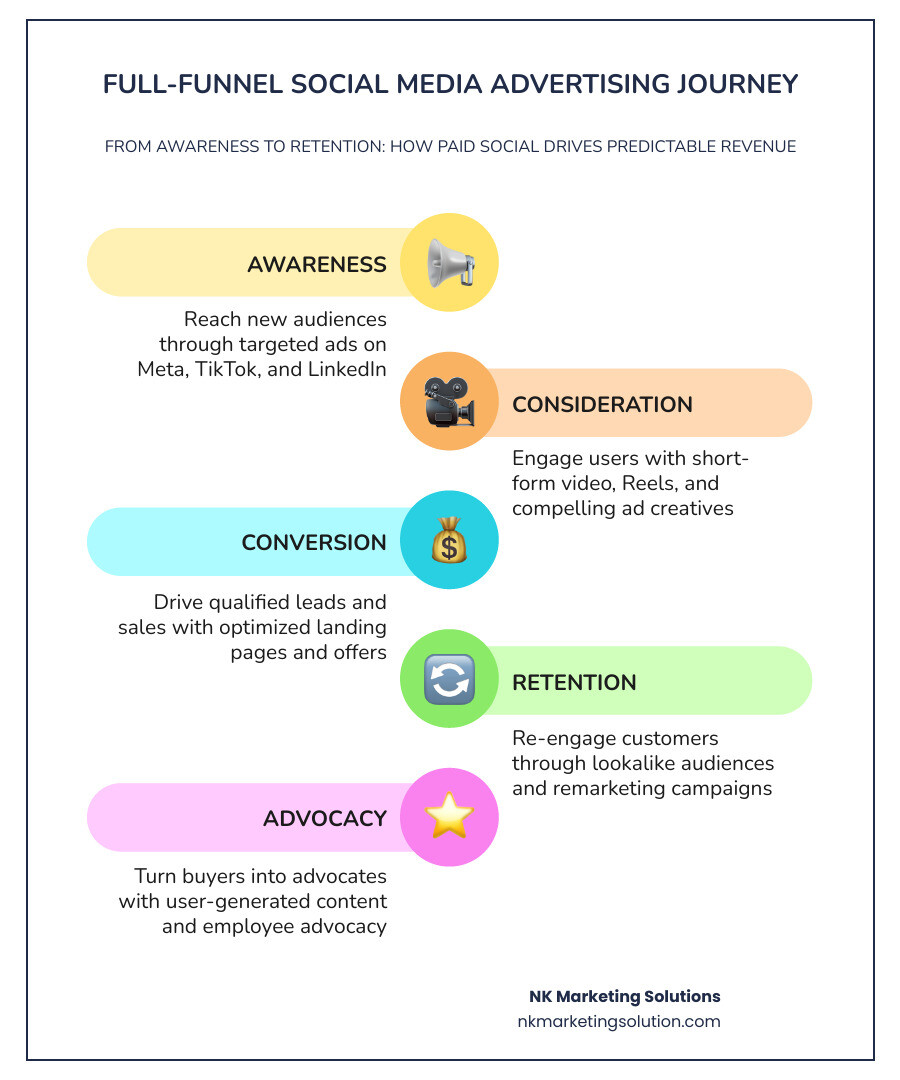
We categorize goals into four main buckets. Each requires a different creative approach and bidding strategy:
- Awareness: Getting your brand in front of as many people as possible. We measure this through reach and impressions.
- Lead Generation: Collecting contact information from potential customers. In 2026, click-to-message ads deliver 3x higher conversion rates for this goal.
- Conversion: Driving direct sales or sign-ups. This is where ROAS is king.
- Retention: Keeping existing customers coming back. It’s often 5x cheaper to keep a customer than to find a new one.
If you aren’t sure which objective fits your business, you can find more info about digital marketing services to see how different tactics align with revenue.
Identifying Your Ideal Audience for Social Media Advertising Strategy
The era of “spray and pray” is over. In 2026, the most successful brands use a mix of data-driven targeting:
- First-Party Data: This is your gold mine. Use your email lists and website visitor data to create custom audiences.
- Lookalike Audiences: Once you know who your best customers are, we ask the platforms to find “lookalikes”—people with similar interests and behaviors.
- Behavioral Targeting: Reaching people based on their past actions, like someone who just visited a real estate site or a fitness blog.
- Demographic Research: The basics still matter. For example, 91% of Baby Boomers are on Facebook, while Gen Z lives on TikTok and Instagram.
Utilizing Advanced Audience Targeting Techniques allows us to exclude people who have already purchased, saving you money on wasted impressions.
Platform Selection and High-Performing Ad Formats
Not all platforms are created equal. Choosing the wrong one is a fast way to see zero ROI. Here is how the landscape looks in 2026:
| Platform | Primary Audience | Best Ad Format | Ideal Goal |
|---|---|---|---|
| Meta (FB/IG) | Broad (All ages) | Reels & Stories | E-commerce / Local Leads |
| Professionals | Document Ads / Thought Leader Ads | B2B Lead Gen | |
| TikTok | Gen Z & Millennials | Creator-led Video | Viral Growth / Shop Sales |
Short-form video is no longer a “trend”—it is the standard. Video ads drive 48% higher sales rates than static images. On TikTok, the motto is “Don’t make ads, make TikToks.” If your content looks too polished or “corporate,” users will swipe past it in half a second.
On LinkedIn, Document Ads are currently achieving 3x higher engagement than standard image ads. Meanwhile, TikTok Shop is projected to reach over $23 billion in U.S. sales this year, making it a powerhouse for impulse purchases. We focus on Optimizing Ad Formats for Maximum Engagement by matching the creative to the way people actually use the app.
Budgeting, Bidding, and Maximizing ROI
How much should you spend? It’s the million-dollar question (usually asked by people with a thousand-dollar budget).
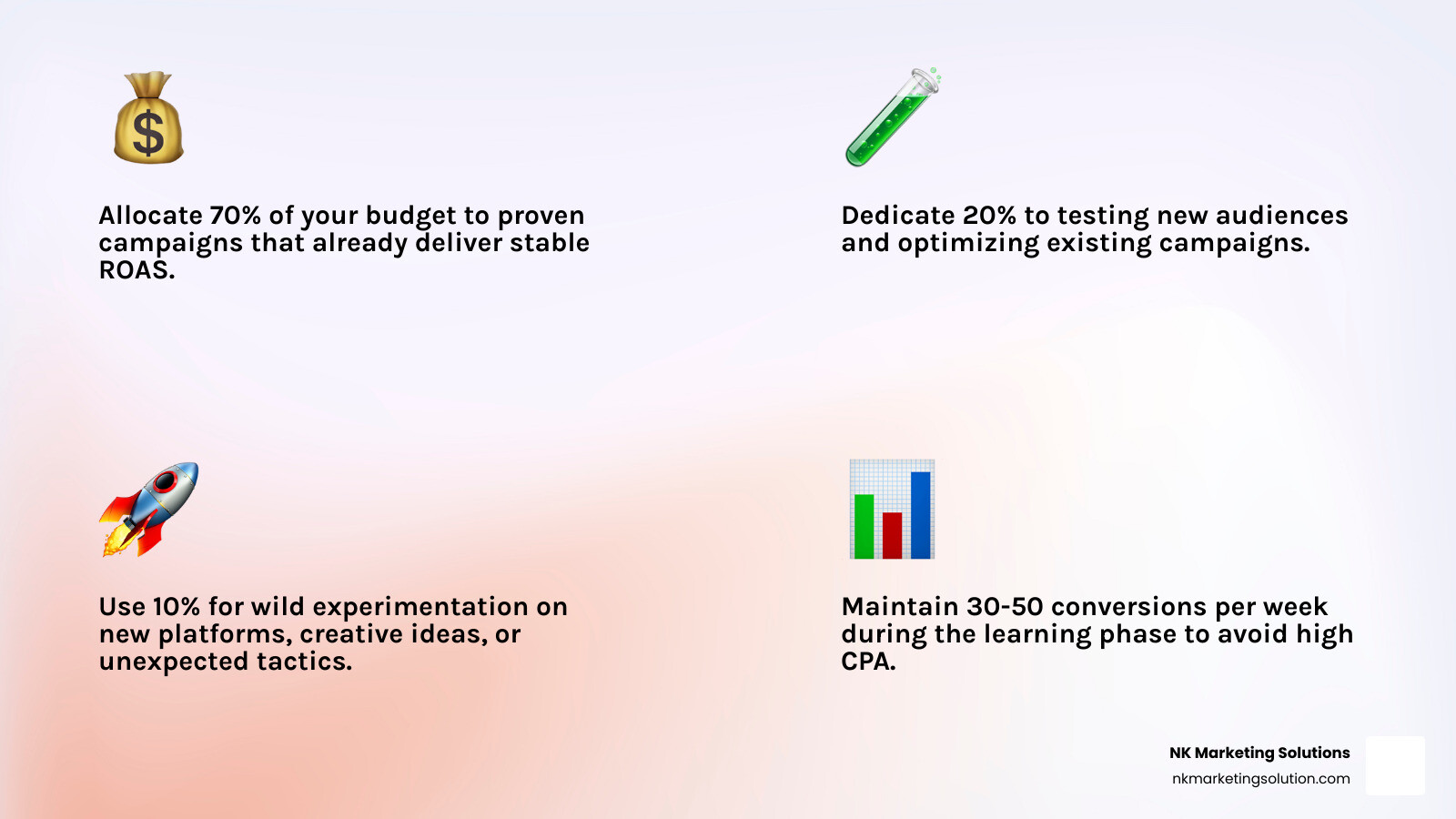
We recommend the 70/20/10 rule for budget allocation:
- 70% goes to proven campaigns that are already delivering a stable ROAS.
- 20% goes to optimizing and testing new audiences for existing products.
- 10% goes to wild experimentation—new platforms, weird creative, or “out there” ideas.
When you launch a new campaign, you enter the “Learning Phase.” Platforms usually need 30-50 conversions per week for their algorithms to optimize properly. If you underfund your campaign during this time, the algorithm never “learns,” and your CPA stays high.
To maximize ROI, you must understand How to Calculate and Improve Your Social Media ROI. This includes setting proper attribution windows. For a $20 impulse buy, a 1-day click window is fine. For a $5,000 B2B service, you might need a 30-day or 90-day window to see the full picture of how your ads are performing.
Leveraging AI and Creator Partnerships for Authenticity
In 2026, AI and humans have formed a powerful partnership. Tools like Meta’s Advantage+ campaigns use AI to automate targeting and creative placement, often delivering a 17% lower CPA than manual setups.

However, AI can’t replace authenticity. This is where Creator Partnerships and User-Generated Content (UGC) come in. Sponsored influencer content performs 90% better in engagement than brand-posted content. Why? Because people trust people more than they trust logos.
- UGC: Ads that look like a customer filmed them on their phone often outperform high-budget studio commercials.
- Employee Advocacy: Posts shared by employees have an 8x higher engagement rate than brand content.
- Spark Ads: On TikTok, you can put money behind a creator’s organic video about your product. This feels native to the feed and builds massive trust.
Understanding The Role of AI in Modern Social Advertising helps us automate the boring stuff so we can focus on the creative storytelling that actually moves the needle.
Measuring Success and Continuous Optimization
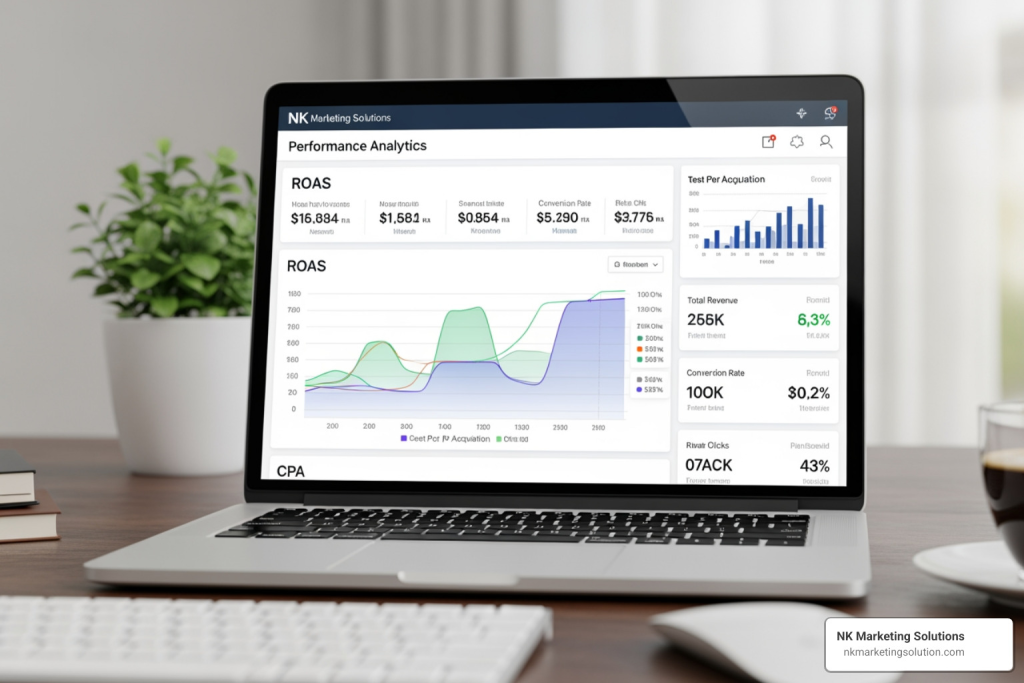
What’s more frustrating than a social media advertising strategy gone wrong? Not knowing why it went wrong. To avoid this, you need a performance dashboard that tracks the metrics that actually impact your bank account.
A/B Testing is your best friend. You should always be testing one variable at a time—maybe it’s the headline, the “hook” of the video, or the color of the CTA button.
Watch out for Creative Fatigue. This usually happens after 2-6 weeks when your frequency (how many times the same person sees your ad) gets too high. When you see your click-through rate (CTR) drop and your cost per result rise, it’s time to refresh your visuals.
We also use Social Listening to see what people are saying about your brand in real-time. If a customer leaves a funny comment on an ad, turning that comment into a new ad creative can lead to viral success. Our focus is always on Data-Driven Marketing Solutions for Growth, ensuring we pivot based on what the data tells us, not just our gut feelings.
Frequently Asked Questions about Social Media Advertising
What is the difference between organic and paid social media?
Think of organic social media as your “digital storefront.” It’s where you build a community, provide customer service (which 53% of brands say is part of their strategy), and share long-term brand values. However, organic reach is limited by algorithms.
Paid social is like a “megaphone.” It allows you to bypass the algorithm to reach specific people who don’t follow you yet. Organic is for loyalty; paid is for growth.
How much should a small business spend on social ads?
For businesses in California, Texas, or Florida, we generally suggest a starting testing budget of $500–$1,000 per month. This allows you to spend $25–$50 a day, which is enough to gather data without breaking the bank. Once you find a campaign where $1 in equals $3 out, you scale that budget as fast as your fulfillment can handle!
How often should I refresh my ad creatives?
Ad creative typically suffers from fatigue after 2 to 6 weeks. In a high-traffic environment like New York or Granada Hills, users see so many ads that they quickly become “blind” to repetitive content. We recommend having a fresh batch of 3-5 creative variants ready to swap in every month.
Conclusion
Building a social media advertising strategy in 2026 isn’t just about clicking “Promote.” It’s about understanding your audience, feeding the AI algorithms the right data, and showing up with authentic content that earns the right to be in the feed.
For teams that need to produce these variations faster, tools like Templated can help automate social media graphics from reusable templates, so brands can create fresh ad visuals without designing every version manually.
At NK Marketing Solutions, we specialize in creating these data-driven revenue systems for small businesses. Whether you are in California, Texas, Florida, or New York, our mission is to provide affordable marketing that actually works—with zero long-term contracts.
Ready to stop shouting into the void and start winning the feed? Start your social strategy with us today and let’s build something that grows.