

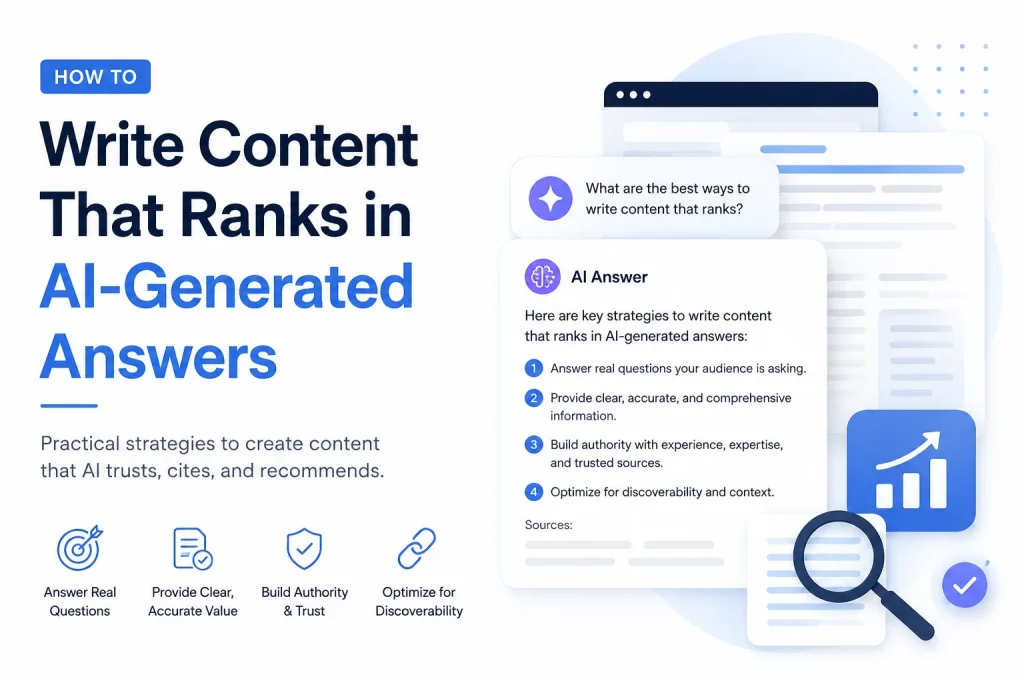
Search behavior is changing fast. People no longer rely only on traditional search results. Many users now get information directly from AI-generated answers in platforms such as Google AI Overviews, ChatGPT, Gemini, and Perplexity.
This shift creates a new challenge for content creators, marketers, and website owners. Ranking on search engines is still important, but visibility inside AI-powered responses is becoming part of modern content strategy.
AI systems do not select content randomly. They look for pages that answer questions clearly, cover topics thoroughly, and provide trustworthy information. Content that is easy to understand often has a better chance of being referenced, summarized, or cited.
That is why writing for AI search requires more than keyword placement. You need strong topical coverage, clear information architecture, semantic relevance, and user-focused answers. Every section should help both readers and retrieval systems understand the topic with less effort.
The good news is that many of the principles behind AI visibility align with high-quality content creation. When you publish useful information, demonstrate expertise, and organize content logically, you improve the experience for users and increase the likelihood of appearing in AI-generated answers.
In this guide, you will learn how AI systems evaluate content, what makes a page citation-worthy, and how to structure articles that support both search engine optimization and answer engine optimization. You will also discover practical ways to improve topical authority, strengthen trust signals, and create content that matches modern search behavior.
Table of Contents
What Are AI-Generated Answers?
AI-generated answers are responses created by artificial intelligence systems that gather, analyze, and summarize information from multiple sources. Instead of showing only a list of web pages, these systems provide direct answers to user questions.
You can see this approach across modern search and AI platforms. Google AI Overviews, ChatGPT, Gemini, and Perplexity all aim to help users find information faster by presenting a summarized response before they visit individual websites.
The goal is simple. Users want quick, accurate, and relevant information. AI-powered search tools attempt to deliver that information in a clear and easy-to-understand format.
Understanding AI Overviews, ChatGPT, Gemini, and Perplexity
Each platform delivers AI-generated answers in a slightly different way. However, they all rely on content available across the web.
Google AI Overviews often appear directly within search results. They provide a summary of information related to a user’s query and may include links to supporting sources.
ChatGPT can generate responses using its knowledge and, when search features are available, retrieve information from online sources to provide more current answers.
Gemini combines Google’s search ecosystem with artificial intelligence to answer questions, explain topics, and assist with research.
Perplexity focuses heavily on source attribution. It frequently cites webpages that support the information included in its responses.
Although these platforms work differently, they share a common objective. They try to identify trustworthy content that best answers the user’s question.
How AI Answers Differ From Traditional Search Results
Traditional search engines primarily display a collection of links. Users review those links and choose which page to visit.
AI-generated answers change that process. The system analyzes information first and presents a summarized response before the user clicks through to a website.
This shift increases the importance of content clarity. If a page contains a direct answer, strong context, and supporting details, AI systems can understand and process the information more efficiently.
For content creators, this means visibility is no longer measured only by rankings. Content must also be easy for AI systems to interpret, extract, and reference.
Why Being Cited Matters More Than Ranking Alone
A high ranking can increase traffic opportunities. However, AI-powered search introduces another layer of visibility.
When an AI platform references your content as a source, your website gains exposure even before users explore traditional search results. This makes citation potential an important part of modern content optimization.
Pages that earn citations often share common characteristics:
- They answer questions directly.
- They provide complete and accurate information.
- They demonstrate expertise and credibility.
- They organize information in a logical structure.
- They cover related concepts that help users understand the topic.
As AI-assisted search continues to evolve, content creators need to think beyond rankings alone. The focus is shifting toward creating information that search engines, AI retrieval systems, and real users can trust.
How AI Systems Select Content for Generated Answers
AI systems do not choose content based on a single ranking factor. They evaluate multiple signals to determine whether a webpage can help answer a user’s question accurately and efficiently.
The process focuses on relevance, clarity, credibility, and topical coverage. Content that satisfies these requirements is more likely to be referenced in AI-generated responses.
Understanding these evaluation factors can help you create pages that serve both users and AI-powered search experiences.
Retrieval and Ranking Mechanisms
Before an AI system generates an answer, it must identify relevant information sources.
The system searches for content that closely matches the user’s intent. It analyzes webpages, extracts useful information, and evaluates which sources provide the strongest answer.
This process is often called information retrieval. Instead of reading an entire website, AI models look for passages, sections, definitions, explanations, and supporting details that directly relate to the query.
That is why content should answer questions clearly and stay focused on the topic. A page with scattered information can make content extraction more difficult.
Relevance Signals AI Models Prioritize
Relevance remains one of the strongest content signals.
AI systems try to understand what the user is actually asking. They then look for content that addresses that specific need.
Several elements can improve topical relevance:
- Question-focused headings
- Clear definitions
- Semantic relationships between concepts
- Supporting explanations
- Contextually related entities
- User intent alignment
For example, an article about AI-generated answers should naturally discuss AI search, answer engines, AI Overviews, content retrieval, source attribution, topical authority, and semantic SEO. These related concepts help establish contextual relevance.
The more closely your content matches the intent behind a query, the easier it becomes for AI systems to identify useful information.
Authority and Trustworthiness Factors
Reliable information plays a major role in content selection.
AI systems aim to provide accurate answers. As a result, they often favor content that demonstrates expertise and credibility.
Trust signals may include:
- Expert authorship
- Accurate information
- Transparent sourcing
- Well-maintained content
- Strong brand reputation
- Consistent topical expertise
This aligns closely with E-E-A-T principles. Experience, expertise, authoritativeness, and trustworthiness help both search engines and AI systems evaluate content quality.
Users also benefit because trustworthy information improves confidence in the answers they receive.
Content Freshness and Accuracy
Many topics change over time. AI systems attempt to surface information that reflects the latest available knowledge.
Fresh content can be especially important for:
- Search trends
- Digital marketing strategies
- Technology updates
- Industry developments
- Product information
- Regulatory changes
Updating existing content helps maintain accuracy and relevance. It also signals that the information is actively maintained rather than abandoned.
However, freshness alone is not enough. Content must remain useful, comprehensive, and factually correct.
Why Some Pages Get Cited While Others Are Ignored
Many websites publish content on the same topic. Yet only a small number become frequent citation sources.
The difference often comes down to content quality and structure.
Pages that earn visibility in AI-generated answers usually provide:
- Direct answers near the beginning of sections
- Strong topical coverage
- Clear content hierarchy
- Logical information flow
- Helpful examples
- Accurate explanations
- Semantic depth without unnecessary repetition
On the other hand, content may be ignored when it contains vague information, weak organization, excessive keyword usage, or limited topic coverage.
AI systems are designed to find the most useful answer available. The easier it is for them to understand and verify your content, the stronger your chances of being selected as a source.
Now that we understand how AI platforms evaluate information, the next step is learning how to write content in a format that makes answers easier to identify, extract, and cite.
Start With Clear and Direct Answers
AI systems are designed to deliver useful information as quickly as possible. When a page provides an immediate answer, it becomes easier for retrieval systems to identify the most relevant information.
Users benefit from this approach as well. They do not have to search through long introductions to find what they need. Instead, they receive the core answer first and can continue reading for deeper explanations.
This writing style supports answer engine optimization, improves readability, and strengthens content relevance.
The Answer-First Writing Method
Answer-first writing means placing the most important information at the beginning of a section.
Instead of building toward the answer, provide it immediately. Then expand with context, examples, and supporting details.
For example:
Less Effective Approach
Many content creators wonder how AI systems choose content for generated answers. Several factors influence this process, including relevance, trust signals, and content quality.
Better Approach
AI systems select content for generated answers based on relevance, credibility, topical coverage, and content structure. They then evaluate supporting information to determine whether the source can answer the user’s query effectively.
The second example helps readers and AI systems understand the main point faster.
Creating Definition-Based Openings
Many users search for definitions, explanations, and quick answers.
Opening sections with a concise definition can improve content clarity and make information easier to extract.
A strong definition should:
- Explain the topic directly.
- Use simple language.
- Avoid unnecessary jargon.
- Match the likely search intent.
- Introduce related concepts naturally.
For example, if a user searches for “AI-generated answers,” the opening definition should clearly explain the term before exploring advanced concepts.
This approach creates a stronger connection between the query and the content.
Writing Concise Summary Sections
Not every visitor wants a long explanation.
Some readers need a quick overview before deciding whether to continue reading. AI systems often work similarly when identifying relevant passages.
A concise summary section can:
- Highlight key points.
- Improve content accessibility.
- Increase scannability.
- Strengthen topical relevance.
- Support information extraction.
The goal is not to reduce depth. The goal is to present important information in a format that is easy to understand.
Once the summary is established, additional details can provide greater context and expertise.
Matching User Questions Immediately
Successful content aligns closely with user intent.
When someone asks a question, they expect a direct response. Delayed answers can reduce engagement and create confusion.
A practical approach is to identify the primary question behind each heading and answer it within the opening sentences.
For example:
Question: How do AI systems choose content?
Direct Answer: AI systems choose content by evaluating relevance, authority, clarity, topical completeness, and supporting context.
The remaining content can then explain how those factors work in practice.
This structure creates a better experience for readers while helping AI systems recognize important information quickly.
Why Direct Answers Improve AI Visibility
Content designed for AI-generated answers often follows a simple pattern:
- Answer the question immediately.
- Explain the answer clearly.
- Add supporting details.
- Cover related concepts.
- Connect the topic to the broader context.
This format reduces ambiguity and helps information retrieval systems understand the purpose of each section.
More importantly, it creates content that serves real users first. When readers can find answers quickly, engagement improves and trust grows over time.
Providing direct answers is a strong starting point. However, content also needs an organized structure that allows AI systems to extract information efficiently. That is where content formatting and information architecture become essential.
Structure Content for Easy AI Extraction
Content quality matters, but structure determines how easily information can be understood. Even the most valuable insights can lose visibility if they are buried inside large blocks of text or poorly organized sections.
AI systems scan content for patterns, relationships, and answers. Clear formatting helps them identify important information faster while improving the reading experience for users.
A well-structured page also supports semantic SEO because related concepts become easier to connect and interpret.
Using Question-Based Headings
Questions reflect how people search.
Many users type complete questions into search engines and AI assistants. Organizing content around those questions helps align your article with real search behavior.
Question-focused headings can:
- Match user intent more accurately.
- Improve topical relevance.
- Support answer extraction.
- Create logical content flow.
- Increase content coverage.
Examples include:
- What Are AI-Generated Answers?
- How Do AI Systems Choose Sources?
- Why Is Topical Authority Important?
- How Can Content Earn AI Citations?
Each heading introduces a specific topic and creates a clear path for both readers and retrieval systems.
Creating Scannable Paragraphs
Modern readers prefer content that is easy to consume.
Long paragraphs often reduce engagement because important information becomes harder to find.
Short paragraphs improve readability and make key ideas stand out.
A practical approach is to focus each paragraph on a single concept. Once that concept is explained, move naturally to the next idea.
This structure helps users absorb information faster and allows AI systems to isolate relevant passages more effectively.
Leveraging Lists and Numbered Steps
Lists help organize information into clear sections.
They simplify complex topics and make important points easier to identify.
For example, content optimized for AI-generated answers often includes:
- Direct answers
- Clear definitions
- Supporting context
- Semantic relationships
- Credible sources
- Strong information hierarchy
Numbered steps work especially well for instructional content because they create a predictable structure that users can follow.
When information is organized logically, both humans and AI systems can process it more efficiently.
Building Comparison Tables
Some topics require users to evaluate multiple options.
Comparison tables provide a structured way to present information without overwhelming readers.
For example, a content creator may compare traditional SEO with answer engine optimization.
A table can quickly highlight differences in:
- Primary goals
- Visibility opportunities
- User interactions
- Search environments
- Content requirements
Tables improve clarity and often help summarize complex relationships between concepts.
Writing Extractable Definitions
Definitions play an important role in AI-powered search.
When a system encounters a clear explanation of a concept, it can more easily determine whether the content satisfies the user’s query.
Strong definitions share several characteristics:
- They are concise.
- They are accurate.
- They avoid unnecessary complexity.
- They explain the topic directly.
- They connect naturally to related concepts.
For example:
Topical Authority refers to a website’s demonstrated expertise and comprehensive coverage of a subject area through interconnected, high-quality content.
A definition like this provides immediate clarity while introducing related semantic concepts.
Creating a Logical Information Hierarchy
Every article should guide readers through a clear learning path.
The structure should move from foundational concepts to advanced topics without creating confusion.
A strong information hierarchy often follows this pattern:
- Define the topic.
- Explain why it matters.
- Describe how it works.
- Explore optimization strategies.
- Address common challenges.
- Discuss future developments.
This approach supports user understanding while helping AI systems identify relationships between sections.
Why Content Structure Influences AI Visibility
AI systems do more than read words. They analyze context, organization, and topical relationships.
Well-structured content makes it easier to identify:
- Main ideas
- Supporting details
- Definitions
- Processes
- Comparisons
- Expert insights
As a result, properly formatted content often has a stronger chance of being referenced in AI-generated answers.
Structure alone, however, is not enough. AI systems also evaluate whether a page covers a topic comprehensively.
Build Comprehensive Topic Coverage Without Adding Fluff
Covering a topic thoroughly does not mean making an article longer. It means answering the main question and addressing the related questions that naturally connect to it.
AI systems look for content that provides complete information. If a page explains only part of a topic, another source may be selected because it offers better context and deeper coverage.
The goal is simple. Create content that helps users understand the subject from multiple angles while keeping every section relevant to the search intent.
Understanding Topical Completeness
Topical completeness means covering the important attributes, subtopics, and questions connected to a subject.
For example, an article about ranking in AI-generated answers should not focus only on keywords.
It should also explain:
- AI search systems
- Content retrieval
- Citation factors
- Answer engine optimization
- Topical authority
- Content structure
- Trust signals
- User intent
These topics are closely related to the primary subject. Together, they create a stronger semantic network that helps users gain a complete understanding.
When content answers both the primary and secondary questions, it becomes more valuable for readers and AI systems.
Covering Primary and Secondary Search Intent
Every search query has a primary intent.
In this case, users want to learn how to create content that appears in AI-generated answers.
However, users often have additional questions.
They may also want to know:
- How AI systems choose sources
- Whether SEO still matters
- What makes content citation-worthy
- How AI Overviews work
- Why some pages are ignored
- How authority affects visibility
Addressing these connected questions improves content depth without changing the topic.
This approach keeps the article focused while expanding its usefulness.
Addressing Follow-Up Questions Users Ask
AI systems are designed to understand query relationships.
When someone asks one question, there is often a sequence of related questions that follow.
For example:
Primary Question
How do I rank in AI-generated answers?
Follow-Up Questions
- What are AI-generated answers?
- How do AI systems find information?
- What content formats work best?
- Does schema markup help?
- How important is E-E-A-T?
- What mistakes should I avoid?
Including these supporting questions helps create a more complete resource.
It also aligns with how users naturally explore a topic.
Creating Semantic Relationships Between Subtopics
Strong content connects ideas instead of treating them as isolated concepts.
For example:
Answer engine optimization connects to content structure.
Content structure connects to information retrieval.
Information retrieval connects to AI citations.
AI citations connect to authority and trust.
Trust connects to E-E-A-T.
These relationships create contextual relevance throughout the article.
When related concepts support one another, the content becomes easier to understand and more semantically rich.
This is one reason topical authority develops over time.
Avoiding Thin Content and Topic Gaps
Thin content often occurs when important questions remain unanswered.
A topic gap can appear when readers leave a page still searching for basic information.
Examples include:
- Defining AI-generated answers without explaining how they work.
- Discussing citations without covering authority signals.
- Mentioning topical authority without explaining semantic relevance.
- Explaining structure without discussing user intent.
Each missing piece weakens the overall topic coverage.
Reviewing the user’s journey can help identify areas that need additional context.
If a reader is likely to ask a follow-up question, the answer should already exist somewhere within the article.
Avoiding Topical Dilution
Many content creators misunderstand comprehensive coverage.
They begin introducing loosely related topics that do not support the main search intent.
For example, a guide about ranking in AI-generated answers does not need lengthy sections about social media marketing, email campaigns, or conversion optimization.
These topics may be valuable, but they do not directly support the user’s goal.
Topical dilution can:
- Reduce content focus.
- Create semantic confusion.
- Weaken topical relevance.
- Interrupt content flow.
Every section should contribute to the central topic.
If a subtopic does not help users understand AI-generated answers, it likely does not belong in the article.
Why Topical Completeness Supports AI Visibility
AI systems prefer content that answers questions thoroughly.
A page that covers definitions, processes, related concepts, trust factors, and practical guidance often provides more value than a page that discusses only one aspect of the topic.
Comprehensive coverage helps establish expertise while reducing the need for users to search elsewhere for additional information.
As a result, the content becomes a stronger candidate for citation, summarization, and reference within AI-generated answers.
However, comprehensive coverage alone is not enough. AI systems also evaluate the reliability of the information itself. That is why supporting claims with evidence, expert insights, and trustworthy sources plays an important role in modern content optimization.
Strengthen Content With Evidence AI Can Trust
AI systems aim to deliver accurate and reliable information. That is why content supported by credible evidence often carries more value than content built only on opinions or general statements.
Users also expect proof. When a claim is supported by research, expert knowledge, or verifiable information, it becomes easier to trust.
Strong evidence improves content quality, supports E-E-A-T principles, and helps establish authority within a topic.
Using Recent Industry Statistics
Statistics can add context and help explain trends.
However, not every statistic improves content quality.
The most useful data points are directly related to the topic being discussed. They should help answer a question, explain a trend, or support a meaningful insight.
For example, when discussing AI-generated answers, relevant statistics may focus on:
- AI search adoption
- Search behavior changes
- AI Overview visibility
- User interaction trends
- Digital content consumption
On the other hand, unrelated marketing statistics can distract readers and weaken topical focus.
Always choose data that supports the search intent and contributes to the overall topic.
Referencing Credible Research
Research provides a foundation for accurate content.
Studies from recognized organizations, academic institutions, industry analysts, and trusted publications can strengthen the reliability of your information.
Research can help explain:
- How AI systems retrieve information
- Emerging search trends
- User behavior patterns
- Content performance factors
- Search technology developments
When using research, focus on interpretation rather than repetition.
Explain why the findings matter and how they relate to the user’s question.
This approach creates additional value beyond simply presenting data.
Including Original Insights and Practical Observations
Not all valuable evidence comes from external sources.
First-hand observations and practical experience can also contribute to content quality.
For example, a digital marketer who regularly analyzes AI search visibility may identify recurring patterns such as:
- Pages with clear definitions receiving more visibility.
- Comprehensive guides outperforming shallow articles.
- Structured content improving information extraction.
- Strong topical authority supporting long-term performance.
These observations help demonstrate real-world experience, which aligns with E-E-A-T principles.
The key is to present insights honestly and avoid unsupported claims.
Adding Expert Commentary
Expert perspectives can help explain complex topics more effectively.
Industry professionals often provide context that research alone cannot deliver.
Expert commentary may help users understand:
- Emerging AI search trends.
- Practical content optimization strategies.
- Common implementation mistakes.
- Future developments within search technology.
When expert insights are relevant to the topic, they can strengthen trust and improve the overall usefulness of the content.
Supporting Claims With Verifiable Sources
Readers should be able to understand where important information originates.
Verifiable sources improve transparency and help users evaluate the reliability of the content.
When supporting a claim, consider:
- The credibility of the source.
- The relevance of the information.
- The publication date.
- The authority of the organization.
- Whether the information aligns with current knowledge.
Reliable sourcing becomes increasingly important as AI-generated answers continue to prioritize trustworthy information.
Balancing Evidence With Readability
Evidence should support the content, not overwhelm it.
A page filled with statistics but lacking explanations may create confusion.
Likewise, a page filled with opinions but lacking evidence may appear less trustworthy.
The strongest content balances both elements.
It uses evidence to support important points while maintaining clear explanations and practical guidance.
This balance improves readability and helps users understand why the information matters.
Why Evidence Supports AI Citation Potential
AI systems evaluate more than keywords and formatting.
They also consider whether content appears reliable, informative, and useful.
Pages that support their claims with credible information often provide stronger signals of expertise and trustworthiness.
When combined with semantic relevance, clear structure, and topical completeness, evidence helps transform content from a simple article into a valuable resource.
Trust, however, extends beyond the information itself. AI systems also evaluate who created the content and whether the source demonstrates expertise. This is where E-E-A-T signals become an important part of content visibility and citation potential.
Build E-E-A-T Signals That Increase Citation Potential
Trust has always been important in search. In AI-powered search experiences, it plays an even bigger role.
AI systems aim to provide helpful and reliable answers. To do that, they often rely on content that demonstrates experience, expertise, authority, and trustworthiness.
These principles are commonly known as E-E-A-T.
While E-E-A-T is not a direct ranking factor, it helps search engines and AI systems evaluate content quality. Strong trust signals can make your content more credible and more useful for users.
Demonstrating Real Experience
Experience shows that the information comes from practical involvement rather than theory alone.
Users often trust content more when they can see evidence of real-world knowledge.
For example, a digital marketer discussing AI search optimization may share:
- Practical observations
- Workflow examples
- Testing methods
- Content performance insights
- Lessons learned from implementation
Experience helps transform generic information into useful guidance.
It also gives readers confidence that the content reflects real situations rather than assumptions.
Showcasing Expertise Within the Topic
Expertise comes from a deep understanding of a subject.
Content that demonstrates expertise often explains concepts clearly, answers related questions, and provides meaningful context.
Signs of expertise include:
- Accurate explanations
- Comprehensive topic coverage
- Correct use of terminology
- Practical recommendations
- Consistent educational value
For example, an article about AI-generated answers should naturally discuss topics such as answer engine optimization, semantic SEO, information retrieval, topical authority, content structure, and user intent.
Covering these related concepts helps demonstrate subject matter expertise.
Building Author Authority
Authority develops over time.
It grows when a website consistently publishes valuable information within a specific topic area.
Rather than writing about unrelated subjects, authoritative websites often focus on a clear area of expertise.
For example, a digital marketing website may build authority through content covering:
- Search engine optimization
- Content marketing
- AI search visibility
- Semantic SEO
- User experience
- Search technology trends
As topical depth increases, the website becomes more strongly associated with those subjects.
This strengthens both user trust and topical authority.
Establishing Brand Trust
Trust extends beyond individual articles.
Users often evaluate the credibility of the website behind the content.
Several factors can contribute to trust:
- Clear author information
- Transparent business details
- Accurate content
- Consistent publishing standards
- Editorial oversight
- Reliable sources
When visitors understand who created the content and why it was published, confidence tends to increase.
Trustworthy brands also make it easier for users to evaluate information objectively.
Maintaining Content Accuracy Over Time
Information changes.
What was accurate last year may no longer reflect current realities.
Regular content updates help maintain quality and relevance.
Areas that often require updates include:
- Search algorithms
- AI technologies
- Industry best practices
- Market trends
- Product features
- Regulatory requirements
Keeping content current demonstrates a commitment to accuracy and user value.
It also helps prevent outdated information from weakening trust.
Creating Consistent Topical Authority
Authority is not built through a single article.
It develops through a collection of interconnected content that covers a subject comprehensively.
For example, a website focusing on AI search optimization may publish supporting content about:
- AI Overviews
- Generative Engine Optimization (GEO)
- Semantic SEO
- Information retrieval systems
- Content architecture
- Search intent analysis
These supporting resources strengthen the overall topical ecosystem.
As the content network grows, both users and AI systems gain a clearer understanding of the website’s expertise.
Why E-E-A-T Matters for AI-Generated Answers
AI systems aim to reduce uncertainty.
When multiple pages discuss the same topic, trust signals can help determine which sources appear more reliable.
Strong E-E-A-T helps support:
- Content credibility
- User confidence
- Topical authority
- Information quality
- Citation potential
More importantly, E-E-A-T encourages content creators to focus on delivering genuine value rather than chasing shortcuts.
Content that demonstrates experience, expertise, authority, and trustworthiness often performs better because it helps users make informed decisions.
Trust signals strengthen content quality, but technical clarity also matters. The next step involves helping search engines and AI systems understand content more efficiently through structured data and schema markup.
Weak authority signals remain one of the main reasons why websites are not ranking on Google, even when the content itself appears well written.
Use Structured Data to Improve AI Understanding
Content tells search engines what a page says. Structured data helps explain what that information means.
Schema markup provides additional context about entities, topics, authors, organizations, questions, and content types. This extra layer of information can help search engines interpret content more accurately.
While structured data does not guarantee inclusion in AI-generated answers, it can improve content clarity and support better understanding across search systems.
What Is Structured Data?
Structured data is a standardized format used to describe information on a webpage.
It helps search engines identify important content elements instead of relying solely on page text.
For example, structured data can indicate:
- An article
- A frequently asked question
- A how-to guide
- An organization
- A product
- An author
This additional context makes content easier to classify and understand.
How Structured Data Supports AI Search
AI systems rely on context when processing information.
When structured data is implemented correctly, it can help reinforce relationships between topics, entities, and content sections.
Benefits may include:
- Improved content interpretation
- Better entity recognition
- Enhanced semantic understanding
- Stronger content classification
- Increased search visibility opportunities
Structured data does not replace quality content. Instead, it supports the information already present on the page.
FAQ Schema
FAQ schema helps identify question-and-answer content.
It works well for pages that address common user concerns and informational queries.
Benefits of FAQ schema include:
- Clear question recognition
- Better content organization
- Improved semantic relationships
- Stronger user intent alignment
For AI-generated answers, question-and-answer formats often align naturally with how users interact with search systems.
How-To Schema
How-to schema is designed for instructional content.
It helps search engines understand that a page contains a process or series of steps.
Examples include:
- How to optimize content for AI search
- How to build topical authority
- How to implement schema markup
- How to improve content structure
This schema type creates additional clarity around procedural information.
Article Schema
Article schema helps identify editorial content.
It can provide details about:
- Headline
- Author
- Publication date
- Publisher
- Article type
These signals contribute to content organization and may support trust-related evaluations.
For informational content, article schema often serves as a foundational structured data format.
Organization Schema
Organization schema helps define the entity behind a website.
It may include information about:
- Business name
- Website
- Contact information
- Brand identity
- Social profiles
Clear organizational information supports transparency and helps establish credibility.
When search systems understand who is publishing the content, entity recognition becomes stronger.
Connecting Schema With Semantic SEO
Structured data and semantic SEO work together.
Semantic SEO focuses on context, relationships, and topic coverage.
Schema markup helps reinforce those relationships in a machine-readable format.
For example:
- An article discusses AI-generated answers.
- Related entities include AI search, answer engine optimization, and topical authority.
- Structured data provides additional context about the content type and source.
Together, these elements create a clearer understanding of the page.
Common Structured Data Mistakes
Many websites implement schema incorrectly.
Some common issues include:
- Using irrelevant schema types
- Adding incomplete markup
- Providing inaccurate information
- Creating schema that does not match page content
- Forgetting to update structured data
Schema should accurately reflect the information visible on the page.
Consistency is important because search systems compare structured data with actual content.
Why Structured Data Matters for AI Visibility
AI-powered search relies heavily on context and relationships.
Structured data helps strengthen those signals by providing a clearer description of the content.
Although schema alone will not make a page appear in AI-generated answers, it can support broader optimization efforts by improving content understanding and entity recognition.
Combined with strong E-E-A-T, topical authority, semantic relevance, and clear content structure, structured data becomes another layer of communication between your website and modern search systems.
Technical clarity creates a stronger foundation for content visibility. The next step is understanding how to optimize specifically for Google AI Overviews, which have become one of the most visible examples of AI-generated answers within search results.
Optimize Specifically for Google AI Overviews
Google AI Overviews are changing how users interact with search results. Instead of reviewing multiple links before finding an answer, users can often see a summarized response directly within the search experience.
This shift creates new visibility opportunities for publishers. Content that is clear, trustworthy, and relevant has a greater chance of being referenced within AI-generated summaries.
While traditional SEO remains important, content creators should also consider how Google extracts and presents information inside AI Overviews.
Understanding AI Overview Citation Patterns
Google AI Overviews are designed to answer questions quickly.
To generate these responses, Google’s systems analyze information from multiple sources and identify content that best satisfies user intent.
Pages that appear as sources often share several characteristics:
- Clear answers
- Strong topical relevance
- Helpful context
- Logical structure
- Reliable information
- Comprehensive coverage
Rather than focusing on individual keywords, Google increasingly evaluates how well content answers a topic as a whole.
This aligns closely with semantic SEO principles and modern information retrieval systems.
Formatting Content for Overview Inclusion
Content formatting influences how easily information can be extracted.
Google AI Overviews often favor content that presents information in a straightforward and organized manner.
Helpful formatting practices include:
- Clear heading hierarchy
- Short paragraphs
- Direct definitions
- Numbered processes
- Bullet-point summaries
- Well-structured sections
When important information is easy to identify, retrieval systems can process it more efficiently.
This improves the likelihood that key insights will be understood and referenced.
Improving Passage-Level Relevance
Google does not always evaluate a page only at the document level.
Modern search systems can analyze individual sections and passages independently.
This means one section of an article may become highly relevant even if users do not need the entire page.
To strengthen passage-level relevance:
- Answer one topic per section.
- Keep headings specific.
- Avoid mixing unrelated concepts.
- Expand important ideas clearly.
- Use supporting context around key answers.
Each section should function as a valuable resource on its own while still contributing to the overall article.
Creating Citation-Friendly Content Blocks
Citation-friendly content is easy to summarize.
Google AI Overviews often rely on concise explanations that directly address a user’s question.
Examples include:
Definition Blocks
AEO (Answer Engine Optimization) is the practice of creating content that helps search engines and AI systems deliver accurate answers to user questions.
Process Blocks
AI systems typically retrieve relevant information, evaluate source quality, compare available content, and generate a response based on the strongest supporting evidence.
Comparison Blocks
Traditional SEO focuses on rankings, while AEO focuses on helping content appear within direct answers and AI-generated responses.
These content formats improve clarity and make important information easier to reference.
Strengthening Topic Coverage for AI Overviews
Google increasingly rewards content that demonstrates subject depth.
Rather than publishing isolated articles, many successful websites build connected topic clusters around a central subject.
For example, a website targeting AI-generated answers may create supporting content covering:
- AI Overviews
- Generative Engine Optimization
- Semantic SEO
- Search intent
- Topical authority
- Content retrieval systems
- Structured data
This interconnected approach helps establish expertise and creates stronger topical signals.
Aligning Content With Informational Search Intent
Most AI Overviews appear for informational queries.
Users often want explanations, definitions, processes, comparisons, or educational content.
To align with informational intent:
- Answer questions directly.
- Explain concepts clearly.
- Cover related subtopics.
- Provide useful context.
- Avoid unnecessary promotional language.
Content that prioritizes education often aligns naturally with AI-generated answer formats.
Focus on Helping Users First
Many content creators attempt to optimize specifically for AI systems.
However, the strongest strategy remains user-focused content creation.
Google’s goal is to help users find useful information.
AI Overviews support that goal by presenting answers more efficiently.
When content is designed to genuinely help readers, it often develops the same qualities that AI systems value:
- Clarity
- Relevance
- Authority
- Accuracy
- Comprehensiveness
As a result, user-focused optimization and AI visibility frequently work together rather than competing with one another.
Why Google AI Overviews Matter for Modern SEO
AI Overviews represent an important evolution in search.
They highlight the growing importance of topical authority, semantic relevance, content quality, and answer-focused writing.
For content creators, the opportunity is not simply to rank. The goal is to become a trusted source that helps search systems answer user questions accurately.
Google is only one part of the AI search ecosystem, though. Other platforms use different citation methods and content discovery approaches. Understanding those differences can help expand visibility beyond traditional search environments.
Optimize Specifically for Google AI Overviews
Google AI Overviews are changing how users interact with search results. Instead of reviewing multiple links before finding an answer, users can often see a summarized response directly within the search experience.
This shift creates new visibility opportunities for publishers. Content that is clear, trustworthy, and relevant has a greater chance of being referenced within AI-generated summaries.
While traditional SEO remains important, content creators should also consider how Google extracts and presents information inside AI Overviews.
Recent algorithm changes discussed in the March 2026 Google Core Update highlight the growing importance of expert-driven content and AI Overview visibility.
Understanding AI Overview Citation Patterns
Google AI Overviews are designed to answer questions quickly.
To generate these responses, Google’s systems analyze information from multiple sources and identify content that best satisfies user intent.
Pages that appear as sources often share several characteristics:
- Clear answers
- Strong topical relevance
- Helpful context
- Logical structure
- Reliable information
- Comprehensive coverage
Rather than focusing on individual keywords, Google increasingly evaluates how well content answers a topic as a whole.
This aligns closely with semantic SEO principles and modern information retrieval systems.
Formatting Content for Overview Inclusion
Content formatting influences how easily information can be extracted.
Google AI Overviews often favor content that presents information in a straightforward and organized manner.
Helpful formatting practices include:
- Clear heading hierarchy
- Short paragraphs
- Direct definitions
- Numbered processes
- Bullet-point summaries
- Well-structured sections
When important information is easy to identify, retrieval systems can process it more efficiently.
This improves the likelihood that key insights will be understood and referenced.
Improving Passage-Level Relevance
Google does not always evaluate a page only at the document level.
Modern search systems can analyze individual sections and passages independently.
This means one section of an article may become highly relevant even if users do not need the entire page.
To strengthen passage-level relevance:
- Answer one topic per section.
- Keep headings specific.
- Avoid mixing unrelated concepts.
- Expand important ideas clearly.
- Use supporting context around key answers.
Each section should function as a valuable resource on its own while still contributing to the overall article.
Creating Citation-Friendly Content Blocks
Citation-friendly content is easy to summarize.
Google AI Overviews often rely on concise explanations that directly address a user’s question.
Examples include:
Definition Blocks
AEO (Answer Engine Optimization) is the practice of creating content that helps search engines and AI systems deliver accurate answers to user questions.
Process Blocks
AI systems typically retrieve relevant information, evaluate source quality, compare available content, and generate a response based on the strongest supporting evidence.
Comparison Blocks
Traditional SEO focuses on rankings, while AEO focuses on helping content appear within direct answers and AI-generated responses.
These content formats improve clarity and make important information easier to reference.
Strengthening Topic Coverage for AI Overviews
Google increasingly rewards content that demonstrates subject depth.
Rather than publishing isolated articles, many successful websites build connected topic clusters around a central subject.
For example, a website targeting AI-generated answers may create supporting content covering:
- AI Overviews
- Generative Engine Optimization
- Semantic SEO
- Search intent
- Topical authority
- Content retrieval systems
- Structured data
This interconnected approach helps establish expertise and creates stronger topical signals.
Aligning Content With Informational Search Intent
Most AI Overviews appear for informational queries.
Users often want explanations, definitions, processes, comparisons, or educational content.
To align with informational intent:
- Answer questions directly.
- Explain concepts clearly.
- Cover related subtopics.
- Provide useful context.
- Avoid unnecessary promotional language.
Content that prioritizes education often aligns naturally with AI-generated answer formats.
Focus on Helping Users First
Many content creators attempt to optimize specifically for AI systems.
However, the strongest strategy remains user-focused content creation.
Google’s goal is to help users find useful information.
AI Overviews support that goal by presenting answers more efficiently.
When content is designed to genuinely help readers, it often develops the same qualities that AI systems value:
- Clarity
- Relevance
- Authority
- Accuracy
- Comprehensiveness
As a result, user-focused optimization and AI visibility frequently work together rather than competing with one another.
Why Google AI Overviews Matter for Modern SEO
AI Overviews represent an important evolution in search.
They highlight the growing importance of topical authority, semantic relevance, content quality, and answer-focused writing.
For content creators, the opportunity is not simply to rank. The goal is to become a trusted source that helps search systems answer user questions accurately.
Google is only one part of the AI search ecosystem, though. Other platforms use different citation methods and content discovery approaches. Understanding those differences can help expand visibility beyond traditional search environments.
Optimize Content for ChatGPT, Gemini, and Perplexity
AI-powered search is no longer limited to traditional search engines. Millions of users now ask questions directly through conversational AI platforms to research topics, compare options, and solve problems.
Although ChatGPT, Gemini, and Perplexity all generate answers, they do not always retrieve, evaluate, and present information in the same way.
Understanding these differences can help content creators build content that remains useful across multiple AI search environments.
How Citation Behavior Differs Across Platforms
Each AI platform has its own approach to sourcing information.
Google AI Overviews often combine information from multiple webpages and display selected sources alongside the summary.
Perplexity frequently emphasizes source attribution and allows users to explore the webpages behind an answer.
Gemini leverages Google’s broader search ecosystem and may incorporate information from highly relevant sources that demonstrate strong topical alignment.
ChatGPT can generate answers from its knowledge base and, when search capabilities are used, may reference information gathered from current online sources.
Despite these differences, all platforms share a common goal: delivering accurate and helpful answers that satisfy user intent.
This means content quality remains a central factor regardless of platform.
Create Citation-Worthy Content Assets
Some content formats naturally perform better in AI-driven environments.
AI systems often prefer content that provides clear informational value and supports answer generation.
Examples include:
- Comprehensive guides
- Step-by-step tutorials
- Industry definitions
- Research-backed articles
- Expert explanations
- Comparison resources
- Educational content hubs
These assets help answer questions completely while providing supporting context.
The stronger the informational value, the more useful the content becomes for both users and AI systems.
Use Clear Definitions and Explanations
AI systems frequently extract concise explanations when responding to user questions.
This makes clear definitions particularly valuable.
For example:
Generative Engine Optimization (GEO) refers to the process of improving content visibility within AI-generated answers by enhancing clarity, authority, topical coverage, and contextual relevance.
Definitions like this help establish topic relevance immediately while supporting semantic understanding.
Clear explanations also reduce ambiguity and improve information retrieval.
Publish Original Insights When Possible
Many websites repeat the same information.
Original insights can help content stand out within competitive topics.
Examples include:
- First-hand observations
- Industry experience
- Process documentation
- Content testing results
- Workflow improvements
- Unique analysis
Original perspectives add depth and demonstrate practical experience.
This aligns with E-E-A-T principles and helps create content that offers value beyond commonly available information.
Earn Mentions From Trusted Sources
Authority extends beyond your own website.
When reputable websites mention, reference, or discuss your content, your brand may become more strongly associated with specific topics.
These external signals can help strengthen:
- Brand recognition
- Topical authority
- Trustworthiness
- Subject relevance
AI systems often evaluate broader web signals when understanding entities and sources.
Consistent recognition within a topic area can support long-term visibility.
Strengthen Entity Recognition
Modern search systems increasingly focus on entities rather than isolated keywords.
An entity may represent:
- A person
- A company
- A product
- A technology
- A concept
- An organization
Content should clearly communicate relationships between entities and topics.
For example, an article discussing AI-generated answers may naturally reference:
- Answer Engine Optimization
- Semantic SEO
- Information Retrieval
- AI Search
- Topical Authority
- E-E-A-T
These connections help create stronger contextual understanding.
Build Topic Clusters Around Core Subjects
One article rarely creates lasting authority.
Instead, authority grows through interconnected content that explores a topic from multiple perspectives.
A topic cluster focused on AI search visibility may include content about:
- AI Overviews
- GEO strategies
- AI citations
- Content architecture
- Search intent
- Entity optimization
- Semantic content networks
These supporting articles reinforce one another and strengthen topical depth.
This approach helps both users and AI systems understand the breadth of your expertise.
Prioritize Accuracy and User Value
Every AI platform aims to provide helpful information.
As a result, content that prioritizes user value tends to align with platform goals.
Focus on:
- Accurate information
- Clear explanations
- Helpful examples
- Practical guidance
- Strong organization
- Comprehensive topic coverage
When content genuinely helps users, it naturally develops many of the qualities that AI systems seek when selecting sources.
Why Multi-Platform Optimization Matters
AI search continues to evolve.
Users may discover content through Google AI Overviews today, ChatGPT tomorrow, and Perplexity next week.
Creating content that performs well across multiple environments reduces dependence on a single traffic source.
More importantly, it encourages a content strategy built around quality, expertise, semantic relevance, and user satisfaction rather than platform-specific shortcuts.
However, even high-quality content can struggle to gain visibility if common mistakes undermine its effectiveness. Understanding those pitfalls is the next step toward creating content that consistently performs in AI-generated answers.
How Retrieval-Augmented Generation (RAG) Influences AI Citations
Many AI-powered search systems rely on Retrieval-Augmented Generation (RAG) to improve answer quality.
Instead of generating responses from model knowledge alone, RAG retrieves information from external sources before creating an answer.
This process makes source selection extremely important.
How Retrieval Works
When a user submits a query, the system first searches for relevant information.
It then evaluates available sources based on relevance, authority, context, and usefulness.
Finally, the retrieved information helps generate the response.
Why Structured Content Performs Better
Retrieval systems work more effectively when information is organized clearly.
Content that includes:
- Question-based headings
- Direct answers
- Definitions
- Lists
- Comparison tables
- Contextual explanations
is often easier to retrieve and understand.
Why RAG Matters for Content Creators
Understanding retrieval helps explain why some pages consistently appear in AI-generated answers.
The goal is not simply to rank.
The goal is to create content that retrieval systems can easily find, interpret, and trust.
Common Reasons Content Fails to Appear in AI-Generated Answers
Many content creators focus on optimization techniques but overlook the issues that prevent content from being selected in the first place.
Even a well-written article can struggle to gain visibility if it lacks relevance, clarity, or trust signals.
Understanding these common mistakes helps improve content quality while creating a stronger foundation for AI search visibility.
Weak Topical Coverage
One of the most common problems is incomplete topic coverage.
Some articles answer only a portion of the user’s question and leave important gaps unresolved.
For example, an article about AI-generated answers may discuss AI Overviews but fail to explain:
- Citation factors
- Information retrieval
- E-E-A-T signals
- Semantic SEO
- Topical authority
When important concepts are missing, AI systems may favor a source that provides a more complete explanation.
Comprehensive coverage helps users find answers without needing additional searches.
Poor Information Architecture
Content structure affects both readability and content extraction.
If information is difficult to navigate, users and AI systems may struggle to identify key points.
Common structural issues include:
- Unclear heading hierarchy
- Long blocks of text
- Mixed topics within the same section
- Missing contextual transitions
- Disorganized content flow
Strong information architecture guides readers through the topic step by step while helping AI systems understand relationships between sections.
Excessive Keyword Optimization
Keyword usage remains important, but over-optimization can reduce content quality.
Some articles repeatedly use the same phrases without adding meaningful value.
This approach often creates:
- Unnatural language
- Poor readability
- Reduced user experience
- Limited semantic depth
Modern search systems understand context, entities, and topical relationships.
Instead of repeating one keyword, focus on natural language and related concepts that support the topic.
Semantic relevance creates stronger content than keyword repetition alone.
Lack of Source Credibility
AI systems prioritize reliable information.
When content lacks credibility signals, it may become less competitive compared to trusted sources.
Common credibility issues include:
- Unsupported claims
- Missing author information
- Outdated references
- Poor factual accuracy
- Weak E-E-A-T signals
Trustworthy content demonstrates transparency and provides evidence where appropriate.
This helps both users and search systems evaluate the reliability of the information.
Outdated Information
Search behavior and AI technologies evolve quickly.
Content that was accurate in the past may no longer reflect current best practices.
Outdated information can create several problems:
- Reduced relevance
- Lower user trust
- Inaccurate recommendations
- Missed optimization opportunities
Regular content reviews help maintain accuracy and ensure information remains aligned with current developments.
Freshness is especially important for topics related to AI, search, and digital marketing.
Missing User Intent Alignment
Some articles focus heavily on what the writer wants to discuss rather than what users want to learn.
This disconnect often leads to poor intent matching.
For example, users searching for ways to rank in AI-generated answers expect actionable guidance.
If the article spends most of its time discussing general AI trends without addressing optimization strategies, the search intent remains unsatisfied.
Strong content aligns every section with the primary goal of the reader.
Publishing Generic Content
Many articles cover the same information using nearly identical explanations.
Generic content rarely stands out in competitive topics.
Users and AI systems both benefit from content that offers:
- Unique perspectives
- Practical insights
- Clear explanations
- Useful examples
- Original analysis
Distinctive content creates additional value beyond information that already exists elsewhere.
Ignoring Entity Relationships
Modern search systems understand topics through entities and contextual relationships.
When content discusses a subject without connecting related concepts, semantic depth becomes limited.
For example, content about AI-generated answers should naturally connect with:
- AI search
- Answer Engine Optimization
- Generative Engine Optimization
- Topical authority
- Search intent
- Information retrieval
These relationships strengthen contextual relevance and improve topical understanding.
Prioritizing Algorithms Over Users
A common mistake is creating content solely for search systems.
Content should always prioritize users first.
When readers can easily understand information, navigate sections, and find answers quickly, optimization often follows naturally.
The most successful content strategies focus on solving problems rather than manipulating algorithms.
Why Avoiding These Mistakes Matters
AI visibility is often the result of many small quality signals working together.
Weak topical coverage, poor structure, limited credibility, and intent mismatches can reduce the overall usefulness of a page.
By eliminating these issues, content creators create stronger resources that better serve users and align more closely with how modern AI systems evaluate information.
Avoiding mistakes is important, but long-term success also requires preparation for future search developments. As AI-powered search continues to evolve, content strategies must adapt to changing user behavior, retrieval systems, and visibility opportunities.
The Future of Content Optimization for AI Search
Search is evolving from a system that primarily displays links to one that increasingly delivers answers. Users now expect fast, accurate information without navigating through multiple pages before finding what they need.
This shift does not eliminate SEO. Instead, it expands the role of content optimization by introducing new visibility opportunities within AI-generated answers.
Content creators who understand these changes can build stronger strategies for both current and future search environments.
From SEO to Generative Engine Optimization
Traditional SEO focuses on improving visibility within search engine results pages.
Generative Engine Optimization (GEO) expands that goal by helping content become useful for AI-generated responses.
Both approaches share several foundations:
- High-quality content
- User intent alignment
- Topical relevance
- Strong site architecture
- Authority signals
The difference is that GEO places additional emphasis on citation potential, answer extraction, semantic relationships, and content clarity.
As AI-powered search grows, many successful strategies will combine SEO and GEO rather than treating them as separate disciplines.
Why Citations Are Becoming a New Visibility Metric
Historically, rankings were the primary measure of search visibility.
AI-generated answers introduce another important signal: citations.
When AI systems reference a webpage as a source, that content gains exposure even if users never view a traditional list of search results.
This changes how visibility is evaluated.
Future content strategies may increasingly focus on:
- Citation frequency
- Source attribution
- Entity recognition
- Brand mentions
- Knowledge contribution
The ability to become a trusted source may become just as important as achieving a top ranking.
The Growing Importance of Entity-Based Search
Search systems are becoming better at understanding entities and relationships.
Instead of evaluating individual keywords alone, modern systems analyze connections between people, organizations, products, concepts, and topics.
For content creators, this means:
- Building topical authority
- Establishing clear subject expertise
- Creating semantic relationships
- Developing comprehensive content ecosystems
Entity-based optimization helps search systems understand not only what a page says but also how it fits into a broader knowledge framework.
Topical Authority Will Continue to Matter
As AI systems become more sophisticated, they are likely to place even greater emphasis on expertise and topical depth.
Publishing isolated articles may become less effective than building interconnected content hubs.
A strong topical authority strategy often includes:
- Pillar content
- Supporting cluster articles
- Consistent topic coverage
- Internal linking
- Semantic relevance
Together, these elements help establish expertise while improving user experience.
User Intent Will Remain the Foundation
Technology changes, but user needs remain remarkably consistent.
People search because they want answers, solutions, explanations, or guidance.
Content that aligns closely with user intent will continue to perform well regardless of how search interfaces evolve.
Successful content creators focus on:
- Solving real problems
- Answering genuine questions
- Providing useful information
- Maintaining accuracy
- Delivering value
These principles support both traditional search and AI-driven discovery.
Trust and Expertise Will Become More Valuable
As AI systems process larger amounts of information, distinguishing reliable sources becomes increasingly important.
Trust signals may continue to influence content visibility through:
- Demonstrated expertise
- First-hand experience
- Transparent authorship
- Accurate information
- Consistent content quality
Building trust is a long-term investment, but it creates advantages that are difficult to replicate quickly.
Content Quality Will Outlast Algorithm Changes
Search technologies will continue to evolve.
New AI models, retrieval systems, and search interfaces will emerge over time.
However, one principle remains consistent: useful content creates value.
Content that is accurate, well-structured, comprehensive, and user-focused is more likely to adapt successfully to future changes.
Rather than chasing every trend, content creators should focus on building resources that remain helpful regardless of platform updates.
Preparing for the Next Generation of AI Search
The future of search will likely involve greater personalization, stronger contextual understanding, and more advanced answer generation.
To prepare for these developments:
- Focus on semantic depth.
- Build topical authority.
- Strengthen E-E-A-T signals.
- Improve content structure.
- Support claims with evidence.
- Prioritize user intent.
- Create citation-worthy resources.
These practices align with both current and emerging search technologies.
How to Measure AI Visibility
Visibility in AI-generated answers should be measured separately from traditional rankings.
A page can gain citations even when organic rankings remain unchanged.
Monitor AI Overview Citations
Track whether your content appears as a source within Google AI Overviews.
This can reveal opportunities that traditional ranking reports may miss.
Measure Brand Mentions
Brand mentions across trusted websites can strengthen authority signals and increase entity recognition.
Analyze Referral Traffic
Traffic from AI-powered platforms may become a growing source of visitors.
Monitoring referral data helps identify which content attracts attention from AI-assisted search experiences.
Track Topical Authority Growth
As your content ecosystem expands, monitor:
- Organic visibility
- Keyword coverage
- Internal link growth
- Entity recognition
- Topic cluster performance
These indicators help evaluate long-term authority development.
Many businesses use specialized platforms and the best local SEO tools to monitor rankings, citations, and AI visibility across different search environments.
Conclusion
Ranking in AI-generated answers starts with creating content that genuinely helps users.
AI systems look for information that is clear, accurate, trustworthy, and comprehensive. They favor content that answers questions directly, covers related concepts thoroughly, and demonstrates real expertise.
The strongest strategy is not to optimize for AI alone. It is to create content that satisfies user intent while making information easy for search engines and AI systems to understand.
By combining semantic SEO, answer engine optimization, topical authority, E-E-A-T principles, structured content, and evidence-based insights, you can build resources that are valuable across Google AI Overviews, ChatGPT, Gemini, Perplexity, and future AI-powered search experiences.
As search continues to evolve, the websites that focus on quality, clarity, and trust will be in the best position to earn visibility, citations, and long-term authority.
Frequently Asked Questions
Can AI-generated content rank in AI Overviews?
Yes. However, content should include human expertise, original insights, accurate information, and clear topical coverage. Generic AI-generated text often struggles to build trust and authority.
Is SEO still important if AI-generated answers are growing?
Yes. Strong SEO fundamentals help search engines discover, understand, and evaluate content. AI visibility often builds on the same foundations that support organic search performance.
What is the difference between SEO and AEO?
SEO focuses on improving visibility in search results. AEO focuses on helping content appear in direct answers, featured snippets, voice search responses, and AI-generated answers.