
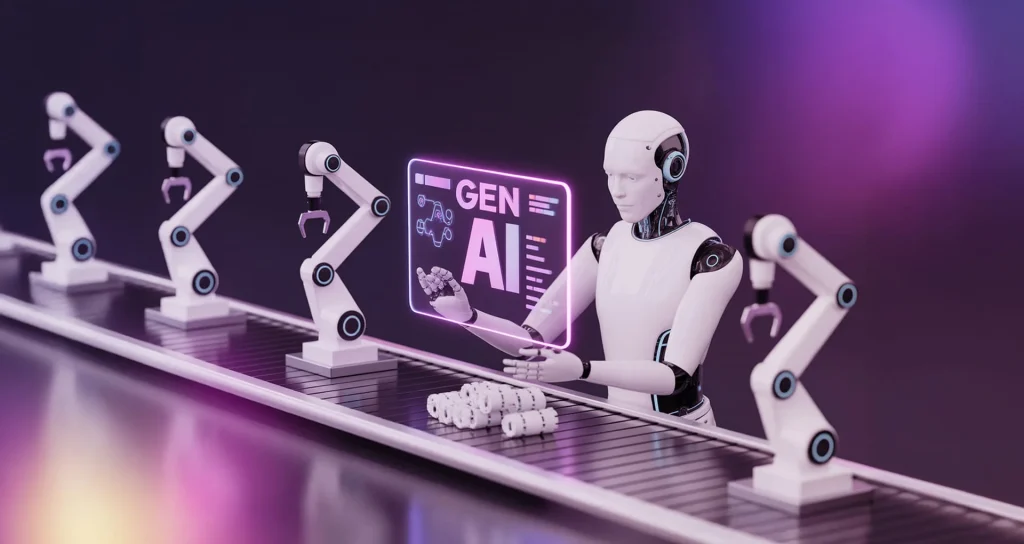
The workplace is undergoing a quiet but powerful transformation. Over the last few years, Generative AI has moved from experimental technology to a practical tool used in everyday business tasks. What once required hours of manual effort—writing reports, designing visuals, summarizing meetings, or drafting emails—can now be completed in minutes with the help of AI.
According to McKinsey, generative AI could add $2.6 trillion to $4.4 trillion annually to the global economy through productivity improvements and automation. Meanwhile, a 2024 Microsoft Work Trend Index report found that 75% of knowledge workers already use AI at work, and most say it helps them save time and focus on higher-value tasks.
But the real shift is not simply about using AI tools occasionally. The real opportunity lies in integrating generative AI directly into daily workflows so that AI becomes a natural part of how work gets done.
In this comprehensive guide, we will explore how generative AI fits into modern workflows, practical use cases, integration strategies, challenges, and future trends.
The Quiet Revolution: How Generative AI Is Reshaping Everyday Work
Generative AI refers to artificial intelligence systems capable of creating new content such as text, images, code, audio, and video based on training data.
Unlike traditional automation systems that follow fixed rules, generative AI systems can analyze context, generate ideas, and assist in creative tasks.
This capability is changing how professionals approach daily work. Instead of spending hours performing repetitive tasks, employees can collaborate with AI to:
- generate ideas
- create first drafts
- analyze information
- automate routine communication
- speed up research and decision-making
The result is a new productivity model where humans focus on strategy and creativity while AI handles time-consuming tasks. For companies like NK Marketing Solutions, integrating generative AI into daily workflows means faster campaign creation, quicker content production, and improved data analysis.
What Generative AI Means in a Workflow Context
To understand how generative AI integrates into workflows, it is important to clarify how it differs from traditional automation.
Traditional Automation
Traditional automation follows predefined rules. For example:
- automated email responses
- scheduled social media posts
- data entry scripts
These systems perform tasks but cannot generate new content or ideas.
Generative AI
Generative AI goes beyond automation by creating new outputs based on prompts and context.
Examples include:
- writing blog drafts
- generating marketing copy
- creating product descriptions
- designing graphics
- summarizing documents
- writing software code
This ability allows AI to assist with both creative and analytical tasks, making it ideal for integration into everyday workflows.
Why Businesses Are Embedding AI into Daily Tasks
Businesses are integrating generative AI for several strategic reasons.
1. Significant Productivity Gains
Studies show that generative AI can improve productivity by 20% to 40% in many knowledge-based roles.
For example:
- customer support teams resolve queries faster
- marketers generate campaigns quickly
- developers write code faster
2. Faster Decision-Making
AI tools can analyze large datasets quickly and summarize key insights, helping managers make informed decisions in less time.
3. Reduced Operational Costs
By automating repetitive tasks, companies reduce the need for manual effort, saving both time and money.
4. Scalable Creativity
Generative AI allows businesses to create large volumes of content without expanding teams.
For digital marketing agencies like NK Marketing Solutions, this means producing more blogs, ads, and social media content efficiently.
m Tools to Teammates: Where Generative AI Fits in the Workflow
The best way to integrate generative AI is to treat it as a collaborative assistant rather than a replacement for human expertise.
Here is how AI fits into different stages of the workflow.
Ideation Stage
AI can help generate ideas quickly.
Examples:
- brainstorming blog topics
- generating marketing campaign concepts
- creating product names
Instead of starting from scratch, teams can use AI to generate multiple creative options instantly.
Creation Stage
Generative AI excels at creating first drafts.
Examples:
- blog posts
- social media captions
- marketing emails
- product descriptions
This significantly reduces the time required to produce content.
Optimization Stage
AI can also improve existing content.
Examples:
- rewriting text for clarity
- optimizing SEO content
- summarizing long documents
- generating headlines
This stage ensures the final output is polished and effective.
Execution Stage
AI helps automate final delivery tasks.
Examples:
- scheduling content
- generating automated responses
- analyzing campaign performance
By integrating AI at every stage, workflows become faster and more efficient.
Everyday Use Cases of Generative AI across Teams
Generative AI is not limited to one department. It can enhance workflows across the entire organization.
Marketing and Content Creation
Marketing teams are among the biggest adopters of generative AI.
Common uses include:
- writing blog posts
- generating ad copy
- creating social media captions
- producing email campaigns
This allows agencies such as NK Marketing Solutions to deliver content faster while maintaining creativity.
Customer Support
AI chatbots and AI-generated responses can assist support teams by:
- answering common customer questions
- generating knowledge base articles
- summarizing support tickets
This improves response times and customer satisfaction.
Product Development
Product teams use generative AI to:
- generate product documentation
- create design ideas
- analyze user feedback
AI speeds up product innovation by helping teams explore ideas quickly.
Data Analysis and Research
Researchers and analysts use AI to:
- summarize reports
- extract insights from large datasets
- generate research summaries
This reduces time spent reading and analyzing information.
The AI-Augmented Workflow Model
One of the most effective approaches to integrating generative AI is the AI-augmented workflow model.
This model focuses on collaboration between humans and AI.
Step 1: Human Defines the Goal
The user provides instructions or prompts to the AI.
Step 2: AI Generates Multiple Options
AI produces ideas, drafts, or insights based on the prompt.
Step 3: Human Reviews and Edits
Humans refine the AI output to ensure accuracy and quality.
Step 4: AI Optimizes and Scales
AI helps refine and expand the output for broader use.
This collaborative approach ensures high productivity without sacrificing quality.Tools Powering the Generative AI Workflow Ecosystem
Several categories of AI tools are enabling workflow integration.
Text Generation Tools
Used for content writing and communication.
Examples:
- AI writing assistants
- marketing copy generators
Design and Visual Tools
Used for creating graphics and presentations.
Examples:
- AI image generators
- automated design tools
Coding Assistants
Used by developers to generate code and debug errors.
Examples:
- AI programming assistants
Meeting and Productivity Tools
Used to summarize meetings and manage tasks.
Examples:
- AI meeting transcription tools
- AI note-taking assistants
By combining these tools, businesses can create AI-powered workflows that dramatically increase efficiency.ractical Steps to Integrate Generative AI into Daily Work
Successfully integrating AI into workflows requires a structured approach.
1. Identify Repetitive Tasks
Start by identifying tasks that consume time but require minimal creativity.
Examples include:
- writing routine emails
- summarizing documents
- generating reports
These tasks are ideal for AI automation.
2. Choose the Right AI Tools
Different tasks require different tools.
Examples:
- writing tools for content creation
- design tools for visual assets
- automation tools for task management
Selecting the right tools ensures maximum efficiency.
3. Train Teams in Prompt Engineering
The effectiveness of AI depends on how instructions are written.
Employees should learn prompt engineering, which involves giving clear instructions to AI systems.
4. Create AI-Assisted Workflows
Instead of using AI randomly, integrate it into structured workflows.
Example workflow:
Idea generation → AI draft → Human editing → AI optimization → Publishing
5. Measure Productivity Improvements
Track key performance indicators such as:
- time saved
- content output
- campaign performance
This helps organizations understand the real impact of AI.
Challenges in Generative AI Workflow Integration
Despite its advantages, integrating generative AI comes with several challenges.
Data Privacy Concerns
Organizations must ensure that sensitive data is not exposed when using AI systems.
AI Hallucinations
AI models sometimes generate incorrect information. Human review is essential to maintain accuracy.
Skill Gaps
Employees may need training to effectively use AI tools.
Over-Dependence on AI
Businesses should avoid relying entirely on AI and maintain human oversight.
Ethical and Responsible AI Use in Workflows
As AI becomes more integrated into business operations, ethical considerations become increasingly important.
Key principles include:
- Transparency
- Bias Prevention
- Human Oversight
- Responsible Data Use
Responsible AI practices help organizations build trust and credibility.rk: AI-Native Workflows
The future workplace will likely be built around AI-native workflows, where AI is embedded in almost every digital tool.
Emerging trends include:
- AI copilots integrated into productivity software
- autonomous AI agents performing complex tasks
- personalized AI assistants for employees
- real-time AI collaboration tools
Experts predict that within the next decade, AI will become as common in the workplace as email and spreadsheets.
Organizations that adapt early will gain a significant competitive advantage.
Frequently Asked Questions
1. How does generative AI improve productivity?
Generative AI automates repetitive tasks such as writing drafts, summarizing information, and generating ideas, allowing employees to focus on higher-value activities.
2. Can generative AI replace human workers?
No. Generative AI is designed to assist humans, not replace them. Human creativity, judgment, and strategic thinking remain essential.
3. What industries benefit the most from generative AI workflows?
Industries such as marketing, software development, customer support, finance, and research benefit significantly from generative AI integration.
4. What are the risks of using generative AI in workflows?
Common risks include data privacy issues, inaccurate outputs, and over-reliance on AI. Proper governance and human oversight can mitigate these risks.
5. How can companies start integrating generative AI?
Businesses should start by identifying repetitive tasks, selecting appropriate AI tools, training employees, and gradually building AI-assisted workflows.
Conclusion
The integration of generative AI into daily workflows is transforming how modern organizations operate. By combining human creativity with AI-powered efficiency, businesses can streamline repetitive tasks, accelerate decision-making, and produce high-quality outputs at scale.
However, the real value of generative AI lies in using it strategically—as a collaborative assistant rather than a replacement for human expertise. Organizations that adopt responsible AI practices, train their teams, and build structured AI-assisted workflows will be better positioned to improve productivity and stay competitive in the evolving digital landscape.