
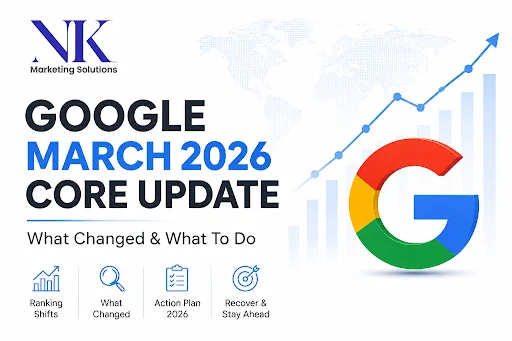
What Is the March 2026 Google’s Core Update? Google’s first broad core update of 2026, launched March 27, 2026. It affects all languages, industries, and site types globally. It is not a penalty, it is a ranking recalibration to surface more relevant, helpful content.
Is this a penalty? No. Core updates do not penalize sites. A ranking drop means other pages are now judged more helpful for a query, not that your site broke a rule.
How long does the rollout last? Google says up to 2 weeks. Based on the December 2025 core update (which ran 18 days), expect full stabilization by mid-April 2026.
Should you make immediate changes? No. Google advises waiting at least one full week after rollout completes before analyzing GSC data or making content changes.
Table of Contents
What You Will Learn
- The full March 2026 timeline Core Update, Spam Update, and Discover Update overlap decoded
- How this update compares to December 2025 and what changed in Google’s approach
- 5 specific ranking signal shifts and what each means for your site
- Which industries were hit hardest and which ones gained
- How to diagnose whether this update affected you exact GSC steps
- 9 actions to take right now to recover rankings and stay stable through the next update
- How AI Overviews are reshaping what “ranking well” means in 2026
- A 2026 content quality checklist you can run against any page on your site
Full March 2026 Update Timeline: Every Event, Every Date
March 2026 did not deliver one algorithm event. It delivered three, landing within weeks of each other and creating what SEO tracking tools called the most volatile SERP period of 2026 so far.
| Date | Event | Impact Level |
| Feb 5 – Feb 27, 2026 | Discover Core Update first-ever update targeting Google Discover only | Medium Discover traffic only |
| March 24–25, 2026 | March 2026 Spam Update completed in under 20 hours (shortest on record) | High sites violating spam policies |
| March 27, 2026 | March 2026 Core Update begins rolling out globally | High all sites, all languages |
| Early April 2026 | Core Update rollout expected to complete | Stabilization period |
| Mid-April 2026 | Safe window to analyze GSC performance changes | Analysis phase begins |
Critical note: The Spam Update and Core Update are separate events with separate mechanisms but their effects overlap. If the Spam Update weakened your site, the Core Update may have compounded that damage. If your site is clean and strong, the Core Update may have handed you rankings vacated by penalized sites. These are not the same problem, and they do not have the same fix.
How the March 2026 Update Compares to December 2025
Most core update coverage treats each update in isolation. That misses the bigger signal.
The December 2025 Core Update took 18 days to complete and produced a SEMrush Sensor volatility peak of 8.2 out of 10. Recovery patterns showed that sites with genuine content depth largely stabilized within the rollout window, while thin and AI-overproduced sites continued to slide.
The March 2026 Core Update is different in three ways.
1. It arrived faster after the previous one. The gap between December 2025 and March 2026 is roughly 90 days shorter than the typical 3–4 month spacing Google maintained through 2024. Google is accelerating its quality enforcement cycle.
2. It was preceded by a Spam Update within 48 hours. The December 2025 cycle had no companion spam action. March 2026 had both running in near-simultaneous overlap. Sites facing compounding signals from both events are dealing with a more complex recovery scenario.
3. Information Gain is a named, confirmed signal for the first time. In December 2025, originality was rewarded implicitly. In March 2026, pattern analysis across hundreds of ranking shifts showed that information gained from what new, specific, first-hand value your page adds is functioning as an explicit ranking input, not just an indirect quality proxy.
The direction is consistent: Google is getting faster at identifying and demoting content that adds nothing new to the conversation.
How Volatile Was This Update? The Numbers
- SEMrush Sensor volatility score peaked at 9.5 out of 10 among the highest ever recorded
- Over 55% of monitored websites experienced ranking shifts in the first two weeks
- Some sites reported organic traffic drops of 20–35% in the first week alone
- The March 2026 Spam Update completed in under 20 hours the shortest confirmed spam update in Google’s history
- 73% of top-ranking pages in competitive YMYL verticals now carry verifiable author credentials, up from approximately 60% post-December 2025
5 Ranking Signals Google Recalibrated in This Update
Google described this update as “a regular update designed to better surface relevant, satisfying content.” That language is intentionally vague. Based on real ranking data and pattern analysis across affected sites, here is what actually moved.
Shift #1: Information Gain Is Now a Direct Ranking Factor
This is the most consequential change in the March 2026 Core Update.
Google now evaluates how much genuinely new information your page contributes relative to everything already ranking for that query. Pages that repackage existing top results even well-written ones, are losing ground. Pages with original data, first-hand experience, proprietary case studies, or insights that competitors cannot replicate are gaining.
This is not about word count or topical coverage. It is about whether your page adds something to the conversation that did not exist before it ranked.
What this means for your site: If your article on a topic covers the same ground as the top 5 results just reordered and reworded it is at higher risk than it was six months ago. A single genuine case study with real numbers, a practitioner’s observation that comes from direct experience, or a specific example that only you have access to is now more valuable than 500 extra words of generic coverage.
Before you audit a page, ask one question: What does this page say that the top 3 results cannot say? If you cannot answer that in 10 seconds, the page needs work.
Shift #2: AI Content Without Human Oversight Is Getting Filtered Out
The March 2026 Core Update did not ban AI-generated content. What it deployed based on pattern analysis aligned with Google’s Gemini 4.0 semantic evaluation capabilities is a more accurate filter for identifying content produced at scale without meaningful human editorial input.
The ranking data tells a clear story:
| Content Type | March 2026 Impact |
| AI-assisted + genuine human editing + real examples | Stable or gaining |
| AI-drafted + light editing + generic coverage | Declining |
| Mass-produced AI content with no oversight | Significant drops |
| Human-written + original data + strong E-E-A-T | Gaining strongly |
| Thin content regardless of how it was produced | Dropping |
The line Google is drawing is not between AI and human writing. It is between content that carries real expertise and content that simulates it. Fluency is not expertise. A page can read perfectly and rank nowhere if it adds nothing a generalist AI could not generate in 30 seconds.
Shift #3: Weak Pages on Strong Domains Are Now Judged on Their Own
This is one of the more significant structural shifts in the March 2026 update, and it catches a lot of sites off guard.
“Parasitic SEO” publishing low-quality content sections on otherwise authoritative domains to borrow ranking power from the domain’s overall trust has been a known tactic for years. The March 2026 update appears to have implemented aggressive page-level authority evaluation, meaning a strong domain reputation no longer protects every page that lives on it.
Weak pages on authority sites are now being evaluated on their own merit and many are dropping regardless of the domain’s overall strength.
If your site carries a mix of strong cornerstone content and thinner filler pages published to capture long-tail traffic, do not assume domain authority carries those pages through. It did not in December 2025, and it does not now.
Shift #4: Google’s Intent Matching Now Goes Beyond the Keyword
Google’s ability to assess whether a page truly satisfies what a user is looking for not just whether it contains the right terms, has become significantly sharper in this update.
Pages that technically cover a keyword but stop short of addressing the full user need are losing ground to pages that understand and answer the complete query, including the question the user would naturally ask next.
- A page about “how to fix 404 errors” should also address when to redirect versus delete because that is the next question users have
- A page about “website performance optimization ” should explain what to do after you measure them, not just define what they are
- A glossary definition should connect to practical application not just restate the term in different words
The shift is toward pages that resolve a user’s need rather than pages that address a keyword. Those are not always the same thing, and the gap is now costing rankings.
Shift #5: YMYL Sites Face a Tighter E-E-A-T Bar
Experience, Expertise, Authoritativeness, and Trustworthiness requirements have tightened again particularly for YMYL topics: health, finance, legal, safety, and related verticals.
73% of top-ranking pages in competitive YMYL categories now display clear, verifiable author credentials with demonstrable first-hand expertise. Anonymous content and generic “editorial team” bylines are losing ground at a measurable rate.
This is not surprising if you have followed Google’s quality rater guidelines over the past two years. But the March 2026 update reflects those guidelines being enforced algorithmically, not just in human quality reviews.
Which Industries and Niches Were Hit Hardest
Not all sites felt this update equally. Pattern analysis across verticals shows clear winners and clear casualties.
Hardest hit:
- Health and medical information sites anonymous authorship and AI-generated symptom content dropped significantly in YMYL enforcement
- Personal finance and investing thin affiliate content and generalist “best credit card” roundups with no demonstrated financial expertise saw steep declines
- Legal information pages without named, credentialed attorneys covering jurisdiction-specific topics lost ground to pages with clear legal expertise signals
- News aggregation and SEO news blogs sites republishing existing reporting without original analysis or commentary were affected by the information gain signal
- Broad generalist blogs sites covering dozens of unrelated topics with no established authority in any single area saw declines consistent with the topical authority shift
Recovering or gaining:
- B2B SaaS with deep documentation high information density, named technical authors, strong internal linking
- Niche specialist sites a site covering one specific topic with genuine depth and first-hand expertise is gaining ground vacated by generalists
- Independent practitioners with personal brands named experts with verifiable credentials, original case studies, and direct industry experience
- Sites with strong AI Overview citations pages already appearing as cited sources in AI-generated answers showed more stability through this update cycle
Winners and Losers: Who Gained, Who Dropped, and Why
Sites Gaining Rankings
- Sites with deep topical authority in a focused subject area not broad generalist blogs
- Sites with named authors who carry verifiable credentials, a LinkedIn profile, and demonstrable real-world experience
- Sites publishing original research, client case studies, and first-hand data that competitors cannot replicate
- Sites with strong Core Web Vitals: LCP under 2.5 seconds, INP under 200ms, CLS under 0.1
- Sites with clean technical architecture no crawl budget waste, minimal duplicate content, strong descriptive internal linking
- Sites that appear as cited sources in Google’s AI Overviews and third-party authoritative publications
Sites Losing Rankings
- Sites with mass-produced AI content that lacks editorial oversight or any original perspective
- Sites using thin, weak pages to absorb long-tail traffic on an otherwise strong domain
- Sites covering keyword topics without fully addressing the user’s underlying need
- Sites with unresolved Core Web Vitals failures, particularly on mobile
- YMYL sites with anonymous or poorly credentialed authorship
- Sites already weakened by the March 2026 Spam Update the Core Update compounded the damage
Across the sites I’ve monitored through this cycle, the pattern is consistent with what Google has been signaling since mid-2024: depth beats breadth, first-hand experience beats aggregation, and named expertise beats anonymous coverage. The March 2026 update did not introduce a new direction; it applied more force to an existing one.
How to Confirm This Update Hit Your Site (GSC Step-by-Step)
Before touching anything on your site, confirm that your traffic changes are actually caused by the March 2026 Core Update and not by something else. Here is the exact diagnostic process.
Step 1 Confirm the Date Match
In Google Search Console: go to Performance > Search Results
- Set the date range: compare March 27 onwards against the same period 4 weeks prior
- Check whether clicks and impressions started dropping specifically around March 27–28
- If your drop began March 24–25, the Spam Update is a more likely cause check your spam policies before anything else
Step 2 Identify Which Pages Were Affected
In GSC Performance, click the Pages tab:
- Sort by clicks, descending identify your top 20 pages from before the update
- Filter by March 27 onwards find which of those pages lost the most clicks
- Export both date ranges to Google Sheets for a clean side-by-side comparison
- Look for patterns: are affected pages in the same topic cluster? The same content type? Written by the same author? Published in the same time period?
Step 3 Separate Spam Update Effects from Core Update Effects
| Symptom | Most Likely Cause |
| Sharp drop on March 24–25, stable after | Spam Update review Google’s spam policies |
| Gradual decline starting March 27, still ongoing | Core Update content quality issue |
| Both sudden and gradual drops | Both updates needs a full audit |
| Rankings fluctuating but no net change | Normal rollout volatility wait for stabilization |
| Competitor pages now outranking yours | Core Update competitors rated more helpful for those queries |
9 Actions to Take Right Now: Recovery + Future-Proofing
Do not make major site changes while the update is still rolling out. Google recommends waiting at least one full week after rollout completion expected mid-April 2026 before making significant content or technical changes. Panic-editing during an active rollout adds noise, not improvement.
Action 1 Watch and Document Before You Touch Anything
The most effective action right now is restraint. Rankings will fluctuate throughout the rollout period. What looks like a 25% traffic drop today may partially self-correct as the update stabilizes.
- Check GSC daily note changes, do not act on them yet
- Monitor your rank tracking tool for volatility patterns versus actual settled losses
- Document everything: which pages changed, by how much, and exactly when it started
Action 2 Audit Every Affected Page for Information Gain
Once the rollout stabilizes, run a page-by-page audit of your affected pages with one central question: does this page add something genuinely new compared to the top 5 results for its target keyword?
- Open each affected page alongside its top 3 ranking competitors
- List what is unique on your page original data, case studies, first-hand experience, specific examples
- If you cannot identify at least 2–3 genuinely unique elements, that page needs substantive work, not a polish pass
Action 3 Strengthen E-E-A-T Signals Across Your Site
E-E-A-T is no longer optional. If your site is missing these, add them as soon as the rollout stabilizes:
- Named author with real credentials on every article not a generic “Staff Writer” or “Editorial Team”
- Author bio with LinkedIn URL, years of experience in the field, and specific expertise claims
- First-person experience markers within the content: “In my audits of 200+ sites…” or “When I tested this approach on a client in the fintech space…”
- Primary source citations: link to original research, Google’s own documentation, and authoritative third-party references
- A detailed About page with entity information company history, team credentials, contact details, and a physical address if relevant
Action 4 Assess Your AI Content Honestly
If your site uses AI-assisted content, now is the time for a real audit not a defensive one. For each AI-assisted page, ask: would a genuine expert in this field recognize this content as containing real insight?
If the answer is no, the page needs a substantial human editorial upgrade. Not a light copy. Not a few inserted examples. A genuine rewrite from a practitioner’s perspective that makes the page worth reading on its own merit.
Action 5 Fix Core Web Vitals Failures
Technical performance is now a ranking liability when it fails, not just a missed opportunity when it is perfect. Run a Core Web Vitals report in GSC and address every “Poor” and “Needs Improvement” cluster:
- LCP above 2.5 seconds: Optimize hero images, implement lazy loading, and evaluate your hosting performance
- INP above 200ms: Audit and defer unnecessary JavaScript; remove or delay third-party scripts that fire on page load
- CLS above 0.1: Add explicit width and height attributes to every image; reserve space for ads and embeds before they load
Action 6 Go Deeper in Your Core Topics, Not Broader
This update rewards focused topical authority over generalist breadth. Publishing across dozens of unrelated topics is now a liability, not a coverage strategy.
- Identify your 5–10 most important topic clusters
- For each cluster, confirm you have a comprehensive pillar page and 4–6 supporting articles that cover the subtopics in real depth
- Link all cluster content together with descriptive internal anchor text
- Do not publish content outside your established topical authority unless you can approach it with genuine expertise not just research
Action 7 Eliminate Thin Pages That Are Dragging Down the Rest
Every page on your site that cannot justify its own ranking on merit is a liability to the pages that can. Run a thin content audit and address what you find:
- Use the GSC Page Indexing report to identify pages with low impressions and zero clicks over 90 days
- For each page: improve it substantively, consolidate it into a stronger page via 301 redirect, or no index it
- Do not leave thin, indexed content sitting on a domain with strong cornerstone pages it now affects how Google evaluates the pages around it
Action 8 Send Clients a Proactive Update This Week
If you manage SEO services for site recovery for clients, do not wait for them to find the rankings drop and call you. Send a brief, calm, factual update now.
Subject: Google March 2026 Core Update What It Means for Your Site
Google released its first broad core update of 2026 on March 27. These updates typically take 2 weeks to fully roll out, so some ranking fluctuation over the next few weeks is normal and expected.
Core updates are not penalties; they are recalibrations to surface more helpful content for searchers. We are actively monitoring your rankings and traffic through this period.
We recommend waiting for the rollout to stabilize before making any major changes. You will receive a full analysis once the update completes, expected mid-April 2026.
If you have questions in the meantime, please reach out.
Action 9 Brief Your Writers and Content Team Right Now
This is the step most site owners skip and it is the one that determines whether the next batch of content helps or hurts you.
Your writers need to understand what this update changed before they write another word. Brief them on:
- Information gain: Every piece they publish should contain at least one element a generalist AI or a rewrite of existing content cannot produce a real case study, a specific number from your own data, a first-hand observation from someone with direct experience
- Full intent coverage: They should write the article and then ask: what would a reader search next after reading this? If the page does not address that, it is not finished
- E-E-A-T requirements: Every article needs a named author with a real bio. No exceptions
- AI content policy: Clarify your team’s process for AI-assisted drafts what level of human editorial input is required before a page publishes
If your writers do not know what changed, they will keep producing content calibrated to pre-March 2026 standards. That gap is avoidable.
How AI Overviews Are Reshaping Post-Update Visibility
Ranking at position 1 is no longer the only version of winning in Google Search.
As AI Overviews and Google’s AI Mode handle a growing proportion of queries, the content that gets cited in those AI-generated answers carries significant visibility often more immediate than a ranked blue link. Users reading an AI Overview see the cited source; they may never scroll to organic results at all.
The March 2026 Core Update affects AI Overview citation patterns in a direct way. Original, authoritative content that demonstrates genuine first-hand expertise is more likely to be pulled into AI-generated answers. Thin, aggregated, or AI-produced content without editorial depth is being excluded from those citations even when it still ranks organically.
This creates a two-tier visibility problem for sites with mixed content quality:
- Strong, expert-driven pages may gain AI Overview citations and the traffic that comes with them
- Weaker pages on the same domain may lose organic rankings and fail to appear in AI answers simultaneously
The practical implication: content quality now affects two separate visibility channels at once. Sites that treat AI Overviews as a separate strategy from SEO are missing that both are now responding to the same quality signals.
What to do: Run a check on your high-traffic target queries in Google Search. Which pages in your niche are currently being cited in AI Overviews? What do they have in common first-person expertise, original data, specific examples, verified authorship? That is your benchmark for what Google’s AI considers trustworthy enough to surface.
Your Realistic Recovery Timeline After March 2026
Google does not hide its position on this: recovery from a core update takes time and does not happen by applying a quick fix during the rollout.
| Scenario | Expected Recovery Path |
| Temporary volatility, otherwise strong site | Partial self-recovery by mid-April 2026 no action needed |
| Core Web Vitals issues fixed promptly | May recover within next GSC refresh cycle 4–8 weeks |
| Content quality improved substantially | Next major core update June/July 2026 |
| E-E-A-T signals strengthened site-wide | Next core update recognition takes time to build |
| Spam Update penalty + Core Update compound hit | Longer recovery 3–6 months with a full audit and rebuild |
Two types of recovery are possible.
Recovery within the current rollout window. Some ranking fluctuations during an active rollout reverse naturally as the algorithm stabilizes. If your drop was caused by temporary signal noise rather than a genuine content quality issue, rankings may partially recover by mid-April without any changes on your end. This is why waiting before making changes matters if you do not want to change something that would have corrected itself.
Recovery at the next core update. Sites with real content quality issues that make genuine, substantive improvements typically see those improvements recognized at the next major core update expected June or July 2026. This is not a failure. It is how Google’s validation cycle works. Start the improvements now so they are in place and indexed before the next cycle begins.
Is Your Site Update-Proof? 2026 Content Quality Checklist
Run this against any page on your site. These are the signals the March 2026 Core Update rewards.
Information Gain
- Does this page contain at least one data point, case study, or observation that no competitor currently ranking for this query can claim?
- Does this page take a specific position or make a specific claim, rather than covering all sides neutrally?
- If a reader has already read the top 3 results, does this page still give them something new?
Intent Coverage
- Does this page answer the full user question including the follow-up question a reader would naturally ask next?
- Does the content match the actual search intent (informational, navigational, transactional) not just the keyword?
E-E-A-T
- Is there a named author with a verifiable credential, a bio, and a LinkedIn or professional profile link?
- Does the content include first-person signals of direct experience, not
- just “experts say” attribution?
- Are sources cited? Do those citations link to primary sources, not secondary aggregators?
- Is there an About page with clear entity information?
Technical Performance
- LCP under 2.5 seconds on mobile?
- INP under 200ms?
- CLS under 0.1?
- No significant crawl issues or duplicate content flagged in GSC?
Topical Authority
- Does this page link to and from other content in the same topical cluster?
- Is the topic within the site’s established authority area or is it a detached single post on an unrelated subject?
AI Overview Eligibility
- Would a researcher or journalist cite this page as a source? Why?
- Is the authorship and expertise visible enough for Google to trust this as a source for an AI-generated answer?
Any “no” answer is a specific improvement opportunity, not a vague content quality problem.
What the March 2026 Core Update Signals About Google’s Long-Term Direction
The March 2026 Core Update is not a standalone event. It is one step in a direction Google has been moving consistently for 18 months.
The update cadence is accelerating. March 2026 delivered three separate algorithm events in a single month: the Discover Core Update completing February 27, the Spam Update March 24–25, and the Core Update from March 27. That is not a coincidence. Google is running quality enforcement across multiple systems simultaneously, and the intervals between updates are getting shorter.
AI Overviews are raising the floor. As AI-generated answers handle more queries directly, the organic results that remain visible are under more pressure to earn their position. The content that gets cited in AI answers sets the quality standard that ranked pages are now measured against. That standard is higher than the one that existed 12 months ago.
Information gain is the new baseline. For years, “high-quality content” was a direction to write better, be more helpful, and go deeper. The March 2026 Core Update treats information gain as a specific, evaluable signal. The question is no longer “is this good content?” It is “does this content exist in a way that nothing currently ranking can replicate?” That is a harder bar, and it is not going to get easier.
The businesses that will hold and grow organic visibility through the rest of 2026 are those that treat content quality as infrastructure built into the production process from day one, not applied as a recovery strategy after an update hits.
Frequently Asked Questions
Is the March 2026 Core Update the same as the March 2026 Spam Update?
No. These are two completely separate events. The Spam Update targeted sites violating Google’s spam policies and completed March 24–25. The Core Update is a broad ranking recalibration that began March 27 and takes up to 2 weeks to complete. Their timing is related; both are part of Google’s March 2026 quality enforcement push but their mechanisms and fixes are different.
My rankings dropped on March 27. Is it definitely the Core Update?
If the drop began specifically on or after March 27, it is likely Core Update related. If it started March 24–25, the Spam Update is the more probable cause. Use Google Search Console’s date range filtering to pinpoint the exact onset of your ranking changes. Some sites are experiencing compound effects from both those cases that require a fuller audit.
Should I immediately rewrite all my AI-generated content?
No. Not all AI content is affected. AI-assisted content that has been substantially edited by human experts, includes original examples and real data, and demonstrates genuine expertise is performing well. Only mass-produced AI content with no meaningful oversight and nothing original to say is at risk. Audit your content honestly before making any wholesale changes.
When is the right time to analyze my GSC data?
Google explicitly recommends waiting at least one full week after the rollout completes before drawing conclusions from performance data. With the rollout expected to complete around mid-April, late April is the right window for a comprehensive analysis. Analyzing too early means making decisions based on fluctuations that may not represent the final settled state.
My site was already hit by the December 2025 Core Update. Will this make recovery longer?
Possibly. If you implemented genuine content improvements after December 2025, the March 2026 Core Update may actually reward that work. If those improvements were primarily cosmetic surface-level edits, added word count, minor restructuring without real substance the March 2026 update will not recognize them. Start from the information gain and E-E-A-T framework above. Recovery recognized at the June/July 2026 core update is a realistic target if improvements are substantive and in place by mid-May.
Can I recover before the next core update?
Technical fixes Core Web Vitals, crawl errors, duplicate content can be recognized within 4–8 weeks. Content quality improvements are typically recognized at the next major core update, expected June or July 2026. Start now to be in position for that cycle.
Want a full SEO audit after the March 2026 Core Update? Book a free consultation today.