
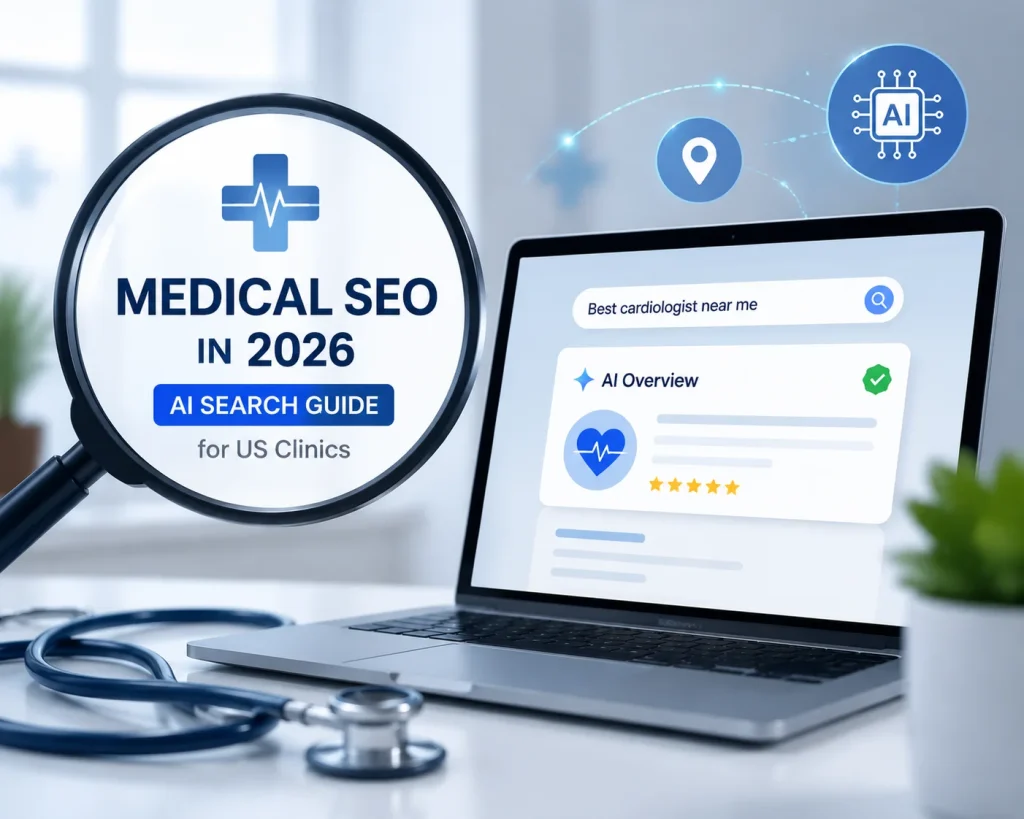
Your next patient is searching for care right now. They may type their symptoms into Google. They may ask ChatGPT which clinic to trust. Either way, a search result decides whether they find you or a competitor. Medical SEO is how you make sure that answer is yours.
But medical SEO in 2026 looks nothing like it did two years ago. Google now answers many health questions on the page itself. AI assistants recommend providers before a patient visits a single website. This guide shows US hospitals and clinics how to adapt, rank, and grow.
Why US Patients Now Start Their Search for Care on Google and AI
Most patients no longer ask a friend for a doctor first. They search. Industry research shows that around 79% of US adults look up health information online before they act. They check symptoms, compare providers, and read reviews. Many healthcare marketers also rely on an SEO training institute to improve online visibility and search performance.
For clinics looking to strengthen their online visibility and attract more patients, working with a Houston healthcare marketing agency can help develop targeted marketing strategies that complement medical SEO and local search efforts.
Here is what changed. Google now shows AI Overviews at the top of many results. According to BrightEdge data, treatment and procedure queries trigger an AI summary close to 100% of the time. Seer Interactive found that click-through can fall from about 1.6% to 0.6% once that summary appears. Fewer patients click. The ones who do are more ready to book.
| Key point: Visibility is no longer just about ranking first. It is about being the source Google and AI quote when they answer a patient’s question. Read more on this in the AI search reports from BrightEdge AI Search Insights and Interactive zero-click study. |
What Is Medical SEO, and How Is It Different From Regular SEO?
Medical SEO is the practice of optimizing a healthcare website so patients find it through search. It covers your service pages, your Google Business Profile, your reviews, and your technical setup. The goal is simple. You want to appear when a patient searches for the care you provide.
Regular SEO and medical SEO share the same foundation. Both need keywords, fast pages, and good links. But healthcare carries higher stakes, so Google applies stricter rules. Three differences matter most.
• Accuracy is non-negotiable. Wrong health information can hurt people. Google rewards content that experts review.
• Trust signals carry more weight. Credentials, licenses, and clear authorship influence rankings more than in other fields.
• Privacy law applies. HIPAA shapes how you build pages, run forms, and track visitors. We cover this trap in detail below.
Google’s YMYL Standard and What It Means for Your Practice
Google labels health content as YMYL, which stands for Your Money or Your Life. These pages can affect a reader’s health, safety, or finances. So Google holds them to a higher bar.
For your practice, YMYL means content cannot cut corners. Each clinical page should show who wrote it and who reviewed it. It should cite reliable medical sources. It should stay current. Learn more about the standard in
The 2026 Shift: Your SEO Now Has Two Jobs
This is the part most guides miss. In 2026, your strategy must do two jobs at once.
1. Win clicks. Rank in the classic results so patients visit your site and book.
2. Win citations. Get quoted inside AI Overviews, ChatGPT, Perplexity, and Gemini answers.
These goals overlap, but they are not the same. A page can rank well yet never get cited by AI. Smart practices now plan for both. We return to the citation half in Pillar 6.
What Are Your Patients Actually Searching For?
Patients do not search the way doctors talk. They use plain words and real worries. Your content must match their language, not your clinical terms.
Search intent usually falls into a few clear buckets. Each one needs a different page and a different goal.
| Intent type | Example search | What it needs | |
| Informational | “symptoms of a sinus infection” | Expert-reviewed condition page | |
| Local provider | “dermatologist near me” | Google Business Profile and local page | |
| Service | “LASIK surgery cost Dallas” | Service page with pricing range | |
| Transactional | “book annual physical online” | Booking page and clear call to action | |
| Strategy tip: Google handles these query types differently in 2026. It floods clinical questions with AI summaries. But it pulled AI Overviews back from local provider searches. So local terms like “clinic near me” still send real clicks. Write your local pages to capture them. | |||
6 Real Benefits of Medical SEO for Hospitals and Private Practices
A strong SEO program pays back in patients, not just rankings. Here are six benefits that matter to your bottom line.
1. More Patient Appointments From Organic Search
Higher rankings bring more visitors who already want care. Those visitors fill more appointment slots. Organic search becomes a steady channel that works while you sleep.
2. A Better Return on Investment Than Paid Ads
Paid ads stop the moment you stop paying. SEO keeps working after the work is done. Over time, the cost per new patient from organic search usually drops well below paid search.
3. Winning Local Searches Even Against Larger Competitors
A small clinic can outrank a big hospital locally. A sharp Google Business Profile and strong reviews often beat size. Local SEO levels the field.
4. Building Patient Trust Before Anyone Calls
Clear, accurate content answers worries early. A patient who trusts your content trusts your clinic. That trust shows up before they ever pick up the phone.
5. Taking Rankings Away From Competing Clinics
Search is a zero-sum game on page one. Every position you win is one a rival loses. Good SEO steadily shifts share toward you.
6. Growth That Compounds Over Time
Each ranked page, review, and link adds to your authority. That authority makes the next page rank faster. The results build on each other month after month
The 6 Pillars of a Medical SEO Strategy in 2026
Most guides still list five pillars. That model is outdated. The rise of AI search adds a sixth. Here is the full framework for medical SEO today.
Pillar 1: Keyword Research and Patient Language
Start with the words patients use, not the words you use. Map each keyword to one page and one intent. Group related terms into topic clusters so Google sees your authority on a subject.
• Build one pillar page per major service. Example: [Internal link: Cardiology services].
• Support it with condition and question pages that link back to the pillar.
• Use tools like Google Keyword Planner to confirm real demand.
Pillar 2: Local SEO and Your Google Business Profile
Local SEO drives most new patient visits. Your Google Business Profile is the engine. Keep it accurate, complete, and active.
• Match your NAP. Your name, address, and phone must match everywhere online.
• Pick precise categories. Choose your primary specialty plus relevant secondary ones.
• Post and respond. Add updates, answer questions, and reply to every review.
• Build local pages. Give each location its own page. Link them from your Locations page.
| Multi-location note: Hospital systems and group practices need a clear location page structure. One page per site. Consistent listings across Google, Bing, and health directories. Inconsistent data confuses both patients and AI assistants, which steers them elsewhere. |
Pillar 3: Technical SEO, Schema, and Web Accessibility
A slow or messy site loses patients and rankings. Technical SEO fixes the foundation. Three areas now matter most.
Speed and Core Web Vitals. Pages must load fast on phones. Most health searches happen on mobile. Compress images and clean up code.
Healthcare schema markup. Schema is structured data that tells search engines what your content means. It also helps AI engines quote you correctly. Add MedicalOrganization, Physician, and FAQPage schema to the right pages.
Web accessibility (WCAG 2.1 AA). Federal rules now push covered entities toward WCAG 2.1 AA standards, with deadlines starting in May 2026 for larger organizations. Accessible sites also rank better and serve more patients. Add alt text, clear labels, and keyboard navigation.
| Compliance flag: Web accessibility is both a legal duty and an SEO win. Most medical SEO guides ignore it. Do not. Review the current rules with your counsel and see ADA.gov web accessibility guidance |
Pillar 4: E-E-A-T Content With Named Clinical Review
E-E-A-T stands for Experience, Expertise, Authoritativeness, and Trustworthiness. For YMYL health content, it is essential. The strongest signal in 2026 is named clinical review.
• Add a credentialed author byline to each clinical page.
• Add a “Medically reviewed by Dr. [Name], [Credentials]” line.
• Show a visible review date so readers and AI see the content is current.
• Link to a full bio page so credentials are easy to verify. Example: [Internal link: Provider bio pages].
These bylines do double duty. They satisfy Google’s quality raters. They also make AI engines more likely to trust and cite your pages.
Pillar 5: Link Building and Online Reputation
Links and reviews tell search engines other people trust you. Both are core to any SEO program.
• Earn relevant links. Aim for local news, health directories, and partner clinics, not spammy sites.
• Grow reviews steadily. Ask happy patients to review you. Reply to all reviews, good and bad.
• Protect your reputation. Monitor your name across Google, Healthgrades, and Yelp.
| Reviews matter more than ever: Reviews shape local rankings and feed AI trust signals. A clinic with 200 recent five-star reviews looks safer to both Google and a patient than one with five old ones. |
Pillar 6: GEO and Getting Cited in AI Answers
This is the new pillar that competitors miss. GEO stands for Generative Engine Optimization. It is the work of getting cited inside AI answers from ChatGPT, Perplexity, Gemini, and Google AI Overviews.
Why it matters: many patients now read an AI answer before they ever click a link. If the AI cites you, you win an implied endorsement. If it cites your rival, you stay invisible.
How to earn AI citations:
3. Answer first. Put a clear, direct answer in the first 40 to 60 words of a page. Research shows AI engines pull heavily from the top of the page.
4. Add fact density. Include specific facts, numbers, and sources. AI engines favor pages that back up claims.
5. Use extractable formats. Short answers, bullet lists, FAQs, and comparison tables are easy for AI to quote.
6. Show trust markers. Author, reviewer, dates, and citations all raise your odds of being cited.
7. Keep content current. AI engines reward recency in healthcare. Update key pages on a schedule.
| Measure it: Run a monthly AI citation audit. Ask ChatGPT, Perplexity, and Gemini your top patient questions. Note who they cite. Track your share over time. Learn the method at GEO for healthcare guide, Contently. |
The HIPAA Compliance Trap Most Medical SEO Guides Miss
Here is a risk almost no SEO guide mentions. Your tracking tools may break HIPAA. This trap has cost healthcare organizations over $100 million in penalties and class action settlements since 2023.
The problem is simple. Standard Google Analytics 4 and the Meta Pixel can send protected health information to third parties. A URL like /appointments/depression-screening plus an IP address can count as PHI. Google will not sign a Business Associate Agreement for GA4. So that data flow can violate the rules.
How to stay safe:
• Audit every script, pixel, and tag on your site.
• Use analytics tools that sign a BAA and are built for healthcare.
• Keep tracking off appointment, portal, and condition pages unless it is compliant.
• Work with your privacy officer and counsel before you launch any tag.
| Important: This is general information, not legal advice. Confirm your setup with a qualified HIPAA attorney. Review current OCR guidance at HHS OCR tracking technologies bulletin |
5 Medical SEO Mistakes That Quietly Cost You Patients
Even good practices make these errors. Each one drains patients you should be winning.
8. Chasing rankings, not citations. You rank but never appear in AI answers. You lose patients before the click.
9. Thin clinical content. Pages with no author and no review fail YMYL standards.
10. Ignoring the Google Business Profile. An outdated profile sinks local visibility fast.
11. Risky tracking setups. Non-compliant pixels create legal exposure and erode trust.
12. Set and forget. Stale pages lose ground. AI and Google both reward fresh content.
How to Measure Medical SEO Success in 2026
Rankings alone no longer tell the full story. In a zero-click world, you need a wider set of metrics. Track these to see real progress.
• New patient appointments from organic sources. The metric that pays the bills.
• AI citation share. How often AI engines quote you for key questions.
• Local pack visibility. Whether you appear in the map results for core terms.
• Google Business Profile actions. Calls, direction requests, and website clicks.
• AI referral traffic. Visits from ChatGPT, Perplexity, and similar tools in your analytics.
• Review growth and rating. Volume, recency, and average score over time.
| Reminder: Use a HIPAA-compliant analytics setup to track all of this. The measurement layer must respect the same privacy rules as the rest of your site. |
What Results Can You Expect, and When?
Medical SEO is a compounding investment, not a quick fix. Timelines vary by competition, site age, and budget. Here is a realistic view.
• Months 1 to 3. Foundation work. Technical fixes, profile cleanup, and first content. Early local wins are common.
• Months 4 to 6. Rankings climb. Content clusters mature. AI citations begin to appear.
• Months 7 to 12. Momentum builds. Organic appointments rise. Authority compounds.
• Beyond 12 months. Steady, lower-cost patient growth as your authority deepens.
Most US practices invest a monthly retainer for ongoing medical SEO services. Typical ranges run from about $1,500 to $10,000 per month, based on market size and goals
Ready to Become the Answer Your Patients Find First?
Patients are searching for your care today. The question is whether Google and AI point them to you or to a competitor. A modern medical SEO strategy makes that answer for you.
Start with the six pillars. Fix your foundation. Win clicks and citations. Stay compliant. Then watch your patient pipeline grow month after month.
Want a tailored plan for your practice? Request a free medical SEO audit, and we will show you exactly where your patients are slipping away and how to win them back.
Frequently Asked Questions
What is medical SEO?
Medical SEO is the process of optimizing a healthcare website so patients find it through search. It improves your rankings on Google, your local visibility, and your chances of being cited by AI search tools.
How is medical SEO different from regular SEO?
Medical SEO follows stricter rules because health is a YMYL topic. It demands expert-reviewed content, strong trust signals, and full HIPAA compliance, on top of standard SEO work.
Does medical SEO still work now that AI answers many questions?
Yes. The goal has expanded. You still rank for local and service searches, which AI Overviews largely leave alone. You also work to get cited inside AI answers through Generative Engine Optimization.
How long does medical SEO take to show results?
Most practices see early local wins within three months. Stronger rankings and AI citations usually build between months four and twelve, then compound over time.
Is Google Analytics HIPAA compliant for medical websites?
No. Google will not sign a Business Associate Agreement for GA4, and it can transmit protected health information. Healthcare sites should use HIPAA-compliant analytics that sign a BAA. Confirm your setup with legal counsel.