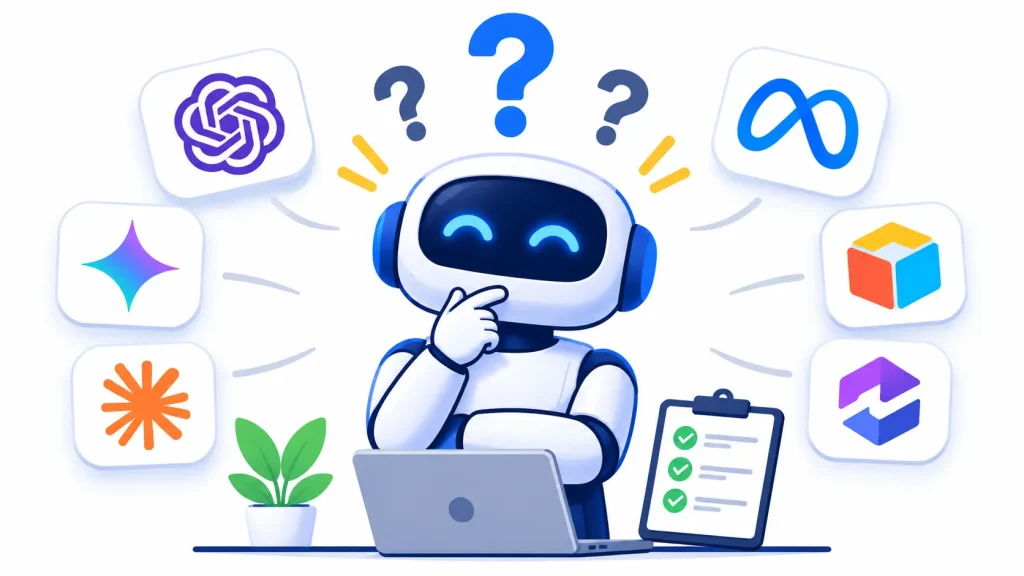
short answer: An agentic AI framework is the toolkit that lets an AI model plan steps, use tools, remember context and ask a human before risky actions. In 2026 the main options are LangGraph, CrewAI, Microsoft Agent Framework, OpenAI Agents SDK, Google ADK, Claude Agent SDK, LlamaIndex Workflows and Mastra. Choose by your team’s programming language, how much control you need, and what you can spend per task. For simple jobs, you may not need a framework at all.
Most “which framework?” articles list tools and stop there. This one also answers the questions that decide whether a project works. Do you need an agent at all? What will it cost to run? What keeps it from doing something costly when nobody is watching? Every date and number comes from a source listed at the end. This space changes fast, so check release notes before you commit.
Agentic AI frameworks at a glance (checked November 2026)
- Microsoft Agent Framework reached version 1.0 in April 2026. It replaces Semantic Kernel and AutoGen, which now get only bug and security fixes.
- LangChain 1.0 and LangGraph 1.0 launched together on October 22, 2025. LangChain’s agent builder now runs on LangGraph.
- Anthropic donated MCP to the Agentic AI Foundation on December 9, 2025. The A2A protocol joined the same foundation in August 2026.
- Anthropic reports that agents use about 4× the tokens of a chat, and multi-agent systems about 15×.
- Gartner expects more than 40% of agentic AI projects to be cancelled by the end of 2027.
- OWASP published its first Top 10 list of risks for agentic applications on December 9, 2025.
What is an agentic AI framework?
An agentic AI framework is a software toolkit that runs the loop around an AI model. The model decides the next step, calls a tool, reads the result, updates its memory and repeats. It stops when the job is done or a person needs to step in. The model does the thinking. The framework makes that thinking reliable.
A framework usually handles five jobs:
- Orchestration: deciding which step runs next.
- Tool use: calling your apps, databases and APIs safely.
- Memory: remembering context, and saving progress so a failed run can resume.
- Teamwork: passing work between several specialized agents.
- Oversight: approval steps, safety rules, logs and traces.
People mix up a few terms, so here is the short version. An AI agent is a model that works toward a goal using tools. An agentic AI framework is the toolkit you use to build and run agents. A multi-agent system is several agents with different roles working together. A protocol such as MCP or A2A is a shared standard that lets tools and agents connect.
Do you need an agentic AI framework at all?
Not always. Anthropic’s guide to building agents says to start with the simplest solution that works and add complexity only when you must. That can mean not building an agent at all. It also suggests starting with direct calls to the model, because frameworks add layers that make problems harder to debug.
Gartner gives a business reason for caution. Its June 2025 forecast says more than 40% of agentic AI projects will be cancelled by the end of 2027 because of rising costs, unclear value or weak risk controls. It also warns about “agent washing,” where vendors relabel ordinary chatbots as agentic. Gartner estimates only about 130 of the thousands of vendors are real.
Climb this ladder one step at a time:
- One model call. Good for a single question, rewrite or sort. No framework needed.
- A model call plus your documents. Good when answers depend on your own files. Usually no framework.
- A fixed workflow. Good when you already know the steps. A framework is optional.
- One agent with tools. Good when the steps change from case to case. A framework often helps.
- Several agents. Good when work splits into parts that can run side by side, and the task is valuable enough to justify the cost. A framework is usually the right call.
If what you need is a smarter feature on your website rather than an autonomous agent, a scoped web development project may be enough.
How does an agentic AI framework work?
Every framework runs the same loop:
- The model reads the goal and decides what to do.
- It calls a tool, such as a database lookup or an email draft.
- The framework passes the result back to the model.
- A person approves any risky step.
- The loop repeats until the job is done, or a step limit sends it to a human.
You could build this loop yourself. A framework gives you tested versions of the hard parts: saved progress, retries, approval pauses, tracing and parallel work. That is why teams reach for one once the loop stops being simple.
Example: a refund agent. This is a made-up example, not a client case. The agent reads the customer’s message and finds the order. Plain code checks the refund policy and enforces a spending cap. Refunds above the cap wait for a person’s approval. The agent writes the reply, and the framework records every step. The lesson: let the model handle messy language, and keep money, permissions and policy in ordinary code.
Which agentic AI frameworks are best in 2026?
These eight are the ones most teams shortlist.
| Framework | Best for | Languages | Watch out for |
|---|---|---|---|
| LangGraph (with LangChain) | Long, stateful workflows with human review | Python, JavaScript | Tracing and hosting run through separate LangSmith products |
| CrewAI | Fast prototypes where work maps to job roles | Python | Can use more tokens than step-by-step graphs |
| Microsoft Agent Framework | Teams on Microsoft and Azure | .NET, Python | Smaller community outside Microsoft |
| OpenAI Agents SDK | Lightweight agents with built-in tracing | Python, TypeScript | Check its version policy before pinning |
| Google ADK | Google Cloud teams and Java backends | Python, Java, Go, TypeScript | Tuned for Gemini |
| Claude Agent SDK | Agents that work with files, code and commands | Python, TypeScript | Built around Claude models |
| LlamaIndex Workflows | Document-heavy, search-first pipelines | Python | TypeScript version archived in April 2026 |
| Mastra | JavaScript and TypeScript product teams | TypeScript | Newer, with fewer public case studies |
LangGraph (with LangChain). Pick it when you want clear control over every step, saved progress and the ability to pause a run for human review. LangChain’s agent builder now runs on LangGraph, so many teams use both. The graph model takes time to learn.
CrewAI. Pick it when your work fits named roles, such as researcher, writer and reviewer. A 2026 comparison reports built-in MCP and A2A support. Because the model steers how agents interact, token costs can run higher than in step-by-step graphs.
Microsoft Agent Framework. Microsoft merged Semantic Kernel and AutoGen into this one toolkit, so new Microsoft projects should start here. It is stable in .NET and Python and supports MCP, A2A, approvals and telemetry.
OpenAI Agents SDK. A light toolkit built around agents, handoffs, guardrails, sessions and tracing. It replaced the experimental Swarm project. An October 2026 comparison noted 0.x version numbers, so pin versions and read release notes before upgrading.
Google ADK. Open source and now available in Python, Java, Go and TypeScript. ADK for Java 1.0.0 came out on March 30, 2026, with A2A support and human approval for tool calls. It is tuned for Gemini but works with other models.
Claude Agent SDK. Anthropic’s SDK offers the agent loop, built-in tools and context handling behind Claude Code. It supports MCP, subagents and permissions. Choose it for agents that read files or run commands. If you want to switch model providers freely, look elsewhere.
LlamaIndex Workflows. Strong when documents are at the center: loading, searching and retrieving before the agent acts. Its standalone TypeScript version was archived on April 30, 2026, so new TypeScript projects should not rely on it.
Mastra. A TypeScript-first framework that bundles workflows, memory and evaluations. It reports a SOC 2 Type II examination, which can help with enterprise buying. It is newer, so ask for references.
Four more are worth a look: PydanticAI (typed, validated outputs), Agno (an agent platform with a control panel), smolagents (agents that write and run Python, so run them inside a sandbox, an isolated space for code) and Haystack (search and document pipelines).
How do you choose the right framework?
Start with your situation, not a popularity list:
| Your situation | Test this first |
|---|---|
| Microsoft and .NET shop, or moving off Semantic Kernel or AutoGen | Microsoft Agent Framework |
| Python team that needs approvals and resumable runs | LangGraph |
| Product team that thinks in roles and wants a quick demo | CrewAI |
| TypeScript web team | Mastra, OpenAI Agents SDK or LangGraph for JavaScript |
| Google Cloud or Java backend | Google ADK |
| Document search is the core | LlamaIndex Workflows or Haystack |
| The agent works with files and commands | Claude Agent SDK |
| One predictable task | No framework |
Then ask five questions:
- Will your team be happy maintaining this language for years?
- Do you want step-by-step control, or the fastest path to a first demo?
- Can you pause a run, review it and resume it?
- Does it support MCP and A2A, and can you read its traces?
- How hard is it to leave? Look at version stability, who maintains it and how much of your code is tied to it.
The best test is a bake-off. Build the same small, real workflow in your top two choices over one or two weeks, using real tools and data. Score each on how often it finishes the task correctly across 30 to 50 saved test cases, the cost per finished task, speed, how it handles errors, and how easily a person can step in. If you send personal data to a model provider during testing, sign a data processing agreement first, because GDPR may apply.
What are MCP and A2A, and why do they matter?
Two open standards now sit under most frameworks. MCP (Model Context Protocol) connects an agent to tools and data. A2A (Agent2Agent) lets separate agents talk and hand off work. Anthropic donated MCP to the Agentic AI Foundation, a Linux Foundation fund, on December 9, 2025. Google gave A2A to the Linux Foundation in June 2025, and it joined the same foundation in August 2026. Neither belongs to one company anymore.
To avoid lock-in, expose your tools as MCP servers, keep business rules in your own code, and favor frameworks that support both standards. Support varies, and some frameworks offer A2A only in a paid managed tier.
What does an AI agent really cost to run?
Framework licenses are usually free. Model usage is not. Anthropic reports that agents use about 4× more tokens than a chat, and multi-agent systems about 15×. Tokens are the units models bill by. Anthropic’s own multi-agent research tool beat a single agent by 90.2% on an internal test, but Anthropic says that only pays off for valuable tasks that split into parallel parts.
Here is what that means for a budget. Suppose a chat answer costs $0.01 (a made-up baseline). A single agent run would cost about $0.04, and a multi-agent run about $0.15. At 10,000 tasks a month, that is $100, $400 and $1,500.
Add platform fees, hosting, human review time and security work. To keep costs down, set step limits and a spending cap per task, use lighter models for easy steps, and track cost per finished task rather than cost per call.
How do you keep AI agents safe?
In December 2025 OWASP published its first Top 10 for agentic applications, built with more than 100 security experts. Four risks matter first:
- Goal hijacking. Hidden instructions in an email or web page redirect the agent. Treat everything the agent reads as untrusted.
- Tool misuse. The agent uses a real tool in a harmful way. Give each tool the least access it needs and check its inputs.
- Too much access. The agent holds more permissions than the task needs. Give each agent its own identity and short-lived credentials.
- Rogue behavior. The agent drifts away from its job. Monitor it and keep a kill switch.
Also run any code an agent writes in a sandbox, require human approval for payments, deletions and outgoing messages, and keep an audit log of every tool call.
How do you move from pilot to production?
Roll out in four stages:
- Shadow. The agent drafts answers, but nobody sees them. Compare them with what people actually did.
- Assist. A person approves every action.
- Limited autonomy. Low-risk actions run alone, with caps set in code.
- Scale. Widen the scope, with alerts on cost, errors and hand-offs to humans.
Watch five numbers: success rate, how often it hands off to a person, tool errors, cost per finished task and response time. Re-run your tests after any change to the model, the prompt or the framework.
Give every agent one clear job. Researchers who studied more than 1,600 runs across seven multi-agent frameworks sorted the failures into 14 types. One summary of that work notes that blurry roles create failures a single agent would never have.
Five mistakes to avoid
- Starting with several agents. Prove one agent or a fixed workflow first.
- Choosing by popularity. GitHub stars don’t test your workload.
- Skipping tests. Without saved test cases, you can’t tell whether a change helped.
- Giving broad access. Scope every tool to the task.
- Ignoring migration risk. Tools get retired. Check a project’s roadmap and release notes before you build on it.
Frequently asked questions
What is an agentic AI framework?
It’s a software toolkit that runs the loop around an AI model: planning steps, calling tools, keeping memory, pausing for human approval and handling errors. Think of it as the safety and control layer around the model.
Which agentic AI framework is best?
There’s no single winner. LangGraph suits workflows that need approvals, CrewAI suits role-based prototypes, Microsoft Agent Framework suits .NET and Azure teams, and Google ADK suits Google Cloud and Java. Match the framework to your language, control needs and budget, then run a bake-off.
Do I need a framework to build an AI agent?
Not for simple jobs. Anthropic advises starting with direct calls to the model and adding a framework only when you need saved progress, retries, approvals or several agents. A fixed workflow often beats an autonomous agent.
What is the difference between LangChain and LangGraph?
LangGraph is the low-level engine for controllable, stateful agents. LangChain is a higher-level layer, and since version 1.0 in October 2025 its agent builder runs on LangGraph. They work together rather than compete.
Is Microsoft AutoGen still supported?
Only for fixes. AutoGen and Semantic Kernel are in maintenance mode, so bug and security patches continue but new features go to Microsoft Agent Framework. Microsoft has published migration paths, so plan a move rather than starting new projects on the old tools.
What are MCP and A2A?
MCP connects an agent to tools and data. A2A lets separate agents talk and hand off work. Both are now hosted by the Agentic AI Foundation under the Linux Foundation, so neither depends on one company.
How much does it cost to run an AI agent?
Framework licenses are often free, so the bill is mostly model tokens. Anthropic reports agents use about 4× the tokens of a chat and multi-agent systems about 15×. Add platform fees, hosting, human review and security work.
Are open-source frameworks safe for business use?
They can be, if you add the controls yourself: least-access tools, sandboxed code, approval steps, audit logs and monitoring. Review the OWASP Top 10 for agentic applications and ask each vendor for compliance evidence.
Ready to put an agent to work?
Test the idea on a small scope first. If you’re planning an AI feature for your website or product and want a second opinion on scope and rollout, talk to the NK Marketing Solutions team. You can see our past work and find more practical guides on our blog.