
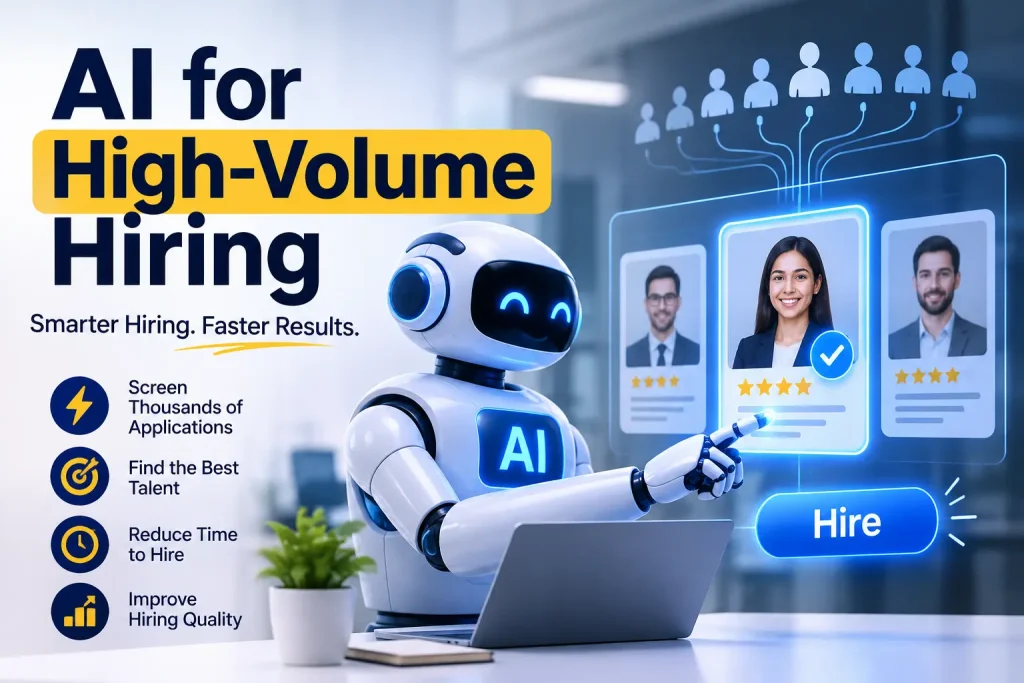
AI for high-volume hiring means using software to parse, screen, rank, schedule and update candidates so a small team can handle hundreds or thousands of applications per role. It saves the most time at screening and scheduling, but it also creates legal duties: in 2026, employers face notice, bias-audit and anti-discrimination rules in places like New York City, Illinois, California and Colorado, and court cases now target AI vendors as well as the employers that use their tools.
Quick answers
- Best use: first-pass screening, scheduling and candidate status updates, with a person deciding who is hired.
- What it will not fix: unclear job criteria, long application forms and weak job ads. Fixing those first can reduce wasted screening effort.
- Cost anchors: SHRM’s 2026 median cost per non-executive hire is $1,300. Appcast’s 2025 median advertising cost per hire is $1,053.
- Biggest risk: discrimination liability that can reach both you and your vendor. Test tools on your own applicants and keep records.
- Not legal advice: the legal summary is general information based on sources through September 2026.
High volume is no longer only a seasonal problem. Candidates now use AI to tailor and mass-submit applications, so recruiters face more resumes that look polished and reveal less. In the Criteria Corp and Lighthouse Research 2026 study of 998 hiring leaders, 92% said AI-generated resumes are commonplace, and only about a third were highly confident that resumes show a candidate’s true skills. Greenhouse’s 2025 survey of more than 4,100 job seekers, recruiters and hiring managers found that 91% of recruiters have spotted candidate deception and 34% spend up to half their week filtering spam and junk applications.
Employers respond with AI screening, which candidates distrust: a March 2025 Gartner survey found that only 26% of candidates trust AI to evaluate them fairly, as reported by Recruiting News Network. This guide shows where AI helps, where it fails, which US laws apply, what the public cost benchmarks say, and how to pilot a tool without creating avoidable legal exposure.
What counts as high-volume hiring?
High-volume hiring means filling many similar roles in a short window, or handling far more applications than a team can read and answer within a few days. Customer service, retail, healthcare staffing, logistics, hospitality and seasonal or campus drives often fit the pattern. There is no single industry threshold, so use this working test: if applications arrive faster than your team can review and reply to them, you have a volume problem that automation may help with.
What does AI actually do in high-volume hiring?
AI handles five repeatable jobs in high-volume hiring: turning resumes into structured data, matching candidates to role criteria, messaging candidates, booking interviews and reporting on the funnel. Each job has a typical failure mode, so each needs a human checkpoint. These tools usually sit on top of, or inside, an applicant tracking system (ATS), which stores applications while the AI layer decides what to do with them.
| Stage | What AI does | Typical failure | Human checkpoint |
|---|---|---|---|
| Parse resumes | Converts resumes and profiles into structured fields | Misreads unusual formats, drops credentials or career gaps | Spot-check a weekly sample of parsed records against the originals |
| Match and rank | Scores candidates against role criteria | Rewards resume polish over skill, reproduces bias from training data, can be manipulated by hidden text | Review borderline and rejected-but-qualified candidates; test on your own data |
| Message candidates | Sends acknowledgments, reminders, missing-document requests | Wrong template or time zone, no route to a human | Review templates; give every message a human contact |
| Schedule | Matches candidate and interviewer calendars | Double-booking, no path for accommodation requests | Handle exceptions manually |
| Report | Shows speed, drop-off and source quality | Measures speed, not quality of hire | Define the success metric before launch |
Two failure modes deserve attention. The first is manipulation: 65% of hiring managers in Greenhouse’s survey said they had caught applicants using AI deceptively, including hiding prompt injections in resumes, which target tools that read text with language models. The second is proxies: in the Workday case, one plaintiff alleges that the vendor’s screening tools treated employment gaps tied to medical leave as a proxy for disability. That is an allegation, not a finding, but it shows why you should ask which signals a tool uses.
Does AI screening reduce bias or add it?
The evidence is mixed and depends on the tool. In a 2024 University of Washington audit, researchers swapped 120 first names associated with white and Black men and women into more than 550 real resumes and had three open-source models rank them. The models preferred white-associated names 85% of the time versus 9% for Black-associated names, and male-associated names 52% of the time versus 11% for female-associated names. They never preferred a Black male-associated name over a white male-associated one. The researchers also noted that removing names may not solve the problem.
The limits matter. These were open-source research models, not commercial hiring products, and Salesforce said its model was released for research use only. The study does not show that any specific product is biased. It shows that you cannot assume a tool is neutral.
A simple adverse-impact check compares advancement rates between groups. Hypothetical example: 60 of 200 applicants in Group A advance (30%) and 30 of 150 in Group B advance (20%). The ratio is 0.20 ÷ 0.30 = 0.67, below the 0.80 line used in the long-standing four-fifths rule of thumb, so the tool and criteria deserve review. That rule is a screening heuristic, not a legal safe harbor, and small samples can mislead.
Which AI hiring laws apply to US employers in 2026?
No single federal statute governs AI hiring tools, so existing anti-discrimination laws apply and a patchwork of state and city rules adds notice, audit and testing duties. Where a candidate lives or where the job sits can decide which rules apply, even if your company is based elsewhere. This table covers US rules only; non-US rules such as the EU AI Act are outside the scope of this guide.
| Jurisdiction | Rule | Status | What it asks of employers |
|---|---|---|---|
| New York City | Local Law 144 (automated employment decision tools) | Enforced since July 2023 | Bias audit and candidate notice for covered tools |
| California | Civil Rights Council regulations under FEHA | Effective 1 October 2025 | Discrimination through automated-decision systems is covered; evidence of anti-bias testing, or its absence, can be considered |
| California | CPPA automated decision-making technology rules | Effective 1 January 2027 | Notice, opt-out or documented exception, and risk assessment for significant decisions including hiring |
| Illinois | HB 3773 (Human Rights Act) | Effective 1 January 2026 | AI-driven discrimination covered; applicants must be notified when AI is used in covered decisions. State rulemaking on notice details was withdrawn in June 2026 |
| Illinois | AI Video Interview Act | In force since 2020 | Consent before AI analyzes video interviews |
| Texas | TRAIGA | Effective 1 January 2026 | Bars using AI with intent to discriminate; intent must be shown |
| Colorado | SB 26-189 (replaced the 2024 AI Act) | Effective 1 January 2027 | Narrower notice and disclosure duties; state rulemaking was under way in September 2026 |
| Connecticut | SB 5 (Public Act 26-15) | Hiring-related provisions from 1 October 2027 | Plain-language disclosure when automated tools interact directly with applicants; anti-bias testing evidence may be considered |
Courts matter as much as statutes. In Mobley v. Workday, a federal court in California has allowed discrimination claims to proceed against an AI vendor on the theory that it can be liable as the agent of the employers using its tools. A March 2026 ruling rejected the argument that age-discrimination disparate-impact claims cannot cover job applicants, and a June 2026 ruling largely denied a motion to dismiss. In Kistler v. Eightfold AI, applicants argue that AI-generated candidate scores can make a vendor a consumer reporting agency under the Fair Credit Reporting Act. Eightfold denies the allegations, and as of a 24 September 2026 docket entry its motion to dismiss was still pending. No court has found that either tool discriminated or broke the law, and both cases are ongoing.
The practical lesson, drawn from Epstein Becker Green’s September 2026 analysis, is that a tool that scores, ranks or filters applicants can expose both vendor and employer, so vendor contracts and decision records matter. This section is general information based on sources through late September 2026, not legal advice. Confirm current requirements with employment counsel before you rely on a tool.
What does high-volume hiring cost, and where can AI save money?
Two public benchmarks frame the budget, and they measure different things. SHRM’s 2026 median cost per non-executive hire is $1,300, up from $1,200 in 2025. Appcast’s 2026 benchmark report puts the 2025 median advertising cost per hire at $1,053 for job-board ads, and it excludes recruiter time and other internal costs, so the two figures should not be compared directly.
| Funnel stage | Median advertising cost to reach it (Appcast, 2025) |
|---|---|
| Click | $0.83 |
| Application | $19.20 |
| Screen | $131 |
| Interview | $275 |
| Offer | $758 |
| Hire | $1,053 |
Advertising cost per screen is nearly seven times advertising cost per application ($131 versus $19.20), which suggests that most applications never reach a screen. Screening is the step where AI tools aim to save recruiter time.
More applications do not mean cheaper hiring. In Appcast’s data, technology roles had the highest apply rate in 2025, at 7.14%, yet median cost per hire rose from $1,364 to $2,795, which Appcast links partly to the extra effort of sifting through more applicants. The 2025 figure includes an expanded set of enterprise accounts; on the same accounts it was $2,782.
To test whether a tool pays off, use this formula: monthly net savings = recruiter hours saved × loaded hourly cost − (subscription + audit and monitoring costs). Hypothetical example: 25 hours × $40 = $1,000, minus $600 in tool and monitoring costs, leaves $400 a month. Replace these assumptions with your own time tracking and vendor quotes.
Fix the top of the funnel before you automate the middle
Screening software only sorts what arrives. Appcast’s benchmark shows that application design and ad quality change both the volume and quality of what arrives:
- Shorter forms win. Apply rate was 5.37% when applying took 1–5 minutes and 3.09% when it took 16 minutes or more. Typical apply time clusters at 6–8 minutes.
- Mobile matters. Depending on the occupation, mobile drives from about 28% to over 85% of applications, so avoid requiring resume uploads on a phone.
- Salary transparency helps. Jobs with a pay range had higher apply rates in all but two months of the period Appcast studied, and cost per application was generally lower.
- Freshness counts. About 53% of a job ad’s applications arrive in its first 10 days, so refresh ads when volume plateaus.
- Judge sources by outcomes. A channel that looks costly per application can be cheaper per interview or offer, so track those costs, not only cost per click.
Appcast is a recruitment-marketing vendor, and its data covers long-apply ads from nearly 1,200 US employers and excludes easy-apply ads, so treat the figures as benchmarks, not promises.
Each fix maps to a marketing channel. A fast, mobile-friendly careers page and short application form come from web development. PPC advertising and social media marketing buy visibility with active and passive candidates, and SEO helps careers and job pages appear when candidates search; adding JobPosting structured data can help eligible roles appear in Google’s job listings. Content marketing answers pay, schedule and culture questions before an application, and email marketing keeps strong runners-up warm for the next opening.
How do you pilot AI screening safely?
Run a controlled pilot in six steps before you let any tool reject candidates on its own.
- Pick one role family. Choose a role with steady volume, for example 100 or more applicants a month, and write three to five must-have criteria tied to job tasks, not proxies such as school names or neighborhoods.
- Baseline first. Record time to first response, time to shortlist, time to fill and recruiter hours per hire for the last 60 to 90 days. Without a baseline, savings are anecdotes.
- Run in shadow mode for two to four weeks. Let the tool rank applicants while recruiters screen as usual. Compare the lists and review every candidate the tool rejected but a recruiter advanced.
- Check selection rates. Where you lawfully hold the data, compare advancement rates across groups. Pause and investigate if one group’s rate falls below four-fifths of the highest group’s rate.
- Add candidate safeguards. Tell candidates that AI is used, offer an accommodation or human-review route, and make sure a person reviews borderline rejections.
- Go live with a kill switch and records. Log each decision and the version of the criteria, review results weekly, and re-test whenever criteria change. Several regimes treat testing and documentation as evidence.
How do you evaluate an AI recruiting vendor?
Feature lists look alike. The answers to these questions do not.
| Ask the vendor | Why it matters |
|---|---|
| Can you show the reasons behind each candidate’s score? | Recruiters cannot check, and candidates cannot challenge, a score with no explanation |
| What data does the tool use beyond the application? | Compiling third-party data is the core of the Eightfold consumer-reporting claim |
| When was your latest independent bias audit, and can we see it? | Required for covered tools in New York City and useful evidence elsewhere |
| Can we set and see criteria and weights? | Lets you document job-related criteria and track changes by version |
| What happens to candidate data, and for how long? | Retention and deletion duties can vary by state |
| How does the contract allocate liability and audit cooperation? | Epstein Becker Green warns that silence in vendor contracts is itself a compliance risk |
| How does it handle career gaps, non-standard resumes and hidden text? | Tests the failure modes listed above |
| Does it integrate with our ATS and calendars? | Weak integrations push manual work back onto recruiters |
If you are considering a custom build, note that a custom tool carries the same legal duties as a bought one. How to work with a software agency and how to hire a dedicated development team cover the practical steps of briefing and managing a build. The same applies to general-purpose AI assistants: whichever model you use, the legal duties above cover how you use it in hiring decisions.
What should stay with people?
Keep these decisions with a person: the final hiring decision, every borderline or negative call on a qualified candidate, accommodation requests, offers and negotiation, and any exception the tool flags. Treat AI output as a recommendation to check, not a verdict. A human review that always agrees with the tool is a rubber stamp, and Epstein Becker Green advises against letting AI recommendations become one. Candidates notice, too: Gartner’s survey found that only 26% trust AI to evaluate them fairly, so a plain notice and a human route can ease distrust.
Frequently asked questions
What is AI for hiring?
It is software that uses machine learning and language models to automate recruiting tasks such as parsing resumes, ranking candidates, messaging applicants and scheduling interviews. A recruiter or hiring manager still makes, and is legally responsible for, the hiring decision.
Can AI handle high-volume recruitment?
Yes, for repeatable steps like first-pass screening, status updates and scheduling. It handles volume well but not judgment, so high-volume teams pair it with human review of borderline cases and regular bias testing.
How does AI candidate screening work?
The tool turns each resume into structured data, compares it with the role criteria you set, scores or ranks the candidate, and moves those above a threshold into a recruiter queue. The quality of the criteria, and whether scores come with reasons, decide whether the result is reliable and defensible.
Is it legal to use AI to screen job candidates in the US?
Generally yes, but existing federal anti-discrimination laws still apply to the outcomes, and some places add notice, audit or testing duties. These include New York City, Illinois, California, Colorado from 2027 and Connecticut from late 2027. This is general information, not legal advice.
Does AI reduce bias in hiring?
Not automatically. A 2024 University of Washington audit found strong racial and gender preferences in three open-source models, while structured, job-related criteria can improve consistency but do not guarantee fair outcomes. Test any tool on your own applicants and repeat the test when criteria change.
Do I have to tell applicants I use AI?
In some places, yes. New York City and Illinois require notice for covered uses, and Colorado and Connecticut add disclosure duties from 2027. Even where it is not required, a plain-language notice and a human-review route are sound practice.
Should a small business use AI for hiring?
Only when volume justifies it. As a rule of thumb, if you handle a few dozen applicants per role and answer each within days, a structured manual process may be enough. Consider AI when response times slip or recruiters spend most of the week on screening and scheduling.
Conclusion
Use AI to clear the first pass, not to make the decision. Start where volume is highest, measure against a baseline, test for adverse impact on your own applicants, and fix application design before buying more clicks or more software. If you want help with the marketing side of high-volume hiring, including job-ad campaigns, a faster careers page and follow-up emails, contact us.