
Key Takeaways
- An AI agent is software that works toward a goal on its own. It does not just answer. It acts.
- Agents run in a loop: perceive, reason, act, and learn. This loop lets them finish multi-step tasks.
- Agent types range from simple reactive agents to advanced learning and multi-agent systems.
- A model creates content. An agent uses tools, keeps memory, and takes real action.
- Businesses value agents for speed, 24/7 operation, and easy scaling.
- Agents need human oversight because they can make mistakes, create security risks, or act out of bounds.
What Are AI Agents?
In plain words: an AI agent is software that works toward a goal on its own.
Ask, What are AI agents? and you will get the same idea. They are semi-autonomous systems that look at their environment, make choices, and take action to finish a task. A normal AI model only makes output. An agent goes further. It plans, reasons, and acts. It connects to tools, data, and other systems to get the job done.
Here is the simplest way to see the shift. A passive AI model waits for you to ask. Then it answers. An active AI agent, sometimes called an autonomous AI agent, starts working and completes a whole workflow by itself. If you want a one-line AI agent definition, use this: an AI agent is software that takes a goal and works until the job is done.
Think of it like this. A chatbot is a helpful assistant who replies to each question. An AI agent is more like a colleague you brief once with a goal. Then that colleague figures out the steps and finishes the work.
The numbers show this is not hype. Gartner predicts that 40% of enterprise applications will include task-specific AI agents by the end of 2026, up from less than 5% in 2025 (Gartner, August 2025). Grand View Research values the global AI agents market at $10.9 billion in 2026, up from $7.6 billion in 2025. It projects the market to reach $182.9 billion by 2033 (Grand View Research, 2025).
The practical result is what matters. You give an agent a goal. It works out the steps, takes action, checks the result, and finishes. No one has to babysit it.
How Do AI Agents Work?
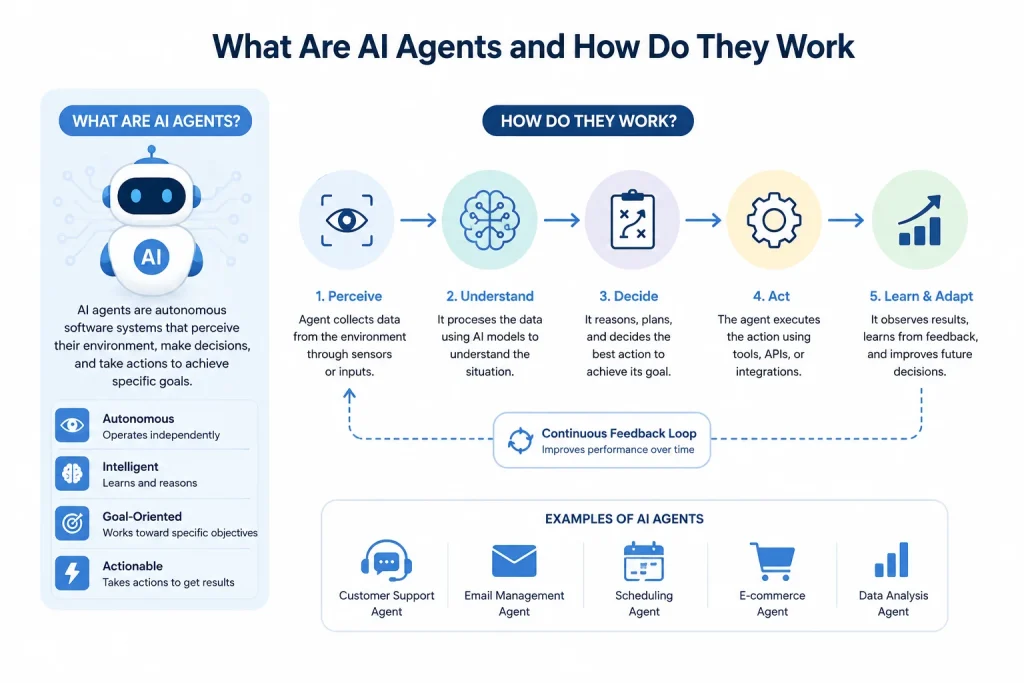
Answer: AI agents run in a simple loop. They perceive, reason, act, and learn. Then they repeat until the task is done.
The easiest way to understand AI agents is to watch the loop. It has four steps.
Step 1: Perceive. The agent takes in information. This can come from an API, a database, or a message from you.
Step 2: Reason. The agent uses its brain, which is a large language model, to plan the next move. It breaks a big goal into small steps.
Step 3: Act. The agent calls a tool. It might search the web, send an email, or update a file.
Step 4: Learn. The agent checks what happened and fine-tunes its approach. Then it loops back to reason again.
The agent keeps going until the goal is met. Or it stops and asks a human for help.
Here is a real example. A customer says, “My order never arrived.” The agent looks up the order. It checks the delivery status. It finds the delay. It sends a replacement. It updates the account. It tells the customer it is done. Nobody had to guide it step by step.
IBM shared a business case where this loop paid off. An insurance client cut contract review time from 90 minutes to 45 minutes using a multi-agent system for legal research (IBM, 2025). That is a real outcome you can measure.
Want a mental image? Picture an AI agent loop like a person cooking a new recipe. They read the instructions (perceive). They decide the steps (reason). They chop and cook (act). They taste the food and adjust the spices (learn). Then they repeat until the dish is right.
Types of AI Agents
Answer: the main types of AI agents are reactive, goal-based, utility-based, and learning agents. Each one handles a different level of complexity.
You do not need to memorize all the types of AI agents to use them. But knowing them helps you pick the right tool. Here are the core AI agent types.
Reactive Agents
A reactive agent is the simplest. It reacts to what is happening right now. It keeps no memory. It does no long-term planning.
A basic customer service bot that answers common questions is a good example. Reactive agents work well when the task is simple and speed matters more than thinking.
Goal-Based Agents
A goal-based agent plans toward a target. It checks its options and picks the one that gets it closer to the goal.
Navigation apps are a great example. They look at routes and choose the one that reaches your destination. Scheduling tools work the same way.
Utility-Based Agents
A utility-based agent does not just reach a goal. It reaches it in the best possible way. It weighs different options and picks the one with the most benefit.
Think of a navigation app that avoids both tolls and heavy traffic. That agent balances two priorities and chooses the best overall route.
Learning Agents
A learning agent improves over time. It watches what works, takes feedback, and adapts. Its internal model keeps updating.
Learning agents shine in situations that change a lot, where fixed rules cannot cover every case.
AI Models vs AI Agents: What’s the Difference?
People often compare AI agents with AI assistants and chatbots, so it helps to separate all three terms. Here is the core difference between an AI model and an AI agent.
| AI Model | AI Agent |
| Creates output, like text or images | Takes action in a real environment |
| Usually has no memory | Keeps context and memory |
| One-step answer | Multi-step planning |
| Passive, waits for a prompt | Autonomous and proactive |
| Limited tool use | Actively uses APIs and tools |
An AI model answers. An AI agent acts. That difference changes how you use them in business. You ask a model a question. You give an agent a whole job.
What Makes AI Agents Autonomous?
Here is what lets an agent work on its own.
- Independent execution. The agent acts without you prompting it at every step.
- Tool integration. It uses outside systems like APIs, databases, and software.
- Memory. It remembers past steps so later decisions build on earlier ones.
- Feedback loops. It changes its behavior based on what worked before.
- Multi-step reasoning. It solves problems that take planning and repetition.
Put these together and an agent can handle work that used to need a person’s full attention.
Benefits of AI Agents for Businesses
Why are so many teams choosing to use AI agents? Here are the main reasons.
They save time. Agents handle routine and complex workflows. Your team is freed up for work that needs real judgment and creativity.
They decide faster. Agents analyze data and act in real time. This matters in fast-moving areas like logistics, finance, and customer support, where any delay costs money.
They never sleep. Agents work 24/7 without getting tired. A support agent at 3 AM is as sharp as one at 3 PM.
They scale easily. When work grows, agents take on more demand without a big jump in cost. You do not have to hire a crowd.
The data backs this up. PwC surveyed 300 senior executives and found 79% say AI agents are already being adopted in their companies. Of those adopters, 66% report higher productivity and 57% report cost savings (PwC, 2025). Deloitte’s survey of more than 3,000 leaders found two-thirds (66%) report productivity gains from AI (Deloitte, 2026). These are measured results, not guesses.
Real-World Applications of AI Agents
AI agents are not science fiction. They work in production today, across many industries.
Banking and Financial Services
Agents do transaction monitoring and spot fraud. They flag risks and start verification. They help with credit decisions and read market data.
Insurance
Agents process claims. They check submissions, confirm coverage, spot fraud, and approve simple cases quickly.
Healthcare and Life Sciences
Agents support diagnostics and handle admin work like scheduling and coding. They speed up research by analyzing large datasets.
Retail
Retailers use agents for inventory, pricing, and personalization. Agents forecast demand and adjust prices in real time.
Cybersecurity
Agents watch systems and detect threats fast, often quicker than any human team.
Manufacturing
Agents improve logistics, watch for problems, and automate order fulfillment.
Customer Support
Agents resolve complex queries from start to finish. They understand intent, pull knowledge, and solve issues.
Customer service is the biggest use case today. LangChain’s survey found 26.5% of teams run agents for customer service, ahead of research and data analysis at 24.4% (LangChain, December 2025). That is the first place most businesses see a payoff.
AI Agent Examples for a Small Business
You do not need to be a big company to benefit. Here are AI agent examples a small business can use right now.
- Customer support. An agent answers questions and processes simple requests. Your team handles the hard cases.
- Scheduling. An agent finds times, books calls, and sends reminders.
- Product content. An agent writes product descriptions from your data, keeping your voice.
- Data entry. An agent reads forms and updates records, saving hours of typing.
- Sales follow-up. An agent sends follow-ups and updates your customer list.
- Research. An agent gathers competitor details and summarizes them.
Each one saves real time. And time is money.
Risks and Limitations of AI Agents
Agents bring real opportunities, but they also come with real AI agent limitations. You need to manage them.
They can get facts wrong. Agents may state false information with total confidence. This is called hallucination. It can push decisions in the wrong direction.
They can act out of line. Because agents act on their own, they can take a step you did not mean. That is hard to undo.
They can create security risks. If an agent reaches your sensitive systems with weak controls, data can leak.
They can slip past rules. You must keep agents inside legal and ethical limits, which is tricky when the system is complex.
The research is clear. LangChain found quality is the top blocker, cited by 33% of teams (LangChain, 2025). McKinsey reports security and risk are the biggest barrier to scaling agentic AI, cited by nearly two-thirds of large organizations (McKinsey, 2025). And Deloitte found only 21% of companies have mature governance for autonomous agents (Deloitte, 2026). That gap between intent and control is wide.
How to Keep AI Agents Safe
You can enjoy the benefits of agents and still stay safe. Here are the standard practices.
- Human-in-the-loop. A person reviews the agent’s work and approves big decisions before they happen.
- Real-time monitoring. Dashboards show what the agent is doing so you can spot problems.
- Guardrails. You set rules for what the agent can access and do.
- Intervention mechanisms. Automatic shutdown triggers stop an agent if it takes forbidden actions.
The goal is balance. Let the agent run efficiently, but keep control and visibility.
This balance is more important than the hype. A widely cited MIT study found 95% of enterprise generative-AI pilots delivered no measurable profit-and-loss impact (MIT NANDA, 2025). McKinsey reports only 23% of organizations are scaling agents in even one function, and fewer than 10% across multiple (McKinsey, November 2025).
The lesson is not to avoid agents. It is to use them with clear goals, clean metrics, and a human who can step in. Organizations that redesign their workflows around AI are three times more likely to see real returns (McKinsey, 2025).
How to Create or Use Your First AI Agent
You do not need deep coding to get started. Here are three paths.
Path 1: Use an existing agent. Start with ChatGPT or Claude and give them tools like web search. This is cheap and the fastest way to learn.
Path 2: Use no-code automation. Tools like Zapier and n8n build workflows with clicks. No code needed. Many small teams start here.
Path 3: Build with a framework. If you code, use tools like LangChain or CrewAI to make a custom agent. This gives the most control but takes the most work.
Which should you choose? The research favors buying. MIT found vendor partnerships succeed about 67% of the time, while internal builds succeed only about a third of the time (MIT, 2025). Menlo Ventures found 76% of enterprise AI use cases are bought, not built (Menlo Ventures, 2025). So start with a proven tool. And whatever you pick, keep a human in the loop.
The Future of AI Agents
The future of AI agents is still early, but the direction is clear. Systems are getting more capable, more collaborative, and more tied into our physical world. This move toward agentic AI is one of the most watched shifts in the industry.
Multi-agent collaboration. Many specialists will work together on one big task. Each agent handles its part and shares information with the others.
Robotics integration. Agents will move beyond software into the real world. This will affect manufacturing, delivery, and healthcare.
More regulation. As agents become more capable, the rules guiding them will tighten. Policymakers want AI that is safe, ethical, and clear.
The numbers point up fast. Gartner predicts that by 2028, a third of user experiences will shift from apps to agentic front ends. By 2029, at least half of knowledge workers will learn to work with, govern, or create AI agents on demand (Gartner, 2025). This is a structural change, not a passing trend.
Frequently Asked Questions About AI Agents
Are AI agents the same as chatbots?
No. A chatbot handles conversation. It answers questions and guides users. An AI agent plans, decides, and completes multi-step tasks. Think of a chatbot as a respondent and an AI agent as a doer.
How are AI agents different from large language models?
An LLM creates output when you prompt it. AI agents, including large language model agents, connect to tools, retrieve data, call APIs, store memory, and act on all of it. Agents do not just answer. They act.
Is ChatGPT an AI agent?
Not fully. ChatGPT is a chatbot built on a large language model. It acts more like an agent when you give it tools such as web search and file analysis. But it still waits for your prompt. It is not fully autonomous.
What are the 7 types of AI agents?
The common types are reactive, model-based, goal-based, utility-based, learning, multi-agent, and human-in-the-loop agents. They range from simple responders to systems that learn and team up.
What are the top AI agents you can use today?
Good options include ChatGPT and Claude with tools, Google Gemini, a support agent like Intercom Fin, and an automation agent like Zapier or n8n.
Can AI agents operate without human supervision?
They can run on their own. But the most responsible use keeps some human oversight for safety, accuracy, and alignment with the goal. Most businesses keep a person in the loop for important steps.
Which tasks are best for AI agents right now?
Pick tasks that are repetitive, high volume, rule-based, or research-heavy. That includes support triage, data entry, reports, lead research, and scheduling. Tasks that need deep relationships or ethical judgment stay with humans.
What are the risks of fully autonomous systems?
They can make wrong choices, lose control, expose sensitive data, and create accountability problems. That is why governance and oversight matter.
Are AI agents safe for high-stakes environments?
They can be, with strong governance, clear guardrails, testing, and real-time monitoring. The higher the stakes, the stronger the safeguards. Only 21% of companies have mature governance for autonomous agents today (Deloitte, 2026). The rest should move carefully.
Conclusion
AI agents are a real shift. They move from answering questions to finishing work. They perceive, reason, act, and learn. They use memory, tools, and planning to handle tasks that used to need humans.
The types of AI agents range from simple reactive agents to advanced learning and multi-agent systems. Agents act where models only respond. That autonomy, tool use, and memory make them powerful for any business. The best agent for you depends on the task you give it.
They bring real benefits: speed, 24/7 work, fewer repetitive tasks, and easy scaling. They also bring real risks: mistakes, security gaps, and governance needs. The answer is not to avoid them. It is to use them with human oversight and clear guardrails.
The research is consistent. Adoption is rising fast, but the value goes to those who plan. Teams that pair agent power with clear goals and a human in the loop see the best results. Teams that deploy without governance see pilots fail.
Your next step is simple. Pick one task an agent can handle. Try a ready-made agent or a no-code tool. Keep a human in the loop. Measure what you save, then grow.