
Publishing original content has become harder than simply avoiding copy-and-paste plagiarism. Writers now research dozens of competing pages, work with freelancers, update old articles, use AI-assisted editing tools, and frequently cover topics where the same facts and phrases appear across hundreds of websites. That creates plenty of room for accidental similarity.
The best plagiarism checker for writers should therefore do more than return a percentage. It should identify the matching source, show exactly which passage caused the match, distinguish harmless similarities from suspicious duplication, and ideally recognize rewritten or paraphrased material.
That matters even more when choosing a plagiarism checker in 2026. Basic exact-match scanning is no longer enough for professional publishing workflows. Writers, bloggers, agencies, editors, and website owners increasingly need plagiarism detection tools capable of reviewing web content, partial matches, paraphrasing, and internal duplication before an article goes live.
After comparing the current capabilities and intended use cases of leading platforms, five tools stand out for professional writers: Originality.ai, Copyscape, Grammarly, Quetext, and Copyleaks. Each solves a slightly different originality problem, so the right choice depends on how and where you publish.
Table of Contents
Why Writers Need Better Plagiarism Detection Tools in 2026
Plagiarism is not limited to deliberately stealing someone else’s paragraphs. It can also happen when a writer follows source material too closely, forgets to attribute an idea, reuses previously published work without realizing it, or produces a paraphrase that remains structurally similar to the source. Oxford University, for example, describes plagiarism broadly as presenting material or ideas from another source as one’s own without full acknowledgement.
That is why a modern content originality checker has become part of the editorial quality-control process rather than merely an academic tool.
Imagine researching five competing articles before writing a 2,500-word guide. You may remember a particular phrase without remembering where you saw it. A freelancer may submit an article containing several rewritten paragraphs from another website. An AI-assisted draft may contain common wording that resembles existing pages. Even your own website can create problems when several articles repeatedly use the same introductions, product descriptions, or explanations.
A strong duplicate content checker gives the editor a chance to investigate these similarities before publication.
It is also important to understand what a similarity percentage actually means. A match does not automatically prove plagiarism. Product names, quotations, statistics, legal terminology, common definitions, and standard phrases can legitimately appear on multiple websites. A plagiarism report should therefore be treated as evidence for review rather than an automatic guilty-or-innocent verdict.
What Makes the Best Plagiarism Checker for Writers?
The best plagiarism checker for writers should combine useful source coverage with reports that a working editor can actually understand.
Database size matters, but database size alone does not determine usefulness. A checker may scan billions of pages yet still struggle with heavily paraphrased passages. Another tool may excel at identifying exact web copies but offer limited semantic matching. That distinction matters when selecting an online plagiarism checker for blogs and commercial content.
Paraphrase detection has become particularly important. Copyleaks, for example, says its plagiarism technology can identify both identical and paraphrased matches across web pages, academic sources, and document libraries. Quetext uses its DeepSearch technology with natural-language and statistical analysis, while Originality.ai specifically markets detection for paraphrase, patchwork, mosaic, and other less obvious forms of plagiarism.
Reporting quality matters just as much. Writers need to know what matched, where the source is located, and whether revision or citation is necessary. Workflow features such as file uploads, shareable reports, team access, API connections, private indexes, and batch checks become increasingly valuable once a publisher handles dozens or hundreds of articles.
Quick Comparison of the 5 Best Plagiarism Checkers for Content Writers
The following comparison focuses specifically on editorial, blogging, SEO, agency, and professional writing workflows rather than ranking the platforms for academic institutions.
| Plagiarism Checker | Best Use Case | Major Strength | Paraphrase Detection | Best For |
| Originality.ai | Professional publishing and content teams | Combined plagiarism, AI, readability and editorial checks | Strong focus | Agencies, editors, publishers |
| Copyscape | Finding copied web content | Simple web duplication detection and monitoring | More focused on web duplication | Bloggers, SEOs, site owners |
| Grammarly | Writing and originality in one workflow | Grammar, writing improvement and plagiarism checking | Useful, but originality is part of a broader writing suite | Freelancers and individual writers |
| Quetext | Easy-to-read originality reports | DeepSearch, similarity feedback and citation support | Yes | Writers, students and small teams |
| Copyleaks | Advanced similarity and paraphrase analysis | Identical, similar and paraphrased detection | Strong focus | Businesses, agencies and technical teams |
This table should not be interpreted as a laboratory accuracy ranking. The platforms use different databases, algorithms, pricing structures, and testing methods, and some published accuracy claims come from the vendors themselves. A useful plagiarism checker for articles is ultimately the one that catches the types of duplication most relevant to your workflow.
Originality.ai: Best Overall Content Originality Checker for Professional Publishers
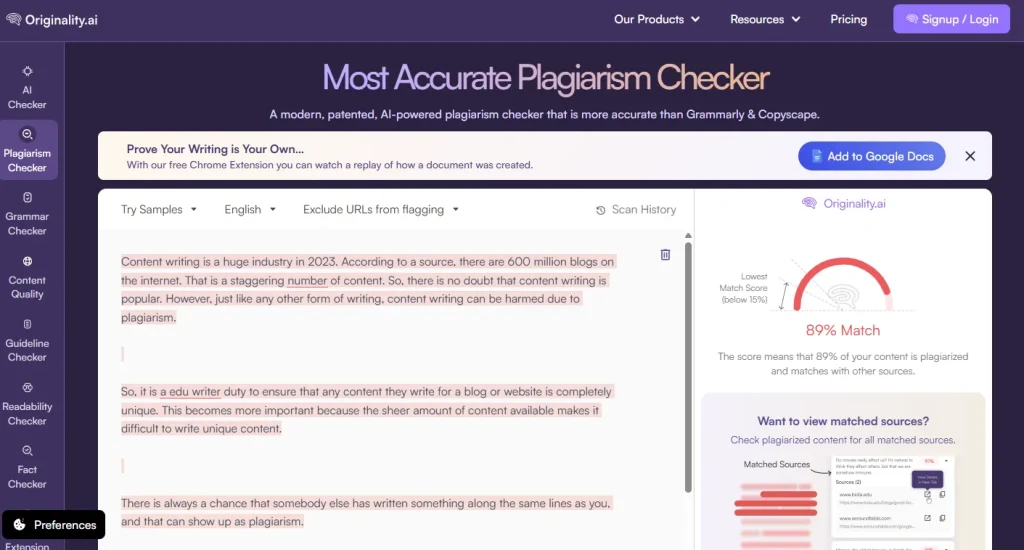
Originality.ai is one of the most writer- and publisher-focused options in this comparison. Its plagiarism checker is specifically positioned toward marketers, writers, editors, blogs, and web publishers rather than being designed primarily around student submissions.
The platform allows users to paste text, upload content, or scan a URL. Its broader editorial suite can combine plagiarism scanning with AI detection, readability, grammar, content quality, and fact-checking features depending on the selected workflow. Originality.ai also promotes detection of global paraphrase, patchwork, mosaic, and unintentional plagiarism.
This combination makes it particularly attractive when a content manager receives material from multiple writers. Instead of using a separate content originality checker, AI detector, and readability application for every submission, several checks can be handled within the same ecosystem.
Originality.ai also offers shareable reporting and a Chrome extension that works with web pages and Google Docs-oriented workflows. Its official pricing page currently offers subscription-based options, including a Pro plan, although prices and allowances can change and should always be checked before purchasing.
The main consideration is that Originality.ai provides more functionality than some writers need. Someone publishing two personal blog posts a month may find a simpler online plagiarism checker sufficient. A content agency managing several writers, however, can benefit much more from the additional quality-control features.
For professional editorial operations, it is my strongest overall choice from this group because the product is built around the exact problems digital publishers face: originality, AI-assisted content review, quality control, and repeatable reporting.
Copyscape: Best Duplicate Content Checker for Bloggers and Websites
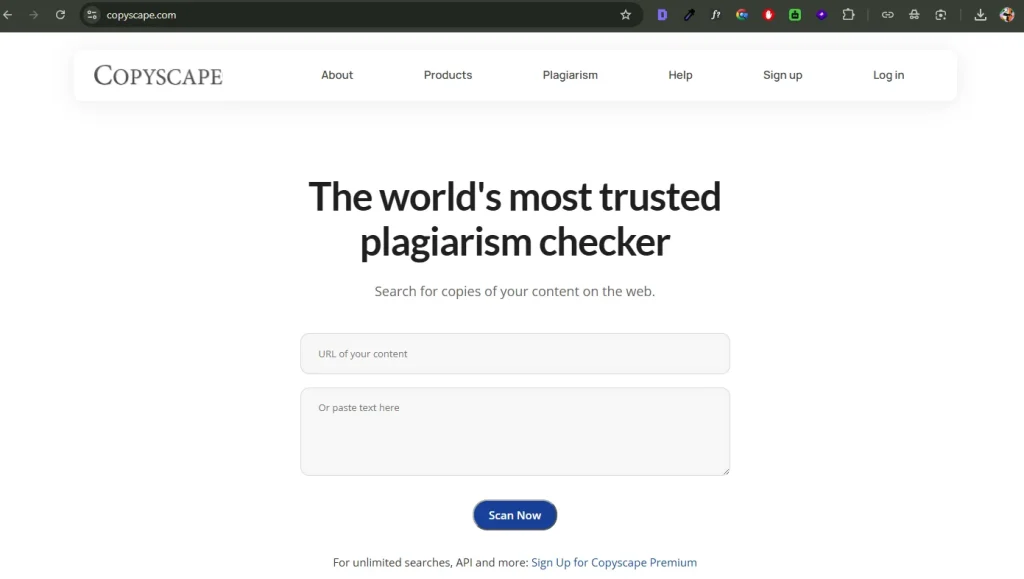
Copyscape has remained closely associated with online duplicate-content checking because its core purpose is straightforward: find copies of content on the web.
Its free service can search for copies of already published web pages, while Copyscape Premium allows writers to paste unpublished text or upload files before publication. Premium also offers batch searching, API access, private indexes, case tracking, team functionality, and WordPress integration.
That makes Copyscape particularly practical as a plagiarism checker for bloggers.
Consider a blogger outsourcing twenty articles per month. The editor may not need academic citation management, AI authorship analysis, or complicated dashboards. The immediate question is simpler: “Does a significant portion of this article already exist somewhere online?”
Copyscape handles that workflow with relatively little friction.
Its Copysentry product serves a different but related purpose. Instead of checking only before publication, Copysentry can monitor published pages and notify site owners when new copies are discovered online.
That makes Copyscape useful on both sides of the plagiarism problem. A writer can check whether submitted content was copied from elsewhere, while a publisher can also watch for other sites copying their own work.
The trade-off is that writers specifically concerned about sophisticated semantic rewriting may prefer a dedicated paraphrase detection tool such as Copyleaks or a broader originality platform such as Originality.ai. Copyscape remains especially compelling when the primary concern is straightforward web duplication and content theft.
Grammarly: Best Plagiarism Checker for Writers Who Also Need Editing Help
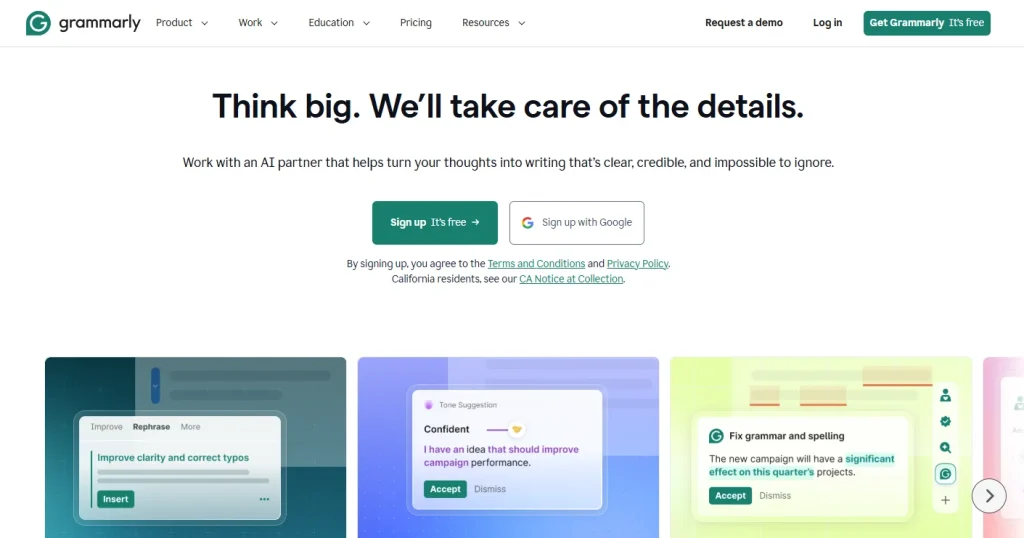
Grammarly approaches originality differently because plagiarism checking is only one part of a much larger writing environment.
Its plagiarism checker compares writing with web pages and academic material, including ProQuest databases, and highlights passages that may require citation. Grammarly also provides grammar, spelling, clarity, tone, rewriting, and other writing-support features.
That combination is valuable for a freelance writer who wants to move from drafting to proofreading and originality checking without jumping between several applications.
Suppose you have finished a 1,800-word client article. You can first correct awkward sentences, clean up grammar, improve readability, and then use the plagiarism feature to investigate questionable similarities. That creates a smoother workflow than using an isolated plagiarism checker for articles followed by a separate editing platform.
Grammarly also now integrates AI detection and plagiarism-related functionality within supported paid plans and environments, further reflecting how originality checking has expanded beyond simple copy matching.
Its weakness is essentially the other side of its strength. Grammarly is primarily a comprehensive writing assistant. If plagiarism detection is your organization’s most important requirement, a specialist platform may provide more specialized controls.
For independent writers who already use Grammarly daily, however, its plagiarism capabilities can be extremely convenient. Instead of buying another tool purely for occasional scans, it may make sense to keep proofreading and originality checking in one environment.
Quetext: A User-Friendly Online Plagiarism Checker With DeepSearch
Quetext is another strong option for writers who want detailed originality feedback without an overly complicated interface.
Its plagiarism technology is built around DeepSearch, which Quetext describes as combining natural-language processing, statistical analysis, contextual scoring, and access to a large collection of sources. The platform also uses ColorGrade feedback to differentiate exact, near-exact, and fuzzier similarities.
That presentation can be helpful when reviewing an article containing multiple types of matches.
A normal duplicate content checker might simply report that 12 percent of a document resembles existing material. That number alone does not tell the writer what to do next. Quetext’s emphasis on visually separating match types and displaying source snippets makes the report easier to investigate.
The service also combines plagiarism checking with tools including citation assistance, grammar checking, AI detection, source exclusion, report downloads, and file-upload functionality depending on the chosen plan.
For bloggers and general content writers, citation generation may not be required for every assignment, but source visibility is still valuable. If a sentence is too close to another publisher’s explanation, you can return to the original source, verify the information, and rewrite the passage based on genuine understanding rather than mechanically swapping synonyms.
That is the correct role of a content originality checker: helping a writer investigate questionable passages, not merely chasing a zero-percent similarity score.
Copyleaks: Best Paraphrase Detection Tool for Advanced Similarity Checking
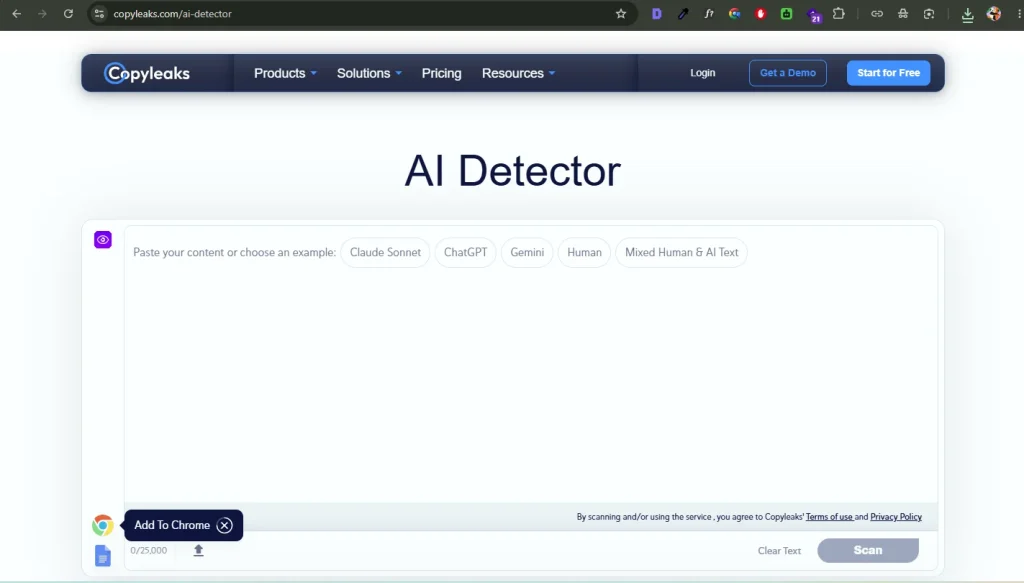
Copyleaks deserves serious consideration when rewritten material is a major concern.
Its plagiarism checker is designed to find duplicate content as well as similar and paraphrased material. Its API documentation says the system can compare submitted content against billions of web pages, academic sources, and private document libraries while identifying identical and paraphrased matches. It can also work with text, documents, and source code.
For content agencies, this addresses an increasingly common problem.
Imagine receiving an article that appears completely original because every sentence has been rewritten. When compared manually with a competing article, however, you discover that the writer preserved the competitor’s argument order, examples, ideas, and sentence structure while changing individual words.
A basic exact-match plagiarism detection tool may overlook much of this. A system designed to evaluate semantic similarity and paraphrasing has a better chance of identifying passages worth human review.
Copyleaks also provides AI-detection products, grammar tools, APIs, and business-oriented integrations. Its pricing currently includes personal and professional subscription options, while education and enterprise offerings are available separately.
For a solo blogger, this may be more technology than necessary. For agencies, organizations, software companies, publishers, or teams handling substantial volumes of content, Copyleaks becomes much more interesting.
Which Plagiarism Checker for Bloggers Should You Choose?
There is no single answer because “blogger” can describe very different publishing operations.
If you operate a small website and mostly want to know whether freelance submissions contain text copied from existing pages, Copyscape is difficult to ignore. Its workflow is directly aligned with web duplication, and its Premium product supports pasted text, file uploads, batch searches, private indexes, APIs, and WordPress-related workflows.
If you run a content agency or large publication where originality is part of a broader editorial review, Originality.ai is more comprehensive. Writers who want editing and plagiarism checking together may find Grammarly more convenient.
Quetext makes sense when you value clear similarity reports and citation-oriented tools, while Copyleaks deserves attention when detecting paraphrasing and more complex similarities is a priority.
The important point is to choose your plagiarism checker for bloggers around your risk rather than around a generic “best tool” label.
A personal blogger and a 40-person content agency should not necessarily use the same system
Why Paraphrase Detection Matters More Than Exact Matching
Traditional plagiarism checking depended heavily on identifying identical strings of text. That remains useful, but modern rewriting makes the problem more complicated.
A writer can change vocabulary without substantially changing the source material. A sentence can be reorganized while preserving its distinctive structure. Several sentences from different sources can be combined into one paragraph. This is sometimes described as patchwork or mosaic plagiarism.
That is why a modern paraphrase detection tool can provide additional value.
Copyleaks explicitly states that its system detects paraphrased matches, while Originality.ai also promotes detection for paraphrase and patchwork plagiarism. Quetext’s DeepSearch technology uses contextual and fuzzy matching rather than relying solely on exact duplication.
Still, no automated checker should replace editorial judgment.
If software marks a paraphrase, read both passages yourself. Ask whether the writer independently explained the idea, properly attributed the source where necessary, or merely disguised someone else’s wording.
The best plagiarism checker for writers helps you ask better questions. It cannot make every editorial decision for you.
Free vs. Paid Online Plagiarism Checker: Which Is Better?
Free plagiarism tools can be useful for quick checks, but professional writers should pay attention to what the free version actually includes.
Some free services restrict word counts, source access, reporting, or the number of scans. Premium products may add deeper databases, downloadable reports, file uploads, APIs, private repositories, source exclusion, team management, or advanced similarity detection.
For example, Copyscape offers a free method for checking published pages, while its Premium service provides pasted-text checks, uploads, batch searching, private indexes, and other professional features. Quetext similarly separates free functionality from more extensive paid allowances and reporting tools.
The cheapest online plagiarism checker is therefore not automatically the least expensive option in practice.
An agency editor who spends an extra twenty minutes interpreting a poor report on every article may lose far more money in editing time than the cost of better software. On the other hand, a hobby blogger publishing once every few weeks may have little reason to purchase an enterprise-style platform.
Choose according to publishing volume, client expectations, team size, and the financial consequences of publishing duplicated material.
How to Use a Plagiarism Checker for Articles Properly
A plagiarism checker should be the beginning of the originality review, not the end.
Run the scan after the article is substantially finished. Scanning a rough draft filled with copied research notes will naturally generate large numbers of matches and may not tell you anything useful.
When the report is ready, examine the sources behind the similarities instead of focusing only on the total percentage. A 15 percent similarity score made up of harmless product names, cited quotations, and standard terminology may require less attention than a 5 percent score containing one nearly duplicated paragraph.
Then examine intent and context.
If a sentence states a widely known fact, rewriting it repeatedly simply to satisfy a duplicate content checker can make the article worse. If the matching passage contains another writer’s distinctive explanation, example, argument, or phrasing, it deserves much closer attention.
Rewrite questionable sections from understanding rather than performing synonym replacement. Read the source, close it, consider the underlying idea, and explain it naturally in the context of your own article. Add attribution when the idea, data, quotation, or claim requires it.
Finally, scan the revised version again.
That second check is particularly useful when the first report identified substantial similarities.
My Opinion: Which Tool Would I Pick for Content Writing?
If I were building a professional editorial workflow today, I would not choose a plagiarism checker solely because it produces the lowest or highest similarity percentage.
For a serious content agency or publishing team, I would lean toward Originality.ai as the best plagiarism checker for writers from this particular group because its workflow combines several checks that digital publishers already perform. The value is less about one headline feature and more about having plagiarism review, AI-related review, readability, and other editorial controls available within the same ecosystem.
For straightforward blog-content checking, I would still keep Copyscape in consideration. It is simple, familiar, focused on web duplication, and particularly useful when the question is whether an outsourced article already exists elsewhere online.
If my biggest concern were sophisticated rewriting, I would look closely at Copyleaks because paraphrased similarity is explicitly central to its plagiarism technology.
For an individual writer who already relies heavily on Grammarly, switching to an entirely separate platform may not be necessary. Convenience matters. A tool you consistently use before every submission is more useful than a theoretically more advanced system you rarely open.
That is the distinction. I think many best plagiarism checker 2026 comparisons miss: workflow fit matters almost as much as the feature list.
Common Mistakes Writers Make With Content Originality Checkers
One common mistake is trying to achieve zero similarity at any cost.
Original writing does not mean every sequence of words must be unique in the history of the internet. Names, product specifications, technical phrases, quotations, legislation, references, and common expressions naturally create overlaps.
Another mistake is automatically rewriting every flagged passage.
The content originality checker is showing similarity, not necessarily misconduct. Before editing, inspect the matching source and ask why the similarity exists.
Writers also make the opposite mistake: dismissing low similarity scores without checking the underlying matches. One copied paragraph can be much more serious than dozens of tiny matches scattered across an article.
Finally, do not assume AI detection and plagiarism detection are interchangeable. An AI detector estimates characteristics associated with machine-generated writing, while a plagiarism checker searches for similarity with existing sources. A piece can be human-written and plagiarized, AI-generated and original in wording, or contain elements of both.
Treat them as different editorial signals.
Best Plagiarism Checker for Writers: Final Verdict
The best plagiarism checker for writers in 2026 depends on what you publish and what type of duplication you are trying to prevent.
Originality.ai is the strongest all-around option in this comparison for publishers, editors, and content teams that want originality checking within a wider quality-control workflow. Copyscape remains highly practical as a duplicate content checker for bloggers, SEO professionals, and website owners who mainly care about copied web content.
Grammarly makes sense for writers who want proofreading and plagiarism checking inside the same writing environment. Quetext offers approachable reports, contextual matching, and citation-oriented features. Copyleaks stands out when an advanced paraphrase detection tool and business-oriented similarity checking are priorities.
Whatever plagiarism checker 2026 solution you choose, avoid treating its percentage as the final judgment on an article. Use plagiarism detection tools to locate questionable similarities, inspect the original sources, apply human judgment, cite material when necessary, and rewrite from genuine understanding.
That process does far more for content quality than simply trying to make a report display “0%.”
Original writing is ultimately an editorial discipline. A good checker makes that discipline easier, faster, and more consistent.
FAQs
What is the best plagiarism checker for writers in 2026?
For professional content teams, Originality.ai is one of the strongest overall choices because its platform combines plagiarism checking with other editorial-quality tools. Copyscape is particularly useful for checking web content, while Grammarly can be more convenient for individual writers who also need grammar and writing assistance.
Can a plagiarism checker detect paraphrased content?
Some advanced plagiarism detection tools can identify more than exact word matches. Copyleaks specifically supports identical and paraphrased similarity detection, while Originality.ai and Quetext also promote systems designed to identify less obvious forms of textual similarity. No system is perfect, so flagged paraphrases should still be manually reviewed.
Is a free online plagiarism checker enough for bloggers?
A free checker may be sufficient for occasional basic checks, particularly when reviewing already published web pages. Professional bloggers and agencies may benefit from paid functionality such as full-document scanning, uploads, deeper reports, private indexes, team features, or batch checking.
Does a high plagiarism percentage always mean an article is plagiarized?
No. A similarity score indicates that portions of the text resemble sources in the checker’s database. Quotations, references, common expressions, names, and standard terminology can all create legitimate matches. Writers should review the individual sources and passages instead of judging originality from the percentage alone.
Are plagiarism checkers and AI detectors the same thing?
No. A plagiarism checker compares writing with existing sources to identify similarities, while an AI detector evaluates patterns associated with machine-generated text. Several 2026 platforms now provide both functions, including Originality.ai, Grammarly, Quetext, and Copyleaks, but the two checks answer different questions.