
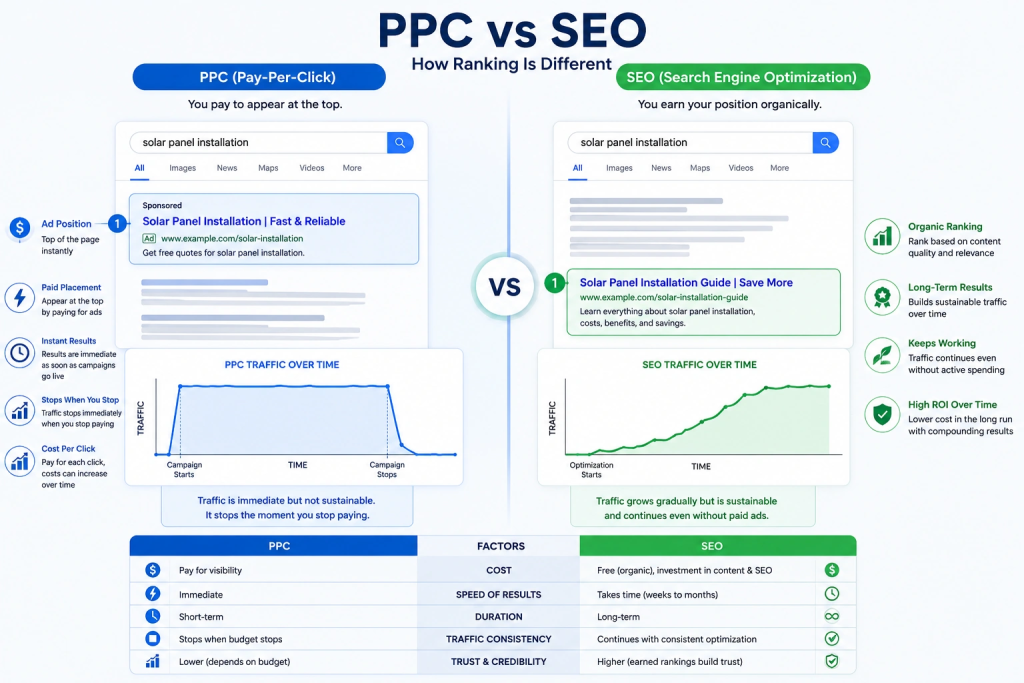
When comparing PPC vs SEO, the biggest ranking difference is how visibility is earned. PPC ranking is determined through a paid advertising auction where factors such as bids, ad quality, competition, search context, and ad assets influence where an ad may appear. SEO ranking, on the other hand, is earned organically through Google’s search systems, which evaluate relevance, content quality, links, technical accessibility, and other signals.
PPC can generate search visibility quickly while a campaign is active, whereas SEO generally requires more time to build organic visibility. However, organic rankings can continue bringing traffic without paying Google for every click. Understanding these differences helps businesses choose the right strategy based on their budget, goals, competition, and how quickly they need results.
PPC vs SEO Ranking at a Glance
The main difference between PPC ranking and SEO ranking is how search visibility is achieved. PPC relies on paid ad auctions, while SEO depends on how well a page satisfies Google’s organic ranking systems. Both can place a business prominently in search results, but the factors, costs, speed, and long-term value are different.
| Factor | PPC Ranking | SEO Ranking |
| Ranking method | Paid ad auction | Organic search ranking systems |
| Cost model | Usually pay per click | No direct payment to Google for organic clicks |
| Speed | Can gain visibility quickly | Usually takes longer to build |
| Main ranking influences | Bid, ad quality, competition, search context, and ad assets | Relevance, content quality, links, technical SEO, and other search signals |
| Control | Greater control over targeting, bids, and campaigns | Less direct control over ranking position |
| Targeting | Can target keywords, locations, devices, audiences, and schedules | Primarily depends on query relevance and search intent |
| Visibility duration | Depends on campaign activity, budget, and auction eligibility | Can continue over time if the page remains competitive |
| Testing | Fast testing of keywords, ads, and landing pages | Changes generally require more time to evaluate |
| Ranking changes | Can change from one ad auction to another | Can fluctuate as competitors, content, and ranking systems change |
| Best suited for | Fast traffic, campaigns, testing, and immediate lead generation | Long-term organic growth and sustainable search visibility |
A simple way to understand PPC vs SEO ranking is that PPC competes for paid placement each time an eligible ad auction occurs, while SEO competes for organic visibility based on the relevance and overall quality of web pages.
Neither method guarantees a permanent top position. PPC advertisers still have to compete in each auction, and organic pages must continue to satisfy search intent while competing against other relevant results. This is why businesses often use PPC for faster visibility while developing SEO as a longer-term acquisition channel.
How Does PPC Ranking Work?
PPC ranking works through a real-time advertising auction. When someone searches for a term that matches an advertiser’s targeting, Google evaluates eligible ads to determine whether they can appear and where they may be shown.
Paying the highest amount does not automatically guarantee the top position in search results for those looking to buy website traffic. Google considers several auction-time factors, including the advertiser’s bid, the expected quality of the ad and landing page, competition, the context of the search, and the expected impact of ad assets.
This means paid search ranking can change from one search to another, even when the advertiser has not changed the campaign.
The Six Factors That Influence Google Ad Rank
Google uses Ad Rank to determine whether an ad is eligible to appear and its position relative to other ads. The main factors include:
- Bid amount: The maximum amount an advertiser is willing to pay for a click.
- Ad and landing page quality: Google evaluates how useful and relevant the ad and landing page are likely to be for the searcher.
- Ad Rank thresholds: An ad must meet minimum requirements to appear in certain positions.
- Auction competitiveness: The strength and quality of competing ads can influence placement.
- Search context: Factors such as the search query, device, location, time, and other contextual signals can affect the auction.
- Ad assets and formats: Google considers the expected impact of additional elements such as sitelinks, call assets, images, and other ad formats.
Because these factors are evaluated at auction time, two people searching for the same keyword may not necessarily see the same ads in the same order.
Quality Score vs Ad Rank: They Are Not the Same Thing
Quality Score and Ad Rank are often treated as the same thing, but they serve different purposes.
Quality Score is a diagnostic score from 1 to 10 that helps advertisers understand how their keyword and ad experience compares with other advertisers. It is mainly based on expected click-through rate, ad relevance, and landing page experience.
However, the visible Quality Score itself does not directly determine an ad’s auction position.
Ad Rank is calculated when the auction happens and considers a broader set of signals. Therefore, advertisers should not focus only on increasing a Quality Score number. Improving ad relevance, landing page usefulness, targeting, and overall campaign quality is more important.
Why the Highest Bid Does Not Always Win
A common misconception about PPC advertising is that the advertiser willing to pay the most automatically receives the highest position.
Google’s auction does not work like a simple highest-bid-wins system.
An advertiser with a lower bid can sometimes earn better visibility if its ad is more relevant to the search, provides a stronger landing page experience, and performs well across other auction-time factors.
This approach allows Google to prioritize ads that are more likely to help users rather than showing ads based only on advertising budgets.
Why Your PPC Position Can Change From One Search to Another
A PPC ad position is not permanently fixed. Google recalculates Ad Rank whenever an eligible auction occurs.
Your ad placement can change because of factors such as:
- The exact search query
- User location
- Device type
- Time of the search
- Competitor bids
- Competitor ad quality
- Available ad assets
- Changes in auction competition
For example, an ad that appears near the top for one search may appear lower or may not appear at all for another user searching the same general keyword.
This auction-by-auction process is one of the biggest differences between PPC and organic SEO ranking. PPC visibility is continuously determined by current auction conditions rather than being a fixed search position.
How Does SEO Ranking Work?
SEO ranking works differently from paid advertising because websites cannot pay Google for a higher organic position. Instead, Google uses automated search systems to evaluate which pages are most relevant and useful for a particular query.
Before a page can rank, Google generally needs to discover, crawl, and index it. Once eligible for search, the page competes with other relevant pages based on factors such as search intent, content quality, links, technical accessibility, page experience, and other ranking signals.
Unlike PPC, there is no single auction that determines an organic position. Organic rankings can improve or decline over time as Google reevaluates pages, competitors publish better content, user expectations change, or ranking systems are updated.
Crawling and Indexing Come Before Ranking
A page cannot compete effectively in organic search if Google cannot properly discover and understand it.
Crawling is the process Google uses to find pages and follow links across the web. Indexing happens when Google processes a page and decides whether it can be stored in its search index.
Ranking comes after these stages.
Technical problems such as blocked pages, incorrect canonical tags, poor internal linking, server errors, or accidental noindex directives can prevent strong content from appearing in search results.
This is why technical SEO is an important foundation for organic visibility.
Relevance and Search Intent
Google tries to show results that best match what a searcher is actually looking for.
A page targeting a keyword should therefore do more than repeat the phrase. It needs to satisfy the underlying search intent.
For example, someone searching “how is ranking different when comparing PPC vs SEO” is primarily looking for an explanation of how both ranking systems work, not just a list of SEO and PPC benefits.
Google may evaluate signals related to:
- Topic relevance
- Query meaning
- Content depth
- Page structure
- Supporting entities
- Contextual terminology
- Whether the page provides a useful answer
Pages that closely match the intent behind a query are generally better positioned to compete than pages that only use the target keyword frequently.
Content Quality and Helpfulness
High-quality content should solve the user’s problem clearly and accurately.
For organic search ranking, useful content typically provides original value rather than simply rewriting what already appears on competing pages.
Strong content usually demonstrates:
- Clear topical coverage
- Accurate information
- First-hand or expert insight where appropriate
- Logical organization
- Useful examples
- Direct answers
- Supporting evidence
- A satisfying user experience
Content length alone does not make a page rank better. A shorter page that completely answers the query can outperform a longer article filled with repetitive or unnecessary information.
Links, Authority, and Trust Signals
Links remain an important part of how search engines understand relationships between pages and websites.
A backlink from a relevant and reputable source can help Google discover content and may contribute to how the page’s importance is evaluated.
However, ranking is not simply about collecting the largest number of backlinks.
The relevance, quality, context, and natural placement of links matter. A smaller number of authoritative and contextually relevant links may be more valuable than hundreds of low-quality links.
Internal links also help search engines understand site structure and the relationship between related topics.
Technical SEO and Page Experience
Even excellent content can struggle if users or search engines cannot access it easily.
Important technical SEO considerations include:
- Crawlability
- Indexability
- Mobile usability
- HTTPS
- Page speed
- Clear site architecture
- Internal linking
- Structured page organization
A strong page experience also removes friction for users. Make the page secure, mobile-friendly, fast enough to use comfortably, and easy to navigate.
Technical improvements do not guarantee high rankings, but they remove barriers that can prevent otherwise strong content from performing well.
Freshness and Changing Search Results
SEO rankings are not permanent.
Google continuously evaluates search results, and a page that performs well today can lose visibility if competitors publish more useful information or the page becomes outdated.
Freshness is especially important for topics where information changes frequently, such as:
- News
- Product specifications
- Prices
- Laws
- Software updates
- Industry trends
For evergreen topics, updating content is still useful when facts, examples, statistics, or recommendations become outdated.
This ongoing reevaluation is another major difference between SEO and PPC ranking. PPC placement can change with every auction, while organic rankings usually change more gradually based on competition, content quality, relevance, and changes in Google’s search system.
The 10 Biggest Ranking Differences Between PPC and SEO
Although PPC and SEO both aim to increase visibility in search results, they reach that goal in very different ways. The biggest differences involve how rankings are earned, how quickly visibility can appear, how much control businesses have, and how long results may last.
1. Paid Auction vs Earned Organic Visibility
The most basic difference is that PPC visibility comes from participating in a paid advertising auction, while SEO visibility is earned through organic search.
With PPC, advertisers bid to compete for sponsored placements. With SEO, websites cannot pay Google to improve their organic position. Instead, pages compete based on relevance, quality, authority, technical accessibility, and other ranking signals.
2. Immediate Eligibility vs Gradual Ranking Growth
PPC campaigns can become eligible for visibility relatively quickly once ads are approved, targeting is set, and the campaign can participate in auctions.
SEO usually takes longer because search engines need to discover, crawl, index, evaluate, and compare a page against existing competitors.
This does not mean SEO always takes months to show results, but organic growth is generally less immediate and less predictable than paid advertising.
3. Ongoing CPC vs No Direct Cost Per Organic Click
PPC commonly operates on a cost-per-click model, meaning advertisers may pay whenever someone clicks an ad.
SEO does not charge a fee each time someone visits an organic result. However, organic growth still requires investment in areas such as content creation, technical improvements, link building, SEO tools, and ongoing optimization.
The difference is therefore not “paid versus free,” but rather paying for ad traffic versus investing in organic visibility.
4. Auction-Time Factors vs Organic Ranking Signals
PPC rankings are determined using factors evaluated during an ad auction, including bids, ad and landing-page quality, competition, search context, and the expected impact of ad assets.
SEO relies on a broader set of organic ranking signals connected to relevance, content usefulness, links, technical accessibility, page experience, and other factors.
This makes the two ranking systems fundamentally different even when they target the same keyword.
5. Precise Targeting vs Search-Intent Matching
PPC gives advertisers much more direct control over who may see an ad.
Campaigns can often be adjusted based on factors such as:
- Keywords
- Location
- Device
- Audience
- Time of day
- Demographics
- Campaign budget
SEO does not provide this same level of targeting control. Organic pages mainly gain visibility when Google determines that the content is relevant to the user’s query and intent.
6. High Advertiser Control vs Algorithmic Control
With PPC, advertisers can directly change bids, budgets, targeting, ad copy, landing pages, and campaign settings.
SEO provides less direct control over ranking position. A website owner can improve a page, but Google ultimately decides which organic result appears and where.
This is why PPC is often easier to manage for businesses that need predictable campaign targeting, while SEO requires more patience and continuous improvement.
7. Short-Term Visibility vs Longer-Term Visibility
Paid search visibility generally depends on an active campaign with sufficient budget and continued auction eligibility.
Once advertising stops, paid visibility can disappear quickly.
Organic visibility may continue even when active SEO work slows down. A strong page can keep attracting visitors for months or longer if it remains relevant and competitive.
However, SEO rankings are never guaranteed permanently.
8. Faster Testing vs Slower SEO Feedback
PPC is useful for quickly testing:
- Keywords
- Headlines
- Offers
- Calls to action
- Landing pages
- Audience segments
Advertisers can collect performance data relatively quickly because campaigns can start generating impressions and clicks soon after launch.
SEO testing usually takes longer because search engines need time to recrawl pages, process changes, and reevaluate rankings.
For this reason, PPC often provides a faster feedback loop for marketing decisions.
9. Auction-by-Auction Volatility vs Organic Ranking Volatility
PPC positions can change whenever a new eligible auction takes place.
A competitor may raise its bid, improve its ads, or enter the auction, causing your placement to change immediately.
SEO rankings also fluctuate, but usually for different reasons. Changes may result from:
- Competitor improvements
- New content
- Updated search intent
- Website changes
- Link changes
- Google ranking-system updates
- So both channels experience volatility, but PPC changes are often more immediate, while SEO movements may develop over a longer period.
10. Paid SERP Placement vs Organic SERP Placement
PPC ads and organic results may appear on the same search engine results page, but they occupy different types of placements.
Paid results are labeled as sponsored advertising, while organic listings are selected by Google’s search systems.
Depending on the query, users may also see shopping results, maps, featured snippets, videos, AI Overviews, AI Mode, and other SERP features.
This means ranking should not be viewed only as reaching “position one.” The real goal is to achieve strong search visibility in the areas of the results page most relevant to the business and its audience.
In simple terms, PPC gives businesses more control and faster access to paid visibility, while SEO focuses on earning organic visibility that can create longer-term value. The right approach depends on how quickly results are needed, how much control is required, and whether the goal is immediate traffic or sustainable search growth.
What Happens to Your Ranking When You Stop PPC or SEO?
One of the clearest differences between PPC and SEO appears when you stop investing in each channel. PPC visibility is closely tied to an active advertising campaign, while organic SEO visibility can continue after active optimization slows down.
However, neither channel provides permanent rankings. PPC stops competing when the campaign is no longer active, while SEO rankings can decline over time if competitors improve, content becomes outdated, or search systems change.
What Happens When You Stop Paying for PPC?
When a PPC campaign is paused, ended, or no longer has enough budget to participate effectively in auctions, the ads stop receiving the same paid search visibility.
This means businesses can lose:
- Paid impressions
- Ad clicks
- Paid traffic
- Lead volume from those ads
- Sponsored search visibility
The effect can be fast because PPC ranking is based on ongoing auction participation.
For example, if a business relies heavily on Google Ads for a high-intent keyword and pauses the campaign, its sponsored placement may disappear even if the campaign previously performed well.
This is why PPC is often described as a channel that requires continuous investment. The advantage is speed and control, but the trade-off is that paid visibility usually does not continue once the campaign stops participating in auctions.
What Happens When You Stop Working on SEO?
SEO behaves differently.
Stopping active SEO work does not automatically remove a page from Google or immediately erase its organic rankings. A well-performing page may continue attracting organic traffic for a considerable period if it remains relevant, useful, technically accessible, and competitive.
However, rankings can gradually decline.
Common reasons include:
- Competitors publishing better content
- Search intent changing
- Information becoming outdated
- New websites entering the SERP
- Lost backlinks
- Technical problems
- Changes to the website
- Google ranking-system updates
For example, an evergreen guide may continue ranking even if it is not updated for several months. But if competitors add newer data, clearer explanations, better examples, and stronger supporting resources, the older page may lose visibility.
SEO should therefore be viewed as a long-term asset that requires maintenance rather than a one-time task.
Which One Has Better Ranking Durability?
SEO generally offers stronger ranking durability because organic visibility is not tied to paying for every click or keeping an advertising campaign active.
A page that earns strong organic rankings can potentially generate traffic repeatedly without a direct advertising charge for each visit.
PPC offers less persistence but significantly more control. Businesses can increase budgets, change bids, adjust targeting, pause campaigns, or launch new ads based on current goals.
The practical difference is simple:
PPC visibility depends heavily on continued campaign participation, while SEO visibility can continue after active work slows down but must remain competitive to survive over time.
For many businesses, this is why combining both channels can work well. PPC can provide immediate search exposure while SEO builds a longer-term source of organic traffic.
Does PPC Help SEO Rankings?
PPC does not directly improve organic SEO rankings. Paying for Google Ads does not give a website a ranking advantage in Google’s unpaid search results because paid ads and organic results use separate systems.
However, PPC can support an SEO strategy indirectly by providing fast data about keywords, user behavior, offers, and landing pages. That information can help businesses make better organic search decisions.
How PPC Data Can Improve Your SEO Strategy
PPC campaigns can reveal valuable search and conversion data much faster than SEO alone.
Businesses can use paid search data to identify:
- Keywords that generate conversions
- Search terms with strong commercial intent
- Headlines that attract more clicks
- Offers that resonate with users
- Landing pages that convert well
- Audience segments with higher purchase intent
For example, if a PPC campaign shows that a particular keyword consistently generates qualified leads, that keyword may also deserve stronger coverage in the company’s organic content strategy.
PPC can therefore reduce guesswork when choosing which topics and search terms are worth targeting with SEO.
PPC Can Help Test Search Intent Faster
One challenge with SEO is that it can take time to understand whether a keyword will actually generate valuable business results.
PPC allows businesses to test that demand more quickly.
A company can run ads for a keyword, analyze click and conversion behavior, and determine whether the search term attracts the right audience before investing heavily in long-form content or landing-page optimization.
This does not make the PPC campaign an SEO ranking factor, but it can make the SEO strategy more informed.
How SEO Can Improve PPC Performance
The relationship also works in the opposite direction.
Strong SEO practices can help create better landing pages and more useful website experiences for paid visitors.
SEO improvements may support PPC campaigns through:
- More relevant landing-page content
- Clearer site navigation
- Faster page performance
- Better mobile usability
- Stronger internal linking
- Improved content depth
- Better alignment with search intent
A well-optimized website can therefore support both organic users and paid visitors.
Can PPC and SEO Appear Together?
Yes. A business can have a paid ad and an organic listing visible for the same search query.
This can increase overall SERP visibility, especially for high-value commercial searches.
For example, a company might use PPC to secure sponsored visibility while its SEO page also ranks organically below the ads. This allows the brand to occupy more search-result real estate and gives users multiple opportunities to visit the website.
The Key Difference to Remember
PPC and SEO can share data and support the same marketing goals, but they do not directly control each other’s rankings.
Running more Google Ads will not automatically push an organic page higher, and achieving a top organic position does not guarantee better PPC placement.
The best approach is to treat them as separate ranking systems that can work together strategically. PPC provides fast testing and immediate paid visibility, while SEO focuses on building sustainable organic visibility over time.
PPC vs SEO: Which Is More Measurable?
Both PPC and SEO can be measured, but PPC usually provides faster and more direct performance data. Because paid campaigns can start generating impressions, clicks, and conversions quickly, businesses can see which keywords, ads, audiences, and landing pages are producing results.
SEO measurement is also valuable, but results often take longer to appear and can be influenced by many factors, including ranking changes, seasonality, competition, search intent, and Google updates.
How PPC Performance Is Measured
PPC platforms provide detailed campaign-level data that helps advertisers understand exactly how their budget is performing.
Common PPC metrics include:
Impressions
Clicks
Click-through rate
Cost per click
Conversion rate
Cost per acquisition
Return on ad spend
Impression share
Search top impression share
Search absolute top impression share
These metrics make it easier to connect ad spend with specific outcomes.
For example, if a campaign spends $1,000 and generates 20 qualified leads, the business can calculate its cost per lead and compare that result with other campaigns.
This level of control makes PPC especially useful when businesses need fast performance feedback.
How SEO Performance Is Measured
SEO performance is typically measured using data from tools such as Google Search Console, analytics platforms, and third-party SEO software.
Important SEO metrics include:
- Organic impressions
- Organic clicks
- Click-through rate
- Average search position
- Organic traffic
- Keyword visibility
- Indexed pages
- Organic conversions
- Engagement on landing pages
- Revenue generated from organic traffic
SEO measurement tends to require a longer-term view because ranking improvements may not immediately translate into traffic or conversions.
For example, a page might improve from position 20 to position 8 before showing a meaningful increase in clicks. The ranking improvement is positive, but the business may need more time before seeing its full traffic potential.
PPC Offers a Faster Feedback Loop
One of PPC’s biggest advantages is speed.
Advertisers can launch a campaign, gather data, and make adjustments based on actual performance. They can pause weak keywords, increase bids on profitable searches, test new ads, or change landing pages without waiting months for results.
This makes paid search marketing useful for testing:
- Keyword profitability
- Customer demand
- Promotional offers
- Ad messaging
- Landing-page performance
- Calls to action
SEO can use many of these insights, but organic results usually take longer to evaluate.
SEO Provides Broader Long-Term Insights
While PPC is easier to measure in the short term, SEO can reveal how a website performs across a much wider range of searches.
A strong article may begin ranking for hundreds of related queries, including terms the business never specifically targeted.
This can help uncover:
- New customer questions
- Long-tail keywords
- Emerging search demand
- Content gaps
- High-performing topics
- Organic conversion opportunities
Over time, this data can guide future content, product, and marketing decisions.
Which One Is Easier to Measure?
For direct campaign attribution, PPC is generally easier to measure because ad spend, clicks, and conversions can be connected more closely within the advertising platform.
SEO attribution can be more complex because users may interact with a brand several times before converting, and ranking changes may take time to influence traffic.
However, easier measurement does not mean PPC is automatically more valuable.
The better comparison is:
PPC gives businesses faster and more controllable performance data, while SEO provides slower but broader insight into long-term organic search demand and visibility.
Businesses using both channels can gain the strongest picture by combining PPC conversion data with SEO search and content performance data.
Which Ranking Strategy Is Better for Your Business?
There is no single winner in the PPC vs SEO debate. The better option depends on your goals, budget, timeline, competition, and how quickly you need search visibility.
PPC is usually stronger when a business needs immediate traffic, tighter targeting, and faster testing. SEO is generally better when the goal is to build long-term organic visibility and reduce dependence on paid clicks.
For many businesses, the strongest approach is not choosing one over the other, but using both at different stages of the customer journey.
Choose PPC When You Need Fast Visibility
PPC advertising is a practical choice when you need to reach potential customers quickly.
It is especially useful for:
- New product or service launches
- Limited-time offers
- Seasonal promotions
- Immediate lead generation
- Testing new keywords
- Entering a competitive market
- Reaching specific locations or audiences
- Promoting high-converting landing pages
For example, a newly launched service may not have enough organic authority to rank quickly. A PPC campaign can provide immediate exposure while the business works on SEO in the background.
PPC also gives advertisers more control over when, where, and to whom ads are shown.
The trade-off is that visibility depends on budget and continued participation in paid auctions.
Choose SEO When You Want Sustainable Organic Growth
SEO is better suited to businesses that want to build a long-term source of search traffic.
- It is particularly useful when:
- Customers regularly search for your products or services
- Your business can publish useful evergreen content
- You want to reduce long-term dependence on paid traffic
- Your industry has strong informational search demand
- You want to build topical authority
- Organic search is an important customer acquisition channel
SEO may take longer to produce strong results, but successful pages can continue generating traffic without paying Google for each click.
For example, a detailed guide that ranks for a high-demand search query may attract visitors repeatedly over months or years, provided it remains useful and competitive.
Use PPC and SEO Together When You Want Maximum Search Visibility
In many cases, the best strategy is to combine paid search and organic search rather than treating them as competing channels.
PPC can support short-term objectives while SEO builds long-term visibility.
A combined strategy might look like this:
- Use PPC to generate traffic immediately
- Identify high-converting keywords from paid campaigns
- Create SEO content around proven search demand
- Use organic rankings to reduce dependence on expensive keywords
- Continue PPC for highly competitive or valuable commercial searches
- Use both channels to increase overall SERP presence
For example, a business may run ads for a profitable keyword while simultaneously optimizing a service page to rank organically for the same search.
If both placements perform well, the brand can gain greater visibility across the search results.
Consider Your Budget, Timeline, and Goals
Before choosing between PPC and SEO, businesses should ask three simple questions:
How quickly do we need results?
If traffic or leads are needed immediately, PPC usually has the advantage.
How much can we invest over time?
PPC requires ongoing ad spend, while SEO usually requires investment in content, technical work, and optimization.
Are we building short-term campaigns or long-term search visibility?
PPC is well suited to immediate campaigns, while SEO is better for building an organic acquisition channel over time.
The right strategy is therefore not determined by which channel is universally “better.” It depends on what the business needs to achieve.
For fast visibility and greater campaign control, PPC is often the stronger starting point. For sustainable organic growth, SEO usually offers more long-term value. Businesses that need both immediate and future results can benefit from using PPC and SEO together.
PPC vs SEO Decision Matrix
Choosing between PPC and SEO becomes easier when you match each strategy to a specific business situation. PPC is usually stronger when speed, targeting, and testing matter most, while SEO is often better when the goal is to build long-term organic visibility.
The table below provides a quick way to decide which option may be the better starting point.
| Business Situation | Better Starting Point | Why |
| You need leads quickly | PPC | Paid campaigns can begin generating visibility soon after launch |
| You are launching a new product or service | PPC | Ads can create immediate exposure before organic rankings develop |
| You want to test keyword profitability | PPC | Paid search provides faster data about clicks, leads, and conversions |
| You want long-term organic growth | SEO | Strong pages can continue attracting traffic over time |
| Paid keywords are becoming expensive | SEO | Organic visibility can reduce dependence on high CPC campaigns |
| Your audience searches for educational content | SEO | Informational content can attract users throughout the buying journey |
| You operate in a highly competitive SERP | PPC + SEO | Using both can increase your overall search presence |
| You need both short-term and long-term results | PPC + SEO | PPC supports immediate demand while SEO builds future visibility |
| You are running a seasonal promotion | PPC | Campaigns can be activated and adjusted around specific dates |
| You want to build authority in your niche | SEO | Consistent, useful content can strengthen topical relevance and visibility |
When PPC Is the Better Starting Point
PPC is usually the better choice when time is the main concern.
For example, a business launching a new service may not want to wait for organic rankings to develop before generating leads. A targeted paid search campaign can provide visibility while the website builds its SEO presence.
PPC is also useful when a business wants to test a market before committing to a larger content strategy.
If certain keywords generate strong conversions through ads, those terms may later become valuable SEO targets.
When SEO Is the Better Starting Point
SEO is often the stronger choice when the business is focused on long-term growth rather than immediate traffic.
This is especially true when customers regularly search for:
- How-to information
- Product comparisons
- Service guides
- Local services
- Industry questions
- Evergreen topics
By creating useful content around these searches, a website can build a consistent source of organic traffic over time.
SEO can also be valuable in industries where paid clicks are expensive, because strong organic rankings may reduce the need to rely on PPC for every visit.
When You Should Use Both
In many cases, PPC and SEO work best together.
A business can use PPC to generate traffic and collect conversion data while SEO builds authority and organic visibility in the background.
For example, PPC can identify which keywords produce the highest-quality leads. SEO can then use those insights to create stronger service pages, comparison pages, and informational content.
This creates a balanced strategy where paid search supports immediate performance and organic search supports longer-term growth.
The best decision is therefore not always choosing one channel over the other. It is choosing the right channel for the right stage of your marketing strategy.
How Do Modern Search Results Affect PPC vs SEO Rankings?
Search ranking in 2026 is not just a contest for one numbered position. A Google results page can include sponsored ads, organic links, local results, shopping modules, videos, featured answers, People Also Ask results, AI Overviews, and other search features. That changes how businesses should think about PPC vs SEO ranking.
A page may hold a strong organic position and still appear below several prominent search features. A paid ad may appear near the top for one search but lower on another. For both channels, the better goal is useful search visibility that produces qualified clicks and conversions, not a fixed position at any cost.
PPC Ads Can Appear in Different Search Locations
Google does not give every search ad one permanent slot. Ads can appear in different areas of the search results when they are eligible and win the relevant auction.
Google Ads uses Ad Rank to decide whether an ad can show and how it ranks against other eligible ads. In searches that trigger AI Overviews, eligible ads can also appear above or below the AI-generated response. In supported markets and situations, ads may appear within an AI Overview as well.
This makes paid search visibility more dynamic than the old idea of “bid for position one.” Advertisers should focus on whether their ads appear in valuable locations for the right searches and whether those impressions turn into profitable actions.
Organic Ranking Is No Longer Just Ten Blue Links
Traditional organic listings still matter, but they now share the search results page with many other formats. Depending on the query, Google may show local packs, videos, images, shopping results, featured snippets, discussion results, AI Overviews, or other modules.
That means an organic result described as “position one” does not always become the first element a person sees. Search Console itself treats position as a relative metric across different search-result elements and impressions.
For SEO, this creates a wider visibility goal. A strong strategy should help a brand become relevant across the parts of the SERP that match the query, not chase one blue-link ranking in isolation.
How AI Overviews and AI Mode Change Search Visibility
AI-driven search adds another layer to the comparison between PPC and SEO.
Google says pages do not need special markup or a separate technical process to become eligible as supporting links in AI Overviews or AI Mode. The same foundations still matter: pages need to be crawlable, indexable, eligible to appear in Search, easy to understand, useful to people, and supported by accurate structured data where relevant.
For content teams, the practical lesson is simple. Write clear answers. Use descriptive headings. Define technical terms before expanding them. Support claims with reliable sources. Keep important information in visible text. Connect related pages with internal links. These practices help both traditional SEO and answer-focused search experiences.
PPC is evolving in parallel. Google can use the user’s query and the context of an AI Overview when deciding whether a relevant ad should appear. So paid search is also moving beyond simple exact-keyword matching toward broader intent and context.
Why Search Visibility Matters More Than a Fixed “Position #1”
A number-one ranking sounds impressive, but it is not a complete business metric.
For PPC, an advertiser could achieve frequent top-of-page visibility and still lose money if clicks are too expensive or the landing page converts poorly. For SEO, a page could improve its average position but gain little traffic if search demand is low or the result does not earn clicks.
A better question is: Does this visibility reach the right people and create useful business outcomes?
Track position alongside impressions, click-through rate, conversions, cost, lead quality, revenue, and search demand. This keeps both PPC and SEO focused on performance rather than vanity rankings.
How Should You Track PPC Rankings vs SEO Rankings?
PPC and SEO use different ranking systems, so they also require different position metrics. Trying to compare an ad’s “rank” directly with an organic page’s average position can lead to poor decisions.
Use metrics that match the channel.
PPC: Top Impression Rate vs Absolute Top Impression Rate
Google Ads replaced the old average-position mindset with prominence metrics that better describe where ads appear on the page.
Search top impression rate shows the percentage of your ad impressions that appeared anywhere above the organic search results.
Search absolute top impression rate shows the percentage of impressions that appeared as the first ad above the organic results.
Google Ads also provides top impression share and absolute top impression share. These metrics compare the impressions you received with the estimated number of eligible impressions you could have received in those locations.
These measures answer more useful questions than “What was my average ad position?” They show how often your ads reached prominent placements and how much additional opportunity may exist.
Still, do not optimize prominence in isolation. A lower-cost placement that produces profitable conversions may be more valuable than paying aggressively for the absolute top position.
SEO: Organic Position, Impressions, Clicks, and Search Visibility
For SEO, Google Search Console provides metrics such as impressions, clicks, click-through rate, queries, and average position.
Impressions show how often a search result from your site was shown under Search Console’s reporting rules. Clicks show how often users clicked through to your site. Average position estimates the relative position of your highest result for each impression and then averages those values.
That average can hide important details. A page might rank third for one query, eleventh for another, and appear inside different search-result layouts. A single average number cannot explain all of those experiences.
For stronger SEO analysis, review position together with the exact query, device, country, page, search appearance, impressions, clicks, and conversions. This gives you a clearer picture of whether ranking gains are actually creating visibility and demand.
Why PPC and SEO “Average Position” Should Not Be Compared Directly
PPC and SEO do not share one ranking ladder.
Paid ads compete against eligible ads in an auction. Organic pages compete inside Google’s unpaid search systems. Their placements can appear in different parts of the results page, and the metrics that describe those placements use different logic.
So a statement such as “our PPC rank is 1.4 while our SEO rank is 3.2” does not create a meaningful apples-to-apples comparison.
Instead, compare the outcomes each channel produces:
- How much qualified search visibility did the channel earn?
- What did that visibility cost?
- How many useful visits, leads, or sales did it create?
- Which queries and landing pages produced the best results?
- How durable are those results likely to be?
This makes the comparison useful for marketing decisions.
Measure Conversions, Not Rankings Alone
Ranking is a means, not the final goal.
A PPC campaign can win premium placements and still fail if its cost per acquisition is too high. An SEO page can rank well and still underperform if it attracts the wrong intent or gives users no clear next step.
For PPC, connect ad visibility with conversions, cost per conversion, conversion value, and return on ad spend where appropriate.
For SEO, connect organic visibility with engaged visits, leads, sales, assisted conversions, and revenue. Also track whether the page wins relevant long-tail searches and supports other pages through internal links.
This performance-first view is one of the most important ways to compare PPC vs SEO in modern search.
PPC vs SEO Ranking Examples
The mechanics become easier to understand when you apply them to real search situations.
Example 1: A New Local Service Business
Imagine a new plumbing company wants leads for “emergency plumber near me.”
With PPC, the company can launch an eligible campaign, set location targeting, choose bidding and budget controls, write relevant ads, and send users to an emergency-service landing page. If the ad wins auctions, the business can gain paid visibility before the website has built much organic authority.
SEO follows a different path. The company needs a crawlable website, a strong local service page, accurate business information, relevant internal links, useful local content, and competitive authority signals. Google then needs time and enough information to evaluate the business against other relevant local results.
Best use: PPC can help create immediate demand capture, while local SEO builds a more durable source of visibility.
Example 2: A High-Competition Commercial Keyword
Now consider a software company targeting “best CRM software for small business.”
In PPC, many advertisers may compete for the same high-value audience. Ad Rank can change from auction to auction based on bids, ad and landing-page quality, competition, search context, thresholds, and the expected impact of assets. The company may gain visibility quickly, but expensive clicks can make weak conversion rates costly.
In SEO, the company must compete with established comparison sites, software brands, review platforms, and editorial publishers. A thin product page is unlikely to satisfy the full intent. The business may need a genuinely useful comparison resource, clear product evidence, strong internal linking, technical accessibility, credible references, and a reason for users to trust its evaluation.
Best use: PPC can test commercial demand quickly. SEO can build broader, longer-term visibility if the company can create a better resource than the pages already competing.
Example 3: An Informational Blog Keyword
Consider the query “how is ranking different when comparing PPC vs SEO.”
The searcher mainly wants an explanation. A strong organic article should answer the question immediately, explain both ranking systems accurately, distinguish Quality Score from Ad Rank, show how paid and organic visibility differ, and help the reader decide when each channel makes sense.
PPC could still appear for this query if Google detects relevant commercial intent and an advertiser is eligible. However, informational queries often give SEO a strong opportunity because detailed educational content can answer related questions and rank for many semantic variations over time.
Best use: SEO usually provides the stronger long-term content opportunity, while PPC can support related commercial queries where a user is closer to choosing a service or platform.
Key Takeaway: How Is Ranking Different When Comparing PPC vs SEO?
PPC ranking is paid, auction-based, and recalculated when eligible ad auctions occur. SEO ranking is organic and earned through Google’s search systems, which assess relevance, usefulness, accessibility, links, context, and many other signals.
PPC gives advertisers faster visibility and more direct control over targeting, budget, bids, and campaigns. SEO gives site owners less control over exact placement, but strong pages can keep earning organic traffic without a direct charge for every click.
The best strategy depends on the job you need search to do. Use PPC when speed, precise targeting, or rapid testing matters. Use SEO when you want to build a durable source of organic discovery. Use both when you need immediate demand capture and long-term search visibility at the same time.
In 2026, also think beyond a single ranking number. Search results now include ads, classic organic listings, local features, shopping modules, videos, AI Overviews, AI Mode, and other answer-led experiences. The real objective is to earn relevant visibility across the search journey and turn that visibility into measurable business value.
Frequently Asked Questions
How is ranking different when comparing PPC vs SEO?
PPC ranking comes from a paid ad auction. Google evaluates factors such as Ad Rank, bids, ad and landing-page quality, competition, search context, thresholds, and assets. SEO ranking is organic. Google’s search systems evaluate which eligible pages best match the query based on relevance, usefulness, accessibility, links, and other signals. PPC can gain visibility quickly; SEO usually builds more gradually.
Does paying more guarantee a higher PPC ranking?
No. A higher bid can improve your ability to compete, but Google does not rank Search ads by bid alone. Ad Rank also considers ad and landing-page quality, thresholds, auction competition, search context, and the expected impact of assets. A lower-bidding advertiser can sometimes outrank a higher bidder when the overall auction signals are stronger.
Does Quality Score directly determine PPC position?
No. Quality Score is a diagnostic 1-to-10 metric that helps advertisers compare expected click-through rate, ad relevance, and landing-page experience with other advertisers. Google states that Quality Score itself is not an input in the ad auction. Ad Rank is calculated at auction time and uses a broader set of factors.
Can PPC improve my SEO ranking?
PPC does not directly raise organic rankings. Paying for Google Ads does not buy an advantage in Google’s unpaid results. PPC can still support SEO indirectly by revealing converting search terms, strong messages, useful landing pages, and audience demand. SEO teams can use those insights to make better content and prioritization decisions.
Can PPC and SEO appear for the same keyword?
Yes. A business can have an eligible paid ad and an organic result on the same search results page. Showing in both areas can increase overall SERP visibility, although neither placement guarantees the other. The paid ad and organic result are evaluated through separate systems.
Is SEO ranking permanent?
No. Organic rankings can rise or fall as competitors improve, search intent changes, pages become outdated, technical issues appear, links change, or Google updates its search systems. Strong SEO can create durable visibility, but businesses still need to maintain useful content and a healthy website.
Why does my PPC ad position change between searches?
Google recalculates Ad Rank when an eligible auction occurs. The exact query, user context, device, location, time, competing advertisers, bids, ad quality, assets, and other auction conditions can change. As a result, the same advertiser may appear in different locations—or not appear at all—across similar searches.
Which ranks faster: PPC or SEO?
PPC can become visible much faster because an approved and eligible campaign can enter ad auctions soon after launch. SEO usually takes longer because Google must discover, crawl, index, understand, and evaluate pages against existing results. The exact timeline varies by website, query, competition, and content quality.
Is PPC better than SEO for a new website?
PPC can be useful for a new website that needs immediate traffic or wants to test demand before organic rankings develop. SEO is still important because it builds the technical, content, and authority foundations needed for long-term organic visibility. Many new businesses benefit from using PPC for speed while building SEO at the same time.
Can an SEO result appear above a PPC ad?
Search layouts vary by query, device, market, and the features Google chooses to show. Ads and organic results can appear in different areas of a SERP, so there is no universal layout where every PPC ad always sits above every organic element. Focus on the actual search appearance and performance data rather than assuming a fixed page order.
Should businesses use PPC and SEO together?
Often, yes. PPC can create immediate visibility, test keywords, and generate conversion data. SEO can build long-term organic discovery and reduce reliance on paid clicks for some searches. Combining the channels can also help a brand appear in more than one relevant area of the search results.
How do AI Overviews affect PPC and SEO visibility?
AI Overviews can change what users see before or around traditional search results. Organic pages may appear as supporting links when Google finds them useful and eligible. Ads can also appear above or below AI Overviews and, in supported situations, within them. For both channels, clear intent matching and strong user value matter more than chasing one fixed ranking number.