
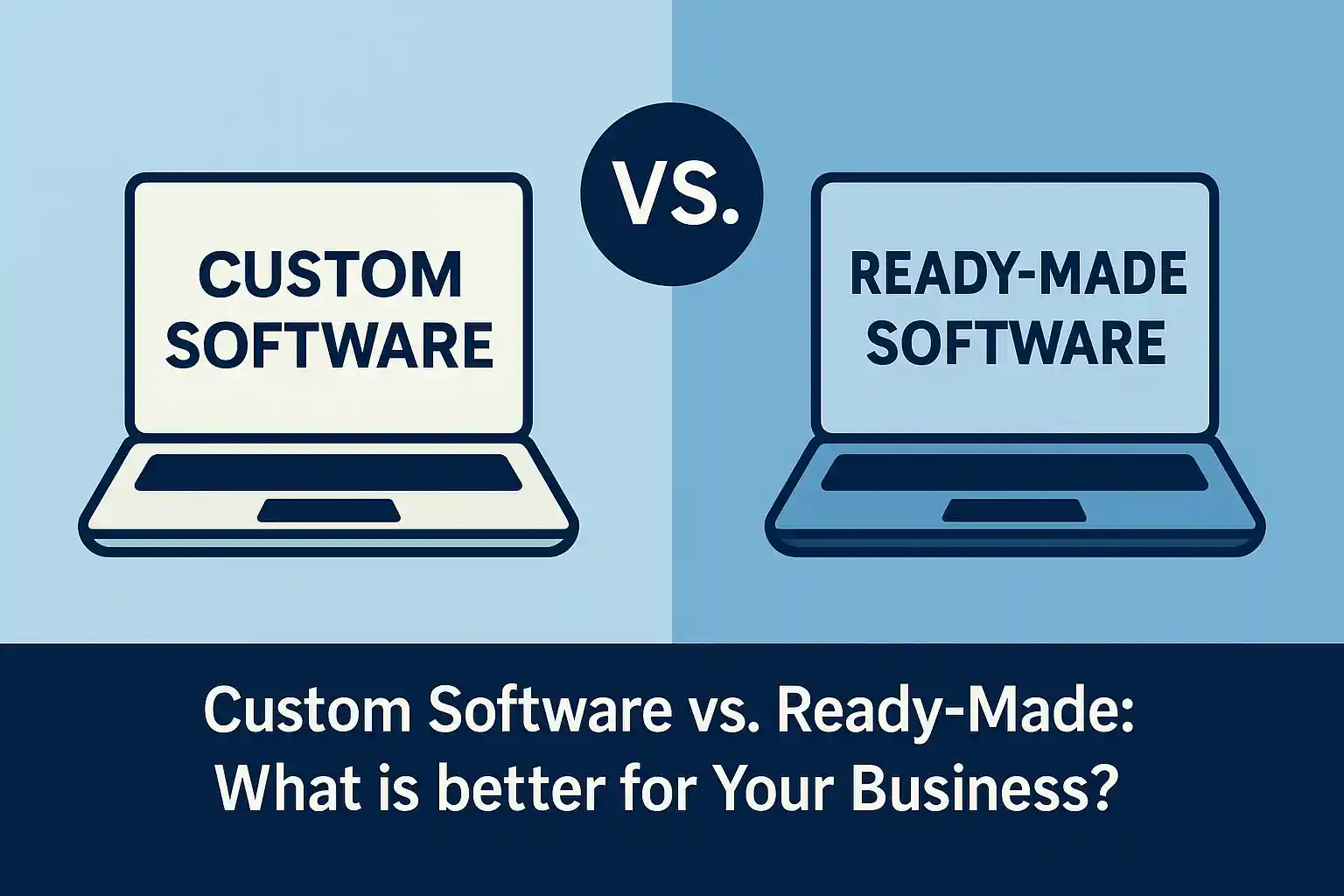
In the digital-first economy, the software powering your operations is the central nervous system of your business. The fundamental choice facing every growing organization is whether to adopt an off-the-shelf, standardized Commercial Off-the-Shelf (COTS) solution (commonly known as Ready-Made or SaaS) or invest in a tailor-made Custom Software Development (often called bespoke software). Many businesses explore custom software development services to understand how to choose between custom software and ready made solutions based on their long-term goals.
This choice is more than just a line item on the budget; it dictates your agility, scalability, data control, and competitive edge for the next decade. Choosing incorrectly can lead to spiraling technical debt, inefficient workflows, and a crippling inability to adapt. Decision-makers also assess which is better for business growth custom software or ready made solutions when planning future scalability.
This blog will provide you a deep, expert-level analysis of both pathways, offering the necessary technical solutions, ROI metrics, and actionable insights to help you make the definitive choice for your organization’s future.
Table Of Content
- Defining the Landscape (Informational Intent)
- The Anatomy of Ready-Made (COTS/SaaS) Solutions
- When Unique Processes Demand Bespoke Solutions
- Unmasking the Hidden Costs of Ready-Made Solutions
- Analyzing the Return on Investment (ROI) of Custom Development
- Technical Solutions for Seamless Integration
- Scaling Your Technology with Your Growth
- Key Scenarios for Ready-Made Software Adoption
- The Custom Software Development Checklist
- Choosing Your Digital Destiny
- FAQs
Defining the Landscape (Informational Intent)
Before evaluating costs and benefits, it is essential to establish a technical understanding of the two principal categories of business software. This clarity is something custom software development companies emphasize when advising clients.
The Anatomy of Ready-Made (COTS/SaaS) Solutions
Ready-Made software, or COTS (Commercial Off-the-Shelf), is pre-built, standardized, and immediately deployable. Modern examples are typically offered as Software as a Service (SaaS), relying on subscription-based cloud deployment.
Technical Characteristics and Key Limitations of SaaS
Standardization: Built for the average user across a broad vertical (e.g., standard CRM, basic accounting).
Deployment: Rapid, usually requiring only configuration, not code deployment.
Technical Content (The Trade-Off): COTS operates on a multi-tenant architecture, meaning customization depth is inherently limited. You cannot access or modify the core source code; you are restricted to API integrations and existing configuration menus. This rigidity often forces businesses to adapt their workflow to the software, rather than the other way around.
This pushes many organizations to compare the business advantages of custom software over ready made tools to assess long-term technical flexibility.
The Principle of Custom (Bespoke) Software Development
Custom, or Bespoke, software is engineered specifically for a single client, solving a unique operational challenge or providing a distinct competitive advantage. Many begin this journey by consulting a custom software development company.
When Unique Processes Demand Bespoke Solutions
Specificity: Built to map 1:1 with an organization’s specific, proprietary, or complex workflow.
Deployment: Varies widely, including on-premise, private cloud, or hybrid models.
Technical Content (The Advantage): Bespoke software provides full control over the technology stack (e.g., using Python/Django, Java, or Node.js). This allows for deep integration with legacy systems and precise compliance with unique data governance or security protocols (e.g., implementing specific encryption standards like AES−256). These benefits become evident when evaluating custom software vs ready made software for small business decision making.
The Cost Analysis (Commercial Investigation Intent)
The common misconception is that custom software is always the more expensive option. A comprehensive evaluation requires analyzing the Total Cost of Ownership (TCO) over a 5 to 7-year lifespan, not just the initial purchase price. This leads many businesses to do a cost comparison of custom software vs ready made software before committing.
Calculating the True Total Cost of Ownership (TCO)
TCO extends beyond licensing fees and includes implementation, hidden costs, and operational drag.
Unmasking the Hidden Costs of Ready-Made Solutions
Implementation/Migration Fees: Often expensive consulting is required to fit the square-peg COTS solution into the round-hole business process.
Feature Creep (COTS): Companies frequently end up paying for enterprise-level subscriptions packed with 80% unnecessary features just to gain access to the critical 20% they require.
Integration Costs: The largest hidden cost is the expense of integrating COTS with existing internal software (e.g., payroll, ERP). These require constant API maintenance and updates from the vendor.
Statistics: Studies show that businesses utilizing COTS software frequently spend 30% more on related consulting, data cleanup, and integration middleware than originally budgeted.
Businesses that want tighter control often turn toward custom software development solutions or custom software development outsourcing for long-term optimization.
Analyzing the Return on Investment (ROI) of Custom Development
While the initial capital expenditure (CapEx) for custom development is high, the long-term ROI justifies the investment through efficiency and competitive advantage.
ROI from Efficiency: Custom software eliminates manual workarounds and redundant data entry, leading to an immediate increase in staff productivity (e.g., a 15–25% reduction in time spent on a core process).
ROI from Competitive Advantage: Bespoke software can automate a proprietary process that competitors cannot replicate, creating a unique market position.
Technical Content: The ROI calculation must factor in intellectual property (IP). Custom code is owned by your business, is a sellable asset, and allows you to control the roadmap—something COTS licensing completely prohibits.
Technical Constraints and Solutions (Procedural/How-To Intent)
The most critical technical consideration is how the software choice impacts scalability and integration with existing (often legacy) business systems.
The Challenge of Integrating with Legacy Systems
Most established businesses run on a combination of old and new platforms. COTS software often struggles to talk to outdated, internal APIs.
Technical Solutions for Seamless Integration
Custom development can build microservices (small, independent services communicating via APIs) specifically designed to translate and integrate with any legacy system, regardless of language or age (e.g., bridging a modern REST API with an older SOAP or mainframe system).
COTS Limitation: If the COTS provider does not offer a pre-built connector, the business must purchase or build expensive third-party middleware, adding another layer of cost and maintenance complexity.
Scaling Your Technology with Your Growth
Rapid business growth can quickly expose the technical limitations of a standardized platform.
COTS Scalability: While SaaS scales vertically (by upgrading your subscription tier), it often hits horizontal limits, such as data storage ceilings, hard limits on the number of API calls per hour, or constraints on data format/fields.
Bespoke Solution: Custom software offers unlimited horizontal scalability. Developers can utilize containerization (like Docker and Kubernetes) and modern cloud architectures (like AWS Lambda or Azure Functions) to automatically adjust resources based on demand. This provides technical agility that no single-vendor COTS solution can match.
Actionable Insight: Demand that your chosen software architecture be cloud-agnostic (capable of running on multiple cloud providers) to avoid vendor lock-in, which is a key technical constraint of most SaaS platforms.
Actionable Insights for Decision-Makers (Commercial/Navigational Intent)
The final decision should be driven by a structured assessment of risk, core business function, and long-term vision.
The 80/20 Rule: When to Choose COTS
If the required features for a function (e.g., email marketing, basic word processing) are 80% or more satisfied by a standard COTS product, that path is clearly the correct one, saving time and initial expense.
Key Scenarios for Ready-Made Software Adoption
Non-Core Functions: Use COTS for utility functions that do not provide a competitive edge (e.g., standard HR management, basic communications).
Immediate Deployment: When time-to-market is the primary constraint and you cannot wait 6–12 months for development.
Low Customization Needs: If your team is willing to conform exactly to the software’s best-practice workflows.
The Blueprint for Committing to Custom Development
If the software function is integral to your Unique Selling Proposition (USP), custom development is an investment in your market future. Many organizations move toward custom software development outsourcing when internal capacity is limited.
The Custom Software Development Checklist
Define the Proprietary Process: Clearly identify the unique 20% of your workflow that provides market advantage. This must be the core focus of the bespoke build.
Establish a Clear Exit Strategy: Custom software requires a commitment to maintenance. Budget 15–20% of the initial development cost annually for ongoing maintenance, security updates, and feature iteration.
Ensure Developer Documentation: Demand complete, clear documentation and ownership of the source code repository (e.g., GitHub, GitLab) to prevent vendor lock-in with your developers.
Actionable Insight: Before investing, conduct a detailed Requirements Elicitation phase. The cost of fixing an error in the requirements phase is 100x cheaper than fixing it once the software is in production.
Choosing Your Digital Destiny
The debate between Custom Software vs. Ready-Made is not about price; it is about control. Ready-made solutions offer speed and standardization, but you are buying a seat on someone else’s bus. Custom software offers higher initial cost and time, but you own the vehicle, control the route, and scale at will.
The most successful companies use a strategic mix: relying on COTS for foundational utilities while fiercely protecting and investing in bespoke solutions for their core competitive processes.
FAQs
1. What does COTS stand for in software development?
COTS stands for Commercial Off-the-Shelf. It refers to software solutions that are ready-made, packaged, and licensed to the general public, such as standard CRM platforms, accounting tools (like QuickBooks), or common productivity suites.
2. Which is cheaper custom software or COTS software?
COTS software is almost always cheaper in terms of initial purchase price (CapEx), as the development costs are spread across many users. However, Custom software can be cheaper over a 5–7 year lifespan (TCO) because it eliminates expensive licensing fees, reduces the cost of workflow workarounds, and provides a significant long-term ROI through increased efficiency.
3. What is the biggest risk of choosing COTS software?
The biggest risk of choosing COTS software is Vendor Lock-in and the inability to adapt to unique business needs. You are permanently dependent on the vendor’s roadmap, pricing, and security maintenance. If your business needs a feature the COTS provider won’t build, you have no recourse.
4. How long does custom software development take?
The timeline for custom software varies greatly based on complexity, but a typical enterprise-grade bespoke application requires a minimum of 6 to 12 months for the full cycle, including requirements gathering, development, testing, and deployment.
5. Should I build custom software for my payroll system?
Generally the answer is no. Functions that are non-differentiating, highly standardized, and subject to frequent legal/regulatory changes (like payroll, basic accounting, and standard email) are best handled by COTS/SaaS solutions. Custom development should be reserved for processes that provide a unique competitive edge.
Your point of view caught my eye and was very interesting. Thanks. I have a question for you. https://www.binance.com/register?ref=QCGZMHR6
Your article helped me a lot, is there any more related content? Thanks! https://www.binance.com/register?ref=QCGZMHR6
Your point of view caught my eye and was very interesting. Thanks. I have a question for you.
Thanks for sharing. I read many of your blog posts, cool, your blog is very good.
Your point of view caught my eye and was very interesting. Thanks. I have a question for you. https://accounts.binance.bh/register/person?ref=QCGZMHR6
Thanks for sharing. I read many of your blog posts, cool, your blog is very good.
Caution is required because this link intends to steal your private credentials and clicking it might compromise your passwords as well as your private banking login details so keep your security settings high and never enter credentials into unverified web platforms.
I don’t think the title of your article matches the content lol. Just kidding, mainly because I had some doubts after reading the article. https://accounts.binance.info/register/person?ref=QCGZMHR6
Thank you for your sharing. I am worried that I lack creative ideas. It is your article that makes me full of hope. Thank you. But, I have a question, can you help me?
Thank you for your sharing. I am worried that I lack creative ideas. It is your article that makes me full of hope. Thank you. But, I have a question, can you help me?