
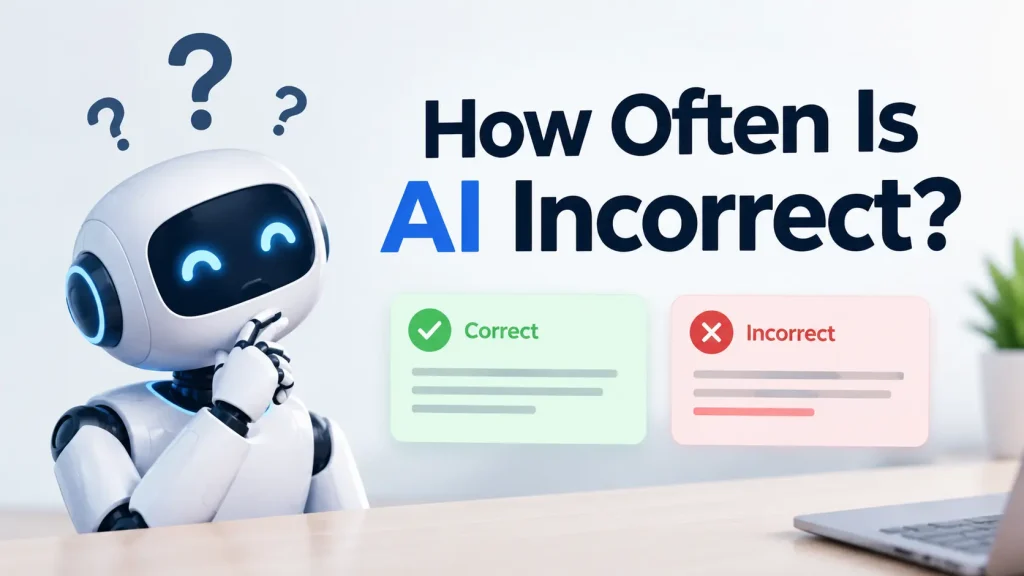
AI can be wrong often enough that you should verify important claims, but there is no universal error rate for every use. An answer may mix accurate information with made-up or misleading details, so fluent wording is not proof of truth. A hallucination is a fabricated or unsupported AI-generated claim presented as if it were true.
This matters when you use AI for research, work, or everyday decisions. A student might rely on an answer for an assignment, while someone else may use one to plan a purchase or understand a news event. The stakes depend on what you do with the information.
This article separates measured accuracy from what people think about AI answers. Those measures can tell you different things, and neither gives one rate for every tool or task.
Key Takeaways
- No single percentage describes errors across all AI tools and tasks.
- Accuracy depends on the model, the question, and the test method.
- A confident response can still contain unsupported claims.
- Search links and citations need their own checks.
- Use expert or official review when an error could cause harm.
How Often Is AI Incorrect?
AI error rates vary by task and by how an evaluation defines a wrong answer. A benchmark result applies to its model, task, and test setup, not every answer you may receive.
An AI error rate only describes the model and test that produced it.
Why There Is No Single Error Rate
One study of general-purpose AI chatbots using 2023-era models found hallucinations on 58-82% of legal research queries. Specialized legal RAG tools, which retrieve information before generating an answer, hallucinated more than 17% in that evaluation.
A 2025 evaluation found ChatGPT with search reached roughly 80% accuracy on legal research. That result was comparable to specialized legal AI tools, but it came from a different evaluation.
What the Available Percentages Measure
Those legal figures describe model performance on specific legal research tests. The evaluations used different tools and setups, so you should not compare them as if they came from one controlled test.
Student surveys measure opinions, not a model’s tested accuracy. In one survey, 75% of students said AI provides inaccurate answers. Also, 94% said it is not equally accurate across areas of study.
In that survey, 90% wanted AI to be transparent about its limitations. Another 87% said effectiveness depends on prompt quality, while 62% said AI gives overly simplified answers. Those results describe student views, not the share of answers that failed a test.
| Test context | Metric | Result | Scope |
| General-purpose chatbots on legal research queries | Hallucination rate | 58-82% | 2023-era models; legal queries |
| Specialized legal RAG tools | Hallucination rate | More than 17% | One legal research evaluation |
| ChatGPT with search on legal research | Accuracy | Roughly 80% | 2025 evaluation; legal research |
| Student survey | Belief that AI provides inaccurate answers | 75% | Student perception, not measured performance |
The legal results come from different evaluations, not one controlled comparison. Before you trust an accuracy claim, check what it actually tested.
Why Accuracy Changes by Task
A model may do well on short questions but struggle with a complex request that needs current facts or careful reading. A student’s broad question about a subject may also need different skills than a legal research task.
When you read a reported accuracy figure, check these five details:
- The task the tool had to complete.
- The model and version that produced the results.
- The test set, including the questions and material used.
- The definition of accuracy or error.
- Whether the result reflects user perception or measured performance.
These details explain why two results may differ without either number being false. Design choices and data conditions can also shape the errors an AI tool produces.
Why AI Gets Answers Wrong
An AI tool can produce plausible wording without checking whether the claim behind it is true. Language that sounds certain is not a built in test of truth. The tool’s training, instructions, and retrieved material all affect its answers.
Training Data Can Carry Gaps and Bias
Training data contains reliable and unreliable information, along with gaps and patterns of bias. A language model learns from those patterns, so its intelligence does not mean it understands every subject or sees every group fairly.
The Gender Shades project found that commercial face-classification systems performed better on male and lighter-skinned faces. The largest error gaps affected darker-skinned females. Those findings concern classification systems, not all AI tools.
A 2023 analysis of more than 5,000 Stable Diffusion images found that the image tool amplified gender and racial stereotypes. A 2024 UNESCO analysis found women were described in domestic roles four times more often than men. These examples show different concerns in image and text outputs.
Plausible Language Is Not a Truth Check
A language model predicts likely word patterns from its training. It does not have a built-in fact checker that confirms each claim before it responds.
This helps explain why an answer can sound smooth while still being incomplete or wrong. The model may produce a likely-sounding detail because it fits the wording, even when the detail lacks support.
That limit matters for information about people, places, and current events. A polished response can hide uncertainty instead of showing where the model has gaps.
Prompts and Retrieved Information Can Mislead
Small changes in a prompt can change what a model thinks you mean. For example, asking about a student who ran for king at the University of Maryland led ChatGPT to interpret the subject differently when the wording changed.
Clear wording can reduce ambiguity, but it cannot ensure accuracy. If a question leaves out a key detail, the model may fill the gap with an assumption instead of asking what you meant.
Search tools can retrieve incomplete results or misread a page. RAG, or retrieval-augmented generation, adds retrieved information to an answer, but retrieval does not guarantee that the final response or its claims are correct.
These design and data limits lead to recognizable kinds of errors in real answers.
What Does AI Get Wrong in Practice?
A convincing looking answer can contain one invented detail among several plausible claims. AI outputs can mix true facts with false claims, misread your request, or give citations that fail to support the content.
It Can Blend Facts With Fabrications
A response may get the main point right but add an unsupported date, name, or claim. That mix makes an error harder to spot than an answer that is plainly wrong from start to finish.
Some errors are about meaning rather than facts. In the University of Maryland student-king example, small changes in wording led ChatGPT to interpret the subject differently. The answer could address a different person or event than you intended.
Citations May Be Fake or Misleading
In Mata v. Avianca, an attorney submitted ChatGPT-generated legal citations and quotations that did not exist. The judge found they had been presented as available in major legal databases.
Between 2023 and 2025, 863 court decisions worldwide addressed AI hallucinations, including 790 in 2025. A 2025 analysis also found hallucinated citations in dozens of accepted NeurIPS papers. These cases show that a citation error can affect court filings and research.
A source can also exist but fail to support the attached claim. A Google AI summary cited a University of Maryland Slavic Languages and Literature guide that did not exist; its URL led to a defunct page.
In another example, an AI search summary linked to a real Guardian article that did not support the claim beside it. A working link is not proof that the cited information matches.
It Can Misread the Request
An AI tool may answer a nearby question instead of the one you asked. That can happen when a prompt has more than one reading or leaves out context that changes the meaning.
A response can also leave out an important limit or turn a suggestion into a firm statement. Those issues can make the output seem more complete than it is, even when each sentence reads smoothly.
These errors are not always obvious on a quick read. Check claims and citations independently before relying on them.
How Can You Verify AI Before Relying on It?
Pick one concrete claim from an AI answer and verify it outside the tool. Check the claim itself, not just the confidence or detail in the response. The higher the stakes, the stronger your review should be.
Use AI to find a lead, then check the underlying material yourself.
Use this five-step checklist before you rely on information:
- Separate factual claims from opinions, advice, or suggestions.
- Search for each important claim in independent, human-created sources.
- Open every citation and confirm the page exists and supports the exact claim.
- Compare conflicting information with an authoritative or subject-specific source.
- Seek expert or official review when an error could have serious consequences.
Use Search and RAG as Starting Points
AI search and RAG can help you locate useful material, but they do not replace checking the material itself. A search result may leave out context, and a generated response may describe a page inaccurately.
Open the full page and match its wording to the claim. If the page supports only part of the answer, treat the rest as unconfirmed rather than assuming the citation covers everything.
Match Your Review to the Stakes
For schoolwork, follow your course rules and disclose or cite AI use when required. Check key facts in the readings or other sources your instructor accepts.
For work or personal decisions, choose sources suited to the subject. An official agency page may help with a rule, while a qualified expert may be needed for a complex health or legal question.
Do not use an AI response as the sole authority for an important decision. The more serious the possible consequences, the more carefully you should check the answer with independent sources and qualified people.
Let the consequences of an error set the depth of your review. A final rule follows: treat AI as a starting point, not the last word.
Conclusion
Artificial intelligence can be useful without serving as a final authority. A fluent answer is not proof of truth, and important claims deserve confirmation from independent, human-created sources.
AI issues can affect students, workers, and people making decisions in daily life. The right check depends on the possible consequences, but one small action can lower the risk.
Choose one factual claim in your next AI response and check it against a trustworthy human-created source before using the result.
FAQ
How often do AI models hallucinate in legal research?
One evaluation found hallucinations on 58-82% of legal research queries for general-purpose chatbots using 2023-era models. That range applies to those tools and queries, not all AI tasks or current models. Other legal evaluations used different methods, so their results should not be treated as direct comparisons or as a general rate for every answer.
Can AI make mistakes when it has web search?
Yes, AI can make mistakes even when it has web search. A tool may misread a search result, miss context on a page, or attach a real link to a claim the page does not support. Search can help you find material, but you still need to open the page and compare it with the answer.
Does a more detailed prompt guarantee a correct AI answer?
No, a more detailed prompt does not guarantee a correct answer. Specific wording can reduce ambiguity and help the tool understand what you mean. It cannot ensure that the facts are right, that the model has enough information, or that its answer reflects the best evidence. Check important claims even when your prompt is precise.
Can AI cite a real source that does not support its claim?
Yes, AI can cite a real source that does not support its claim. A link may lead to a valid article while the article says something different from the attached summary. Open the page, find the relevant passage, and check whether it supports the exact statement rather than only a related topic.
What is the difference between an AI hallucination and a regular mistake?
A hallucination is fabricated or unsupported content presented as fact. It is one kind of AI error, and the terms can overlap when an incorrect answer includes made-up details. A regular mistake may also come from an outdated fact or a misunderstanding. In either case, the key question is whether reliable evidence supports the claim.
Is AI safe to use for important decisions?
Do not treat AI as the sole authority for an important decision. It can help you find questions to ask or information to review, but an error may have serious consequences. Check claims with an appropriate expert or official source, especially when the choice affects health, legal rights, money, or safety.