
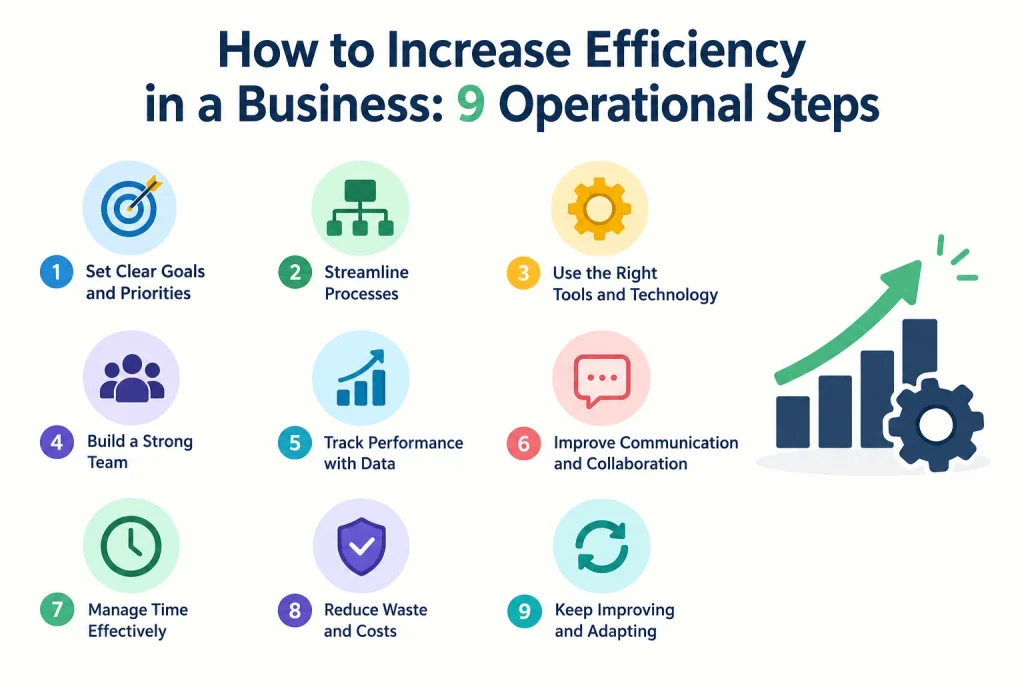
Understanding how to increase efficiency in a business starts with removing wasted time, money, and effort from daily operations. Business efficiency is the ability to produce high-quality goods or services using the smallest necessary amount of resources. Instead of requiring employees to work longer hours, efficient companies simplify their workflows, document repeatable tasks, and automate routine work.
According to research from Asana’s Anatomy of Work index, knowledge workers spend roughly 60% of their workday on “work about work.” This term refers to coordination activities such as searching for files, chasing status approvals, attending unnecessary meetings, and copying data between apps. Only 40% of the workday remains for the skilled jobs employees were hired to perform.
Organizations can reclaim that lost time by auditing existing processes before purchasing new software. The nine operational steps below explain how business leaders identify bottlenecks, standardize work, and measure efficiency gains accurately.
Business Efficiency vs. Productivity vs. Effectiveness
Business efficiency is the practice of minimizing wasted time, money, and effort during daily operations, while productivity measures the total volume of output. Effectiveness measures whether those tasks actually help the company reach its strategic goals. Understanding the difference between these three metrics prevents managers from optimizing the wrong activities.
| Metric | Core Definition | Guiding Question | Practical Business Example |
| Productivity | Total volume of output compared to input. | How much work did the team complete? | A customer support representative closes 80 support tickets in a single day. |
| Efficiency | Completing tasks with minimal wasted time, cost, or effort. | How smoothly and affordably did the team complete the work? | Self-service help articles and automated routing allow the team to solve those issues in half the time. |
| Effectiveness | Completing the right tasks to achieve core business goals. | Did this work move the company forward? | The engineering team fixes the software bug that caused customers to submit those 80 tickets in the first place. |
Key Operational Rule: Managers should prioritize effectiveness first, then build efficiency around those valuable tasks. Making an unnecessary task faster still wastes company resources.
9 Ways to Improve Business Efficiency
Companies improve operational efficiency by removing workflow waste first, standardizing core processes second, and automating repetitive tasks third. Jumping straight to software purchases without fixing broken procedures often creates faster errors. The nine strategies below follow a logical sequence from process cleanup to long-term measurement.
1. Audit Workflows to Eliminate Operational Bottlenecks
An operational bottleneck is a single stage in a workflow where tasks pile up and slow down the entire process. Business leaders cannot fix bottlenecks they have not mapped. Management teams should start by choosing one recurring process—such as client onboarding, order fulfillment, or monthly invoicing—and listing every step required from start to finish.
Borrowing from Lean Six Sigma methodology, operations managers inspect workflows for eight common types of waste, known by the acronym DOWNTIME:
- Defects: Mistakes in products or paperwork that require rework or customer refunds.
- Overproduction: Creating reports, product features, or inventory before customers or teams need them.
- Waiting: Idle time spent waiting for a manager’s signature, file access, or supplier delivery.
- Non-Utilized Talent: Paying skilled specialists to perform basic data entry or routine filing.
- Transportation: Unnecessary movement of physical inventory or digital files across multiple handoffs.
- Inventory Excess: Cash tied up in unsold warehouse stock, unused software licenses, or backlogged tasks.
- Motion: Employees clicking through five separate software tabs or walking across a warehouse to finish one job.
- Extra Processing: Requiring three management signatures to approve a routine $100 supply purchase.
Once the team maps the workflow, leaders can apply the ESCAP filter: Eliminate unnecessary steps, Simplify complicated rules, Combine duplicate actions, Automate routine handoffs, and Prioritize tasks by financial return.
2. Document Standard Operating Procedures (SOPs)
A Standard Operating Procedure (SOP) is a documented, step-by-step guide that explains how to complete a recurring business task. When a vital process exists only inside one employee’s memory, the company faces a major operational risk. Whenever that employee takes time off or leaves the organization, work slows down while coworkers figure out what to do.
SOPs turn individual knowledge into a shared company asset:
- Keep documentation brief: Teams rarely read 100-page training manuals. Checklists with 5 to 10 clear bullet points work best for daily tasks.
- Record tasks in real time: The employee who performs the job can record a three-minute screen-share video explaining the steps, then turn the audio transcript into a written checklist.
- Store files in one central hub: Hosting all SOPs in a searchable company wiki allows new hires to find answers independently without interrupting senior staff. For structured guidance on implementing systems, organizations can explore professional Content Marketing frameworks to organize internal knowledge bases effectively.
3. Implement Workflow Automation for Repetitive Tasks
Workflow automation uses software rules to execute repetitive, predictable tasks without human intervention. After a company strips out unnecessary steps and writes clear SOPs, automation becomes a strong multiplier. According to McKinsey’s global automation research, roughly 70% of organizations pilot or scale automation across one or more business units to reduce human error and speed up delivery.
Small and mid-sized businesses get the best return by automating frequent, rule-based tasks that require no creative judgment:
- Accounting and Billing: Accounting software can automatically send recurring invoices, issue late-payment reminders, and categorize standard bank expenses.
- Sales and Lead Management: Integration tools (often called Robotic Process Automation or RPA connectors) can copy new website inquiry forms directly into a Customer Relationship Management (CRM) system and assign a sales representative automatically.
- Customer Support Triage: Automated helpdesks can answer common order-tracking or password-reset requests immediately, sending only complex problems to human agents.
4. Streamline Communication and Reduce Meeting Overload
Streamlining workplace communication means establishing clear rules for when teams should use instant messaging, shared project boards, or live meetings. Adding more status meetings or sending constant chat messages fragments employee attention and slows down complex projects.
Organizations can protect focus time by setting three communication standards:
- Default to Asynchronous Updates: Asynchronous communication happens when team members send and read updates on their own schedules rather than meeting live. Written project updates or short recorded videos work well for routine status reports, saving live meetings for complex problem-solving.
- Adopt a 25-Minute Meeting Default: Changing company calendar settings from 30 and 60 minutes to 25 and 50 minutes builds breathing room into the schedule. Requiring a written agenda for every calendar invite also allows employees to decline meetings that lack a clear decision goal.
- Centralize Project Tracking: Splitting task updates across email, chat apps, and text messages causes lost information. Companies operate more smoothly when they pick one chat tool for urgent questions and one project management platform as the single source of truth for deadlines.
5. Invest in Targeted Employee Training and Autonomy
Employee training and decision-making autonomy reduce errors and remove management approval bottlenecks. Software tools only improve efficiency when staff members know how to use them properly. When leadership rolls out new systems without proper onboarding, employees often fall back on slow, manual workarounds.
Micromanagement also slows down daily operations. If customer-facing staff must wait hours for a supervisor to approve every minor request, cycle times suffer. Gallup’s workplace research indicates that business units with engaged, well-supported employees achieve 14% to 18% higher productivity and 23% higher profitability than disengaged teams.
- Cross-train core roles: Training at least two employees on every critical workflow prevents work from stopping during sick days or vacations.
- Set clear approval limits: Giving customer service representatives authority to resolve billing issues up to a fixed amount (such as $100) solves customer problems on the first contact.
6. Track Key Performance Indicators (KPIs) for Decision-Making
Key Performance Indicators (KPIs) are measurable values that demonstrate how effectively a company achieves core operational objectives. Using data analytics and business intelligence (BI) dashboards allows managers to spot slowdowns early rather than relying on guesswork.
Tracking too many numbers can overwhelm a team. Department heads should monitor three to five focused KPIs tied directly to operational flow:
- Operations and Fulfillment: Order-to-Delivery Cycle Time and Product Defect Rate.
- Sales and Marketing: Customer Acquisition Cost (CAC) and Average Lead Response Time.
- Professional Services: Billable Utilization Rate and Project Budget Variance.
7. Optimize Supply Chain and Vendor Management
Supply chain and vendor optimization ensures that a business receives necessary physical materials or digital software services on time and at the lowest reasonable cost. Delays in the supply chain halt production and frustrate buyers.
- For Physical Product Businesses: Demand forecasting and Just-In-Time (JIT) inventory systems help companies keep popular items in stock without tying up cash in overcrowded warehouses. Reviewing supplier delivery speeds every quarter helps identify unreliable vendors early.
- For Service and Digital Businesses: Conducting a quarterly software audit uncovers unused subscriptions and overlapping tools. Connecting core software programs so billing, inventory, and project boards share data automatically eliminates manual file uploads.
8. Outsource Non-Core Business Activities
Outsourcing non-core activities involves hiring specialized external contractors or agencies to handle secondary administrative tasks. Building internal departments for every minor business requirement increases fixed payroll costs and distracts leadership from revenue-generating work.
Small and medium-sized companies frequently improve efficiency by outsourcing:
- Payroll processing, routine bookkeeping, and tax preparation.
- Information technology (IT) helpdesk support and cybersecurity monitoring.
- Specialized legal contract review or seasonal customer support overflow.
9. Use Structured Time Management and Agile Workflows
Structured time management and Agile workflows break large projects into short, focused work cycles while reducing multitasking. When employees constantly switch between financial spreadsheets, email alerts, and chat notifications, their brains need several minutes to refocus after every interruption.
Two scheduling habits help teams finish work faster:
- Two-Week Agile Sprints: Instead of managing massive six-month projects all at once, teams break work into two-week batches called sprints. Tracking tasks on a visual board (To Do → In Progress → Review → Complete) shows everyone where work stands without needing status meetings.
- Time-Blocking: Employees group similar administrative tasks—such as answering emails or reviewing invoices—into two set windows per day, leaving morning hours open for uninterrupted focus work.
How to Measure Business Efficiency (3 Core Formulas)
Business leaders measure operational efficiency by comparing the resources invested (money, time, and labor) against the revenue or output generated. Establishing baseline numbers before changing a workflow allows managers to prove whether their adjustments worked.
1. Operating Expense Ratio (OER)
The Operating Expense Ratio measures how much it costs to run a company compared to the total revenue brought in. Operating expenses include rent, payroll, software subscriptions, and utilities. A shrinking percentage over several quarters indicates that the business is running more efficiently.
$$\text{Operating Expense Ratio} = \left( \frac{\text{Total Operating Expenses}}{\text{Total Revenue}} \right) \times 100$$
- Example: A company spending $60,000 in operating expenses to generate $100,000 in revenue has an OER of 60%. Lowering expenses to $50,000 while keeping revenue at $100,000 improves the OER to 50%.
2. Revenue Per Employee
Revenue Per Employee calculates how much annual sales volume the company generates for each full-time worker. This ratio shows how effectively an organization combines human talent with training and technology.
$$\text{Revenue Per Employee} = \frac{\text{Total Annual Revenue}}{\text{Total Full-Time Equivalent Employees}}$$
- Example: A business earning $2,000,000 in annual revenue with 20 full-time staff members generates $100,000 per employee.
3. Process Cycle Time Efficiency
Process Cycle Time Efficiency compares the actual minutes spent working on a task against the total elapsed time from start to finish (which includes waiting in queues).
$$\text{Cycle Time Efficiency} = \left( \frac{\text{Active Value-Added Work Time}}{\text{Total End-to-End Lead Time}} \right) \times 100$$
- Example: Preparing a client contract takes only 30 minutes of active typing, but the document sits in a manager’s inbox for 9 hours and 30 minutes waiting for approval (10 hours, or 600 minutes total). The cycle time efficiency is only 5% ($30 \div 600 \times 100$). Removing the approval bottleneck raises efficiency immediately.
Common Mistakes That Reduce Operational Efficiency
Even well-intentioned management teams can accidentally slow down their companies when trying to modernize operations. Avoiding three common traps protects long-term performance:
- Adopting Too Many Software Tools at Once: Buying a new app every month without canceling older platforms causes tool fatigue. Every extra program adds login hurdles, training time, and integration maintenance.
- Changing Multiple Department Workflows Simultaneously: Overhauling accounting, sales, and customer support in the same week overwhelms employees. Successful operations managers fix one bottleneck per month, stabilize the new habit, and then move to the next area.
- Confusing Blind Cost-Cutting with Efficiency: Eliminating quality control checks or freezing employee training budgets lowers expenses in the short term, but the resulting product defects, customer refunds, and staff turnover increase costs later.
Frequently Asked Questions (FAQs)
What is the fastest way to increase efficiency in a business without spending money?
The fastest zero-cost way to increase business efficiency is to cut unnecessary status meetings and write simple checklists (SOPs) for the company’s three most common tasks. Removing redundant manager sign-offs and shortening default meeting times from 60 minutes to 25 minutes frees up several hours of productive work time every week at no financial cost.
What are the biggest causes of inefficiency in a business?
The most common causes of business inefficiency are undocumented processes, manual data entry across disconnected software apps, unclear employee responsibilities, and excessive approval bottlenecks. When staff members spend over half their day searching for information or waiting for supervisor permission, overall output drops.
How often should a company audit its operational processes?
Most small and mid-sized businesses benefit from auditing their core operational workflows and software subscriptions once per quarter. A quarterly review gives teams enough time to collect ninety days of performance data while catching wasted spending or slow processes before they damage annual profit margins.
Conclusion: A 30-Day Operational Action Plan
Improving business efficiency is an ongoing practice of finding workplace friction and removing it systematically. Rather than attempting a massive company overhaul all at once, leadership teams can follow a structured 30-day schedule to build momentum:
- Week 1 (Identify): Survey department leads to identify the single most frustrating, repetitive bottleneck in their weekly schedule.
- Week 2 (Simplify): Map every step of that target workflow and remove duplicate data entry or unnecessary approval stops.
- Week 3 (Standardize and Automate): Write a one-page SOP checklist for the updated process and connect existing software tools to handle routine steps automatically.
- Week 4 (Measure): Compare the Process Cycle Time before and after the change to verify the hours saved.
Organizations looking to streamline operations and scale predictably can explore comprehensive Digital Marketing Services to align internal workflows with external growth goals. For personalized guidance on removing operational friction, businesses can also Get a Free Consultation to map out a custom efficiency strategy.