

Reviewed against public model benchmarks and vendor documentation. Last updated September 2026. About 12 minutes to read.
If you have spent any time researching AI for your product or business, you have probably hit the same wall many teams hit. Everyone tells you to just use an LLM, and then the bill arrives. Or the response takes four seconds when your app needs two hundred milliseconds. Or your compliance team finds out that customer data left the building.
That is usually the moment people start asking the real question. Not which AI is smartest, but which one actually fits what you are building.
This guide answers that with real numbers, not just theory. We will define both terms clearly, compare them across the factors that actually matter, show you current 2026 benchmark data, and walk through a decision framework you can apply today.
Quick answer
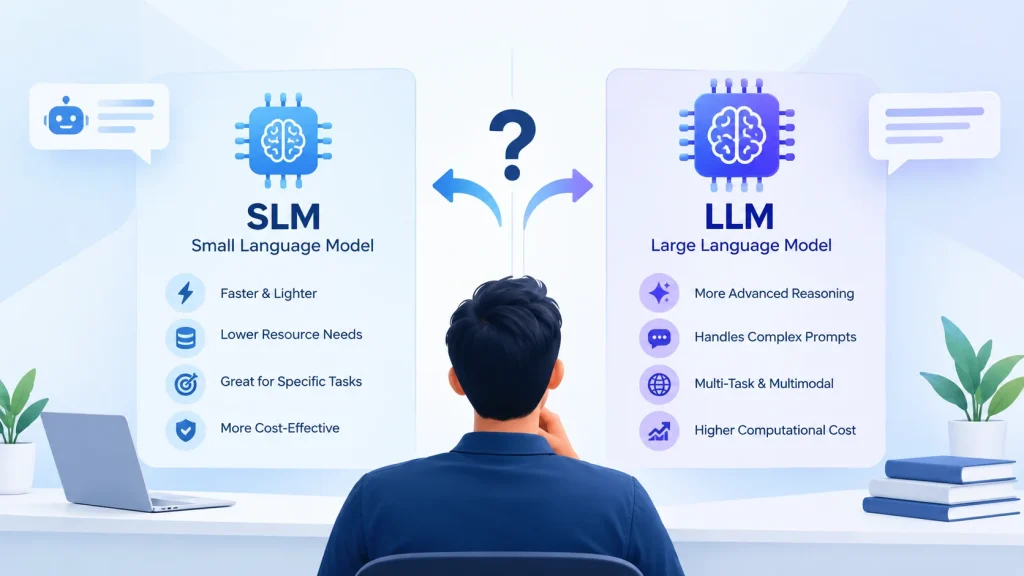
A Small Language Model, or SLM, typically has somewhere between one and fifteen billion parameters. It can run on a single GPU, a laptop, or even a phone, and it is tuned to do one job, such as classification, extraction, or summarization, reliably and cheaply.
A Large Language Model, or LLM, typically has over one hundred billion parameters. It needs cloud scale infrastructure and is built to handle almost any task, from open ended reasoning to creative writing to multi step planning.
Choose an SLM when your task is well defined, latency matters, or data cannot leave your environment. Choose an LLM when the task is open ended, requires broad world knowledge, or you are still figuring out what the task even is.
Key takeaways
- SLMs and LLMs are not competing products. They are different tools for different jobs, and the size gap between them, roughly one to fifteen billion parameters versus over one hundred billion, drives almost every other trade off.
- The cost per query for a well chosen SLM can be well over one hundred times cheaper than a frontier LLM API call, because you are not paying for capability you do not use.
- The top performing SLMs of 2026, models like IBM’s Granite 4.1, Alibaba’s Qwen3.5, Google’s Gemma 4, and Microsoft’s Phi-4-mini, now match or beat thirty billion parameter models from 2024 on standard benchmarks.
- The industry is not really choosing one over the other anymore. The dominant 2026 pattern is a hybrid architecture, where an LLM acts as the reasoning layer and delegates repetitive, well defined tasks to a fleet of specialized SLMs.
- Most teams overspend by defaulting to the biggest model available just in case. If your task is narrow and repeatable, that default is usually the wrong call.
What is a language model, in plain terms
A language model is software trained to predict what word, or token, comes next in a sequence of text. That simple mechanic, repeated at scale, is what lets a model answer questions, summarize a report, write code, or hold a conversation. Every model you have heard of, including ChatGPT, Claude, Gemini, and Llama, works on this same underlying principle. What separates them is not the concept. It is the scale and the data they were trained on.
A useful way to picture the difference: think of an LLM as a large general hospital, staffed and equipped to treat almost anything that walks through the door. An SLM is more like a specialist clinic down the street, built around one kind of case, with a shorter wait and a lower bill, as long as your problem actually fits what that clinic treats.
What is a Small Language Model, or SLM
An SLM is a language model built around a simple idea: use only as much intelligence as the task requires, and nothing more. Instead of training on a slice of the entire internet, SLMs are trained, or distilled from a larger model, on a smaller, carefully curated dataset that is often focused on one domain or task type.
Because they carry far fewer parameters, SLMs can run on a single consumer GPU, a company server, or even directly on a smartphone, with no round trip to the cloud required. That is what makes them attractive for anything where speed, cost, or data privacy cannot be compromised.
What is a Large Language Model, or LLM
An LLM is trained on massive, broad datasets, including public web text, books, and code, using enormous compute budgets. The payoff is versatility. An LLM can reason across domains it was never explicitly trained for, hold context over long conversations, and generalize to tasks nobody anticipated when it was built. The trade off is cost, latency, and a heavier operational footprint, since running one typically requires cloud scale GPU infrastructure.
SLM vs LLM at a glance
| Factor | Small Language Model | Large Language Model |
|---|---|---|
| Parameter count | Roughly 1 to 15 billion | 100 billion to over 1 trillion |
| Where it runs | Phone, laptop, single GPU, edge device | Cloud GPU or TPU clusters |
| Typical latency | Tens of milliseconds | Hundreds of milliseconds to several seconds |
| Training data | Curated, focused on a specific domain | Broad, at internet scale |
| Best at | Narrow, repeatable tasks | Reasoning across many domains |
| Fine tuning | Hours, on a single GPU, low cost | Days to weeks, on distributed clusters |
| Data privacy | Can stay entirely inside your own infrastructure | Usually leaves your environment through an API |
| Typical cost pattern | Mostly fixed, if hosted internally | Variable, paid per token |
Where SLMs and LLMs actually differ
Size and architecture
The parameter count is not just a vanity number. It is a rough proxy for how much world knowledge and nuance a model can represent. More parameters mean better contextual understanding but a much heavier compute bill. SLMs compensate for fewer parameters with techniques like quantization, pruning, and knowledge distillation, which compress a model’s size while trying to preserve as much of its capability as possible.
Cost
This is usually the deciding factor for teams once they move from prototype to production.
LLM APIs bill per token. That is convenient at low volume, but at high volume it scales linearly, or worse, with usage. You are renting intelligence you do not fully need for every request.
SLMs hosted on your own infrastructure flip the model. You pay a mostly fixed infrastructure cost, such as a GPU or a server, and your marginal cost per additional query drops close to zero.
If you are processing millions of narrow, repetitive requests a month, such as document classification, PII redaction, or ticket triage, the SLM route usually wins on cost by a wide margin.
Latency
Latency is the trade off people underestimate until it costs them a user. An LLM’s attention mechanism has to work across a much larger parameter space, which drives up what is known as time to first token. SLMs, by contrast, can respond in tens of milliseconds, which is fast enough for real time voice assistants, live customer support, or features running directly on a device that need to feel instant.
Accuracy, and where bigger is not automatically better
It is tempting to assume the larger model always wins on accuracy. In practice, that is only true for open ended reasoning that spans multiple domains. For narrow, well defined tasks, a fine tuned SLM often matches or beats a general purpose LLM, simply because it is not spending capacity trying to be good at everything else. We will show you real 2026 benchmark numbers on this shortly.
Fine tuning and customization
Fine tuning an LLM is a heavy lift. It requires specialized infrastructure, large teams, and real money. Fine tuning an SLM is comparatively lightweight. Techniques like LoRA, short for Low Rank Adaptation, and PEFT, short for Parameter Efficient Fine Tuning, let a small engineering team adapt an SLM to a new domain in a matter of hours, on a single GPU. That difference alone changes how fast you can iterate.
Deployment and operations
Running an LLM at scale typically means building, or buying, a serious MLOps stack to manage distributed inference, memory, and uptime. SLMs are simpler to operate. They containerize cleanly and fit into standard Kubernetes workflows that most platform teams already run.
Data privacy and compliance
If you are in healthcare, finance, or legal, this factor alone can decide the architecture. Sending personally identifiable information to a third party LLM API introduces a data processing relationship you have to govern, document, and defend to auditors. An SLM deployed inside your own infrastructure never sends that data anywhere. It simply does not leave your perimeter.
Energy and environmental footprint
It is worth saying plainly that training and running frontier LLMs consumes a genuinely large amount of energy. SLMs, by virtue of their size, have a meaningfully smaller footprint. That is a real consideration if your organization tracks sustainability commitments.
2026 benchmark snapshot: how today’s small models actually perform
Most SLM vs LLM comparisons online still reference models from 2023 to 2024, such as Mistral 7B, DistilBERT, and GPT 2. That is outdated. Here is where the current generation of open weight models under ten billion parameters stands on three widely used benchmarks: MMLU Pro, which tests broad reasoning across many subjects, HumanEval, which tests functional code generation, and GSM8K, which tests multi step math reasoning.
| Model | Parameters | MMLU Pro | HumanEval | GSM8K | Context window |
|---|---|---|---|---|---|
| IBM Granite 4.1 | 8B | 56.0% | 87.2% | 92.5% | 131K |
| Qwen3.5-9B | 9B | 82.5% | 76.0% | 91.2% | 128K |
| Gemma 4 E4B | About 4.5B | 78.1% | 71.3% | 89.2% | 128K |
| DeepSeek-R1-Distill-Qwen-7B | 7B | 72.8% | 55.1% | 92.8% | 128K |
| Phi-4-mini | 3.8B | 52.8% | 74.4% | 88.6% | 128K |
| Llama 3.1 8B Instruct | 8B | 73.0% | 72.6% | 86.4% | 128K |
Model names in the table above link to each vendor’s official model card. Scores are compiled from a mid 2026 independent benchmark roundup and vary by evaluation methodology, quantization, and prompt format, so treat them as directional, not absolute, and check each model’s official card before making a production decision.
The takeaway: several models built in 2026 now post benchmark scores that would have been considered flagship level just two years earlier. If you last evaluated SLMs before 2025, it is worth another look. The gap has closed faster than most roadmaps assumed it would.
Real world cost comparison
Numbers vary by provider and use case, but the order of magnitude is consistent across the industry.
| SLM, hosted internally | LLM, accessed by API | |
|---|---|---|
| Typical training cost | Tens of thousands of dollars | Tens of millions of dollars at frontier scale |
| Fine tuning cost | Roughly $1,000 to $50,000 | Roughly $100,000 to over $1,000,000 |
| Hardware | A few GPUs, or consumer grade hardware | Thousands of GPUs or TPUs, cloud clusters |
| Inference cost pattern | Low, mostly fixed | Variable, scales with usage |
When an SLM is the right call
- Focused, repetitive tasks. Document classification, entity extraction, sentiment tagging, and form parsing all have a narrow, predictable shape.
- Latency sensitive or offline environments. Mobile apps, embedded devices, or anywhere a round trip to the cloud is not acceptable.
- Strict data privacy requirements. Healthcare, legal, and financial workflows where data cannot leave your infrastructure.
- Cost sensitive, high volume workloads. If you are running the same type of query millions of times a month, the per query savings compound fast.
Example: a bank needs to mask account numbers and names in chat transcripts before they reach an analytics platform. An LLM here is overkill. A fine tuned model with three to four billion parameters can do it locally, with latency under fifty milliseconds and no data ever leaving the bank’s own servers.
When an LLM is the right call
- Open ended or unpredictable tasks. General purpose assistants, creative writing, and anything where you cannot fully list the possible inputs in advance.
- Reasoning across domains. Synthesizing information across legal, financial, and technical material in a single request.
- Early stage prototyping. When you are still validating whether a problem is even solvable with AI, an LLM gives you a strong baseline without months of data collection.
Example: a strategy consultant needs to synthesize signal from thousands of news articles, filings, and social posts to spot a market shift. That kind of broad synthesis across domains is exactly what LLMs are built for.
The real 2026 trend: you do not have to choose
The SLM vs LLM framing is useful for understanding trade offs, but it is increasingly the wrong lens for architecture decisions. What we are actually seeing in production systems this year is a hybrid pattern. An LLM sits at the top as a planner, breaking a complex request into smaller steps, then delegates each step to the SLM best suited for it. The LLM brings the reasoning and judgment. The SLM fleet brings the speed and cost efficiency to execute at scale.
If you are designing a new AI system in 2026, this hybrid model, not a single monolithic choice, is probably the architecture worth planning for from day one.
Common mistakes teams make
- Defaulting to the biggest available model just in case. Reaching for the largest model regardless of task complexity almost always costs more and performs worse on narrow tasks than a properly fine tuned SLM would.
- Ignoring total cost of ownership. Teams calculate cost per token but forget observability, rate limiting, and the engineering time spent managing prompts for a general purpose model.
- Underestimating model drift. Third party LLM providers update their models regularly, which can quietly break prompts that worked yesterday. An SLM hosted on your own infrastructure gives you version stability you control.
- Treating this as a decision made only once. As benchmarks shift every few months, it is worth reevaluating your model choice on a regular cadence, not just once at launch.
Frequently asked questions
Is an SLM just a smaller version of an LLM? Not always. Some SLMs are distilled from a larger model, but many are trained from scratch on a curated dataset focused on one domain. What defines an SLM is not its lineage. It is the parameter count and the focus on a narrower set of tasks.
Can an SLM be as accurate as an LLM? Yes, within its trained domain. On narrow, well defined tasks, a fine tuned SLM frequently matches or beats a general purpose LLM. On open ended reasoning across unfamiliar domains, LLMs still have the edge.
Do SLMs work offline? Yes, and that is one of their main advantages. Because they are small enough to run on a phone, laptop, or edge device, SLMs can operate without an internet connection, unlike most LLMs, which depend on cloud infrastructure.
Is it cheaper to run an SLM than an LLM? For high volume, narrow tasks, yes, often dramatically so, since you are paying mostly fixed infrastructure costs instead of a variable per token fee. For low volume or highly varied workloads, an LLM API can still be more cost effective simply because you avoid infrastructure overhead.
Which should I choose for a chatbot? It depends on scope. A chatbot answering questions about your own product or company is a great fit for a fine tuned SLM. A chatbot meant to handle any question a user might ask, across any topic, needs an LLM’s broader knowledge base.
Bottom line
There is no universal winner in the SLM vs LLM comparison. There is only a better or worse fit for what you are building. Start by asking how narrow and repeatable your task actually is. If you can describe the input and expected output precisely, an SLM will likely serve you faster, cheaper, and with fewer privacy headaches. If your use case is genuinely open ended, an LLM’s breadth is worth the extra cost and latency. And if you are building anything complex in 2026, do not be surprised if the real answer is both: an LLM directing a fleet of specialized SLMs underneath it.