
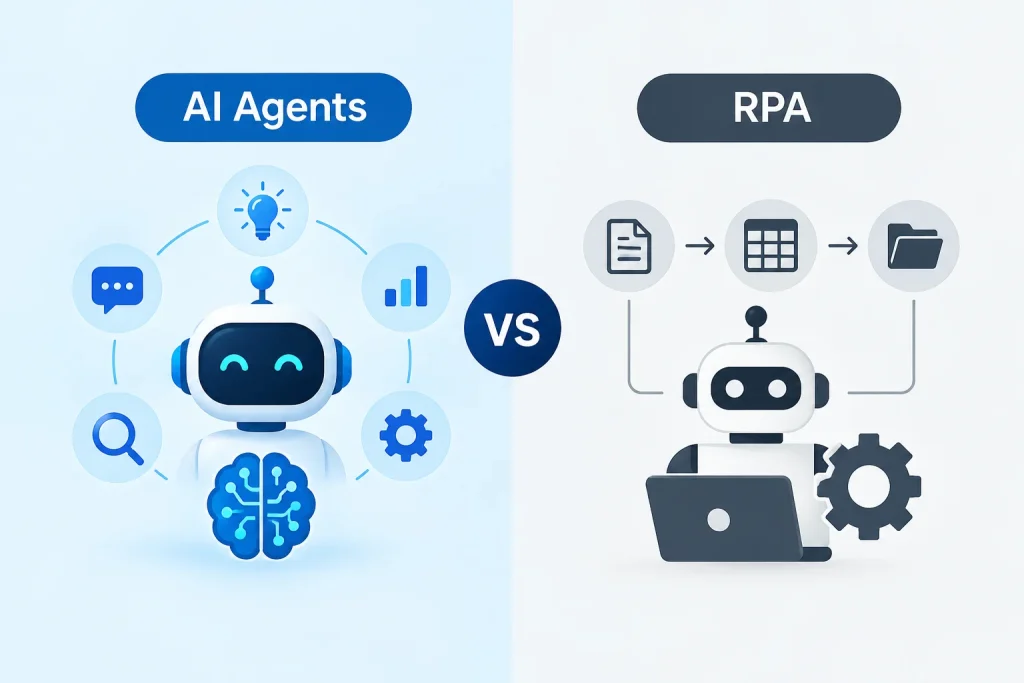
AI agents and RPA are both enterprise automation technologies, but they work differently. RPA uses rule-based software bots to automate repetitive, structured tasks on stable systems. AI agents use large language models (LLMs) to reason, adapt, and make decisions on unstructured data. RPA automates 20 to 30 percent of business processes. AI agents automate 60 to 80 percent. The cost comparison favors AI agents: $77,000 in year one versus $228,000 for RPA (Beam.ai, 2026). Maintenance for RPA runs 20 to 30 percent of initial cost annually. For AI agents it runs 10 to 15 percent. The recommended approach in 2026 is hybrid: keep stable RPA bots running, deploy AI agents for complex tasks, and orchestrate both together.
What Is RPA (Robotic Process Automation)?
Robotic Process Automation (RPA) is software that uses rule-based bots to automate repetitive, structured, human tasks on digital systems. These bots mimic what a person does on a computer: clicking buttons, copying fields, pasting data, and moving between applications exactly as programmed. RPA was introduced in the early 2000s and became the default enterprise automation tool by the mid 2010s.
RPA is not artificial intelligence. It does not learn, reason, or adapt. It follows a script. If the script says copy the value in field A and paste it into field B, the bot does that every time. If field B moves to a different location on the screen, the bot fails and needs a human to update the script.
According to the IBM MIT AI Lab, RPA can be cheaper and faster to deploy than AI tools, and is less prone to errors in stable environments (CIO.com, 2025). But its capabilities are limited to processes that never change.
What Are AI Agents?
AI agents are autonomous software programs powered by large language models (LLMs) that can reason, plan, use tools, and take actions to accomplish goals. Unlike RPA bots, AI agents do not follow predefined scripts. They receive a goal, analyze the situation, decide what to do, execute the action, and adapt when conditions change.
AI agents can browse the web, search documents, run code, make API calls, and interact with multiple software systems in a single workflow. They handle unstructured data (emails, PDFs, images, natural language) that RPA cannot process without separate preprocessing.
TechTarget defines AI agents as automation programs powered by LLMs that operate using an orchestration framework, guiding them from receiving an initial prompt to using various tools to complete a task (TechTarget, 2025).
Examples of AI agent platforms include CrewAI, LangChain, LangGraph, Microsoft AutoGen, Semantic Kernel, OpenAI Swarm, Google Vertex AI Agent Builder, and Hugging Face Smolagents.
AI Agents vs RPA: What Is the Difference?
The core difference is how each technology makes decisions. RPA executes tasks by script. AI agents achieve goals through reasoning. RPA follows if-then rules. AI agents use LLMs to understand context, make judgments, and adapt to new information.
Decision Making
RPA has zero decision-making capability. If a process step requires a judgment call, the bot stops and waits for a human. AI agents can evaluate context, weigh options, and make autonomous decisions within defined guardrails.
Data Handling
RPA processes only structured data: spreadsheets, databases, forms with predictable fields. 80 to 90 percent of enterprise data is unstructured (emails, PDFs, Slack messages, meeting transcripts). AI agents process both structured and unstructured data natively.
Adaptability
RPA scripts break when the environment changes. A UI update, a new form field, a different PDF format, and the bot needs manual reprogramming. AI agents adapt to changes by reasoning about the goal and adjusting their approach.
Scope
RPA automates single tasks between specific applications. AI agents orchestrate end-to-end processes across multiple tools and systems.
Learning
RPA is static. It does not improve over time. AI agents improve through feedback loops and accumulated context, learning which approaches work best for each type of task.
AI Agents vs RPA: Head to Head Comparison
| Dimension | RPA | AI Agents |
|---|---|---|
| Architecture | Rule-based scripts | LLM-powered reasoning with tool use |
| Data Input | Structured only | Structured plus unstructured |
| Adaptability | Breaks on changes | Adapts to changes |
| Decision Making | None (if-then rules) | Judgment, trade-offs, escalation |
| Scope | Single task, specific apps | End-to-end process orchestration |
| Learning | Static, manual reprogramming | Continuous improvement via feedback |
| Implementation Time | 3 to 6 months | 1 to 2 weeks for first agent |
| Maintenance Cost | 20 to 30 percent of initial cost annually | 10 to 15 percent of initial cost annually |
| Process Coverage | 20 to 30 percent of business processes | 60 to 80 percent of business processes |
| Failure Mode | Stops on errors | Adaptive recovery plus human escalation |
| Interface Dependency | GUI-based, breaks on UI changes | API plus adaptive UI handling |
| Compute Cost | Low (lightweight scripts) | Higher (LLM inference) |
| Multimodality | Limited to text and clicks | Text, images, audio, video |
| API Access Required | No (screen scraping works) | Yes (depends on API availability) |
| Maturity | 15+ years, well established | 2 to 3 years, rapidly evolving |
| User-Facing Capability | Employee-facing (background) | Customer-facing (direct interaction) |
The Cost Math That Changed the Conversation
Year One Costs
Traditional RPA implementations cost approximately $228,000 in year one versus $77,000 for AI automation platforms. That is a 66 percent difference (Beam.ai, 2026).
RPA breakdown: $50,000 to $100,000 licensing plus $100,000 to $150,000 implementation, consulting, and training.
AI Agent breakdown: $25,000 to $50,000 platform fees plus $25,000 to $50,000 integration, prompt engineering, and guardrails.
The 4 to 1 Maintenance Ratio
For every $1 spent on RPA licensing, enterprises spend $3.41 to $4.00 on consulting and maintenance to keep bots running. Licensing is roughly 25 percent of total cost. The other 75 percent is keeping fragile scripts alive (Kognitos, 2026).
This ratio is structural. It comes from the architecture, not from bad implementations. Every UI change, every format update, every new exception requires a developer to update the script.
RPA Project Failure Rate
30 to 50 percent of RPA projects fail outright (Coasty.ai, 2026). Maintenance costs eat 60 to 75 percent of total RPA automation budgets.
AI Agent ROI
AI agents deliver 8 to 1 ROI versus RPA 2 to 1 (Coasty.ai, 2026). Forrester found organizations achieving 210 percent ROI over three years with AI agent deployments, with payback under six months (Beam.ai, 2026).
Total Cost of Ownership
Enterprises that transitioned from RPA to AI agents report a 40 percent reduction in total cost of ownership within 24 months.
ROI Calculator: When Does the Switch Make Sense?
| Factor | Keep RPA | Migrate to AI Agents |
|---|---|---|
| Process changes more than twice per year | X | |
| Inputs are 100 percent structured and predictable | X | |
| Exception rate is under 5 percent | X | |
| Exception rate is over 10 percent | X | |
| Task involves unstructured data (emails, PDFs, images) | X | |
| Process requires decisions or judgment calls | X | |
| Bot maintenance cost exceeds 30 percent of licensing | X | |
| Process is fully stable and never changes | X |
If three or more factors point to Migrate, the economics favor AI agents.
The AI Agents Market vs The RPA Market
The numbers tell the story. The intelligent process automation market is projected to grow from $15.2 billion in 2024 to $48.8 billion by 2034 at a CAGR of 14.3 percent (GM Insights, 2025). The AI agents market is forecast to rise from $7.8 billion in 2025 to $52.6 billion by 2030 (MarketsandMarkets, 2025).
The RPA market grew 14.5 percent to $3.6 billion in 2024, well below Forrester’s earlier projection of $22 billion by 2025. Enterprise budgets are moving, and the trajectory is clear.
According to a Gartner survey, 15 percent of day-to-day work decisions will be made autonomously by AI by 2028 (VentureBeat, 2024). McKinsey estimates AI could contribute between $2.6 trillion and $4.4 trillion annually to the global economy as generative AI reshapes how work gets done (Geeks Ltd, 2025).
When RPA Still Makes Sense
RPA is not dead. It is narrower than people thought. There are specific use cases where a deterministic bot is still the right tool.
High-volume, rule-based tasks on stable systems. Scheduled data transfers between legacy systems with fixed schemas that genuinely never change.
Regulatory reporting that follows an exact template. Quarterly reports that must be generated in a specific format with no variation, where the penalty for deviation is compliance risk.
Simple UI automation on systems with no API. When a legacy system has no API, no database access, and the only way to interact with it is through the UI, RPA screen-scraping capability is still the practical choice.
The pattern is that RPA works when the process is fully predictable and the environment is fully stable. The moment either condition breaks, maintenance costs spike and the economics flip.
Air France-KLM reported saving 200,000 hours through RPA bots handling structured data tasks (ComputerWeekly, 2025). That is a legitimate RPA success story. But even Air France-KLM is now increasing the intelligence of those bots by adding AI capabilities.
When to Choose AI Agents Over RPA
AI agents are the better choice when:
The task involves unstructured data. Emails, PDFs, social media posts, meeting transcripts, images. Anything that requires understanding, not just extracting.
The process requires judgment. Prioritizing customer inquiries, evaluating risk, making recommendations, handling exceptions that do not fit a predefined rule set.
The environment changes frequently. Vendor interfaces update, formats shift, new data sources appear. AI agents adapt. RPA bots break.
You need end-to-end orchestration. A process that spans multiple systems, requires coordination between steps, and involves handoffs between departments.
Speed to deployment matters. An AI agent can be deployed in days. An RPA bot requires weeks of process documentation, script development, and testing.
Hybrid Architecture: Using RPA and AI Agents Together
The most effective automation strategy in 2026 is not RPA or AI agents. It is RPA and AI agents, orchestrated together.
Deloitte calls this Agentic Process Automation (APA). Deloitte defines APA across six dimensions: primary focus (dynamic workflows vs well-defined tasks), complexity to build/deploy (higher for APA), adaptability (APA adapts autonomously, RPA requires human editing), speed to value (RPA faster per use case, APA adapts across use cases), data format (APA handles unstructured data natively), and contextual understanding (APA understands context, RPA does not) (Deloitte AI Institute, 2025).
The concept is straightforward: AI agents handle the cognitive work (understanding, deciding, adapting), while RPA bots handle the execution work (clicking, copying, pasting) on systems where UI automation is still the practical choice.
How Hybrid Orchestration Works
An incoming request enters the AI agent reasoning layer. The agent analyzes the request type and routes it to the appropriate handler.
Structured tasks go to RPA bots for execution. Unstructured tasks stay with AI agents for cognitive processing. Complex decisions get routed to human review. The result is an orchestrated output that uses the right technology for each step.
This solves the automation sprawl problem: dozens of RPA bots, various API integrations, and manual processes that handle exceptions, all managed by a single intelligence layer.
Practical Hybrid Use Cases
Intelligent document processing. RPA extracts structured data from fixed-format documents. AI agents interpret unstructured documents. The orchestration layer routes each document to the appropriate handler.
Customer onboarding. RPA performs data entry into legacy systems. AI agents verify identities, assess risk, and make approval decisions. The orchestration layer coordinates the sequence.
Automated email responses. RPA manages templated replies for routine inquiries. AI agents personalize responses for complex queries. The orchestration layer determines which type of response is needed.
Insurance claims processing. RPA manages structured workflows (data entry, status updates, payment processing). AI agents interpret complex documents (medical records, accident reports, policy interpretations) and make coverage determinations.
Phase 1: Audit (Weeks 1 to 2)
Inventory all existing RPA bots. For each bot, document what process it automates, how often the process changes, current exception rate, monthly maintenance hours and cost, and dependencies on other bots or systems.
Rank bots by maintenance cost. The most expensive-to-maintain bots are your first migration candidates.
Phase 2: Pilot (Weeks 3 to 6)
Select 2 to 3 high-maintenance bots for replacement. Build AI agent equivalents that handle the same process. Run both in parallel for 2 to 4 weeks. Compare accuracy (error rates), exception handling (how many exceptions require human intervention), processing speed, and maintenance effort.
Phase 3: Hybrid Deployment (Weeks 7 to 12)
Deploy AI agents for the pilot processes. Keep RPA bots running for stable, low-maintenance processes. Implement an orchestration layer that routes work between agents and bots based on task type.
Phase 4: Scale (Months 4 to 12)
Redirect all new automation requests to AI agents. Continue migrating RPA bots as their maintenance costs exceed the cost of an AI agent equivalent. Retire bots that are no longer needed.
Phase 5: Optimize (Ongoing)
Monitor agent performance. Expand capabilities. Add new use cases. The goal is not to eliminate all RPA. It is to use each technology where it performs best.
Governance: Managing RPA and AI Agents at Scale
Forrester warns that unmanaged proliferation of AI agents will lead to the same governance challenges that plagued scaled-up RPA deployments: overlapping functionalities, poor governance, and high maintenance costs. Do not repeat those mistakes.
Governance Checklist
Centralized inventory. Maintain a single registry of all automation assets: RPA bots, AI agents, API integrations, and manual processes. Know what exists and what it does.
Ownership assignment. Every bot and agent has a designated owner responsible for performance, updates, and retirement.
Performance monitoring. Track error rates, exception rates, processing times, and cost per transaction for every automation asset.
Access controls. AI agents that interact with customer data or financial systems require the same access governance as RPA bots: role-based access, audit trails, and compliance reviews.
Escalation paths. Every AI agent needs clear rules for when to escalate to a human. Unlike RPA bots that stop on errors, AI agents can make autonomous decisions. Those decisions need guardrails.
Regular review. Quarterly review of all automation assets. Retire bots that are no longer cost-effective. Consolidate agents with overlapping capabilities.
Industry Use Cases: AI Agents vs RPA
Financial Services
Invoice processing: RPA extracts data from fixed-format invoices. AI agents interpret variable-format invoices and validate against purchase orders. Beam.ai reports reducing invoice processing cost from $15.97 per document to $3.24 with AI agents.
Regulatory reporting: RPA generates reports in exact template format. AI agents analyze regulatory changes and adapt reporting logic.
Fraud detection: RPA flags transactions matching known patterns. AI agents analyze transaction patterns and detect novel fraud methods in real time.
Customer onboarding: RPA enters customer data into systems. AI agents verify identity, assess risk, and make approval decisions.
Healthcare
Claims processing: RPA extracts structured data from claim forms. AI agents interpret clinical notes and assess medical necessity.
Prior authorization: RPA submits standardized authorization requests. AI agents analyze clinical criteria and draft authorization narratives.
Patient scheduling: RPA updates scheduling systems with confirmed appointments. AI agents handle complex scheduling requests and coordinate across departments.
E-Commerce
Order processing: RPA updates order status in ERP. AI agents handle order exceptions and coordinate returns.
Product listing: RPA uploads product data to marketplaces from structured feeds. AI agents generate product descriptions and optimize listings.
Customer support: RPA routes tickets to appropriate teams. AI agents handle customer inquiries, draft responses, and resolve issues.
Manufacturing
Inventory updates: RPA syncs inventory levels between systems. AI agents predict demand and recommend reorder points.
Quality reporting: RPA generates quality reports from structured data. AI agents analyze defect patterns and recommend process changes.
Supplier communication: RPA sends standardized purchase orders and confirmations. AI agents negotiate terms, handle exceptions, and manage relationships.
Frequently Asked Questions
What is the difference between AI agents and RPA?
RPA uses rule-based software bots to automate repetitive, structured tasks on stable systems. AI agents use large language models (LLMs) to reason, adapt, and make decisions on unstructured data. RPA follows scripts. AI agents achieve goals through reasoning. RPA automates 20 to 30 percent of business processes. AI agents automate 60 to 80 percent.
Will AI agents replace RPA completely?
Not entirely. RPA will continue to be used for high-volume, rule-based tasks on stable systems where deterministic execution is preferred. However, the majority of new automation deployments will use AI agents, and many existing RPA bots will be replaced as their maintenance costs exceed the cost of AI agent equivalents.
How much does it cost to migrate from RPA to AI agents?
A typical pilot migration of 2 to 3 bots costs $15,000 to $50,000 and takes 4 to 6 weeks. Full enterprise migration typically takes 6 to 12 months and costs $100,000 to $500,000, depending on scale. The ROI typically pays back within 6 to 12 months through reduced maintenance costs.
Can I run RPA and AI agents together?
Yes. This is the recommended approach for most enterprises. Deloitte calls this Agentic Process Automation (APA). An orchestration layer routes work between RPA bots (for structured, stable tasks) and AI agents (for unstructured, dynamic tasks).
Which RPA vendors support AI agents?
UiPath (Agent Builder, Maestro, ScreenPlay), Automation Anywhere (Agentic Process Automation System, acquired Aisera), Microsoft (Power Automate with agentic workflows), Blue Prism (autonomous agents), and Pega all offer AI agent capabilities within their platforms. The trend is convergence: former RPA companies adding AI agent layers.
What is the ROI of AI agents vs RPA?
AI agents deliver 8 to 1 ROI versus RPA 2 to 1. Forrester found 210 percent ROI over three years for AI agent deployments, with payback under six months. Traditional RPA ROI is typically 2x to 3x over 3 years. AI agents achieve higher ROI because maintenance costs are lower (10 to 15 percent vs 20 to 30 percent annually) and process coverage is higher (60 to 80 percent vs 20 to 30 percent).
Do I need to replace all my RPA bots with AI agents?
No. The migration pattern that works is: keep stable, low-maintenance bots running. Redirect all new automation requests to AI agents. Retire high-maintenance bots first. The savings from replacing fragile bots fund the rest of the transition.
What are the best AI agent frameworks for enterprise automation?
The leading AI agent orchestration frameworks include CrewAI, LangChain, LangGraph, Microsoft AutoGen, Semantic Kernel, Google Vertex AI Agent Builder, Hugging Face Smolagents, Letta, LlamaIndex, and OpenAI Swarm. These frameworks help manage workflows and integrate AI agents with external tools.
Conclusion
AI agents and RPA solve different problems in different ways. RPA is the right tool for structured, repetitive tasks on stable systems where deterministic execution matters. AI agents are the right tool for tasks that involve unstructured data, require judgment, or operate in changing environments.
The practical decision in 2026 is not which one wins. It is which processes should stay on RPA and which should move to AI agents. The migration roadmap is straightforward: audit your existing bots, pilot agent replacements for the most expensive-to-maintain ones, implement hybrid orchestration, and scale from there.