

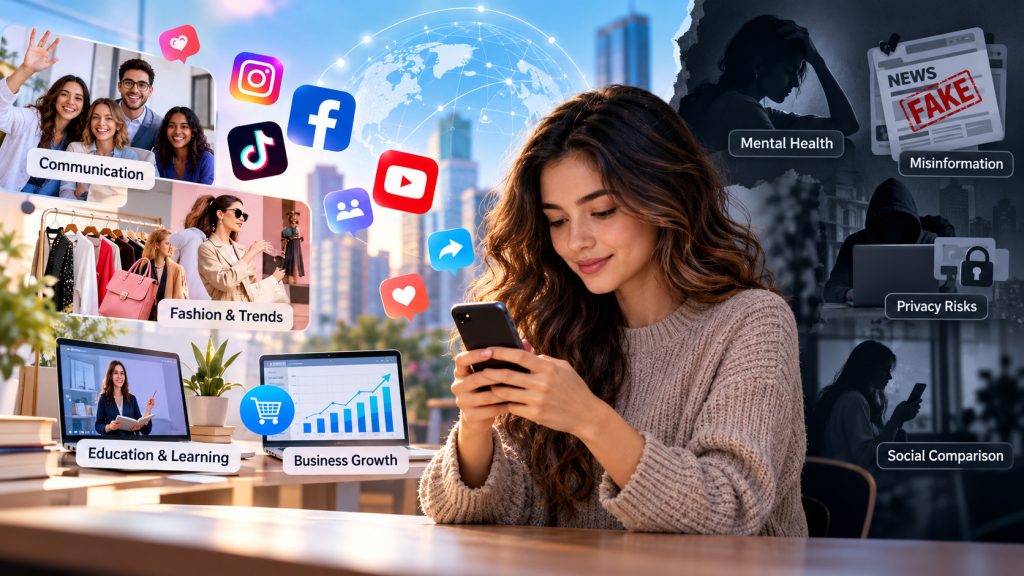
Social media has changed how I communicate, discover fashion, learn new skills, follow the news, and interact with businesses. It makes information easier to access, but it also creates challenges involving misinformation, privacy, mental health, and constant digital distractions.
The real question is no longer whether social media influences modern society. It is how I can use that influence to make better decisions without losing control of my time, attention, or personal information.
According to Pew Research Center’s 2025 survey, 84% of U.S. adults reported using YouTube, 71% Facebook, and 50% Instagram. TikTok was used by 37%. The research surveyed 5,022 U.S. adults and highlights the importance of these platforms in everyday life.
These figures show platform adoption, not whether social media makes people’s lives better or worse. To understand its effects, I need to look beyond user numbers and examine what people actually experience online.
What Is the Influence of Social Media on Modern Society?
Social media influences modern society by changing how people communicate, build relationships, access information, discover products, and participate in culture.
Unlike traditional media, platforms such as Facebook, Instagram, TikTok, YouTube, Snapchat, and X allow users to create content, respond to others, and share information almost instantly.
This creates opportunities, but it also changes how attention and trust work.
A useful video can help me understand a difficult subject in minutes. A misleading video can spread an incorrect claim just as quickly.
The main benefits and risks include:
| Area | Positive influence | Potential risk |
|---|---|---|
| Communication | Easier contact across distances | Less attention during face-to-face conversations |
| Education | Tutorials and access to knowledge | Misinformation and weak sources |
| Fashion | Faster discovery of styles and designers | Impulsive purchases and social comparison |
| Business | Direct customer engagement | Misleading advertising and reputation problems |
| Relationships | Communities and social support | Cyberbullying and pressure for approval |
| News | Quick access to updates | Rumors and misleading context |
| Mental health | Opportunities for belonging | Harmful content and problematic usage patterns |
For me, the solution is not to treat social media as completely good or bad. It is to understand how individual platforms and personal habits shape the outcome.
How Does Social Media Affect Communication and Relationships?
Social media makes communication easier
One of the most noticeable benefits of social media is how easily people can stay connected across geographical boundaries.
I can share photographs, participate in a group conversation, or communicate with relatives living thousands of miles away without the delays associated with older communication methods.
Online communities also help people connect through shared interests.
Someone interested in photography can exchange ideas with other photographers. A student can join a study group. A small business owner can talk with customers without depending entirely on physical meetings.
These interactions may help people form relationships that would otherwise be difficult to establish.
Why online connection does not always mean stronger relationships
The problem begins when constant connectivity starts replacing meaningful attention.
I might respond to several online messages while ignoring the person sitting beside me. I may also judge a friendship by likes, comments, or response times rather than the actual quality of that relationship.
Digital interactions can support relationships, but they cannot automatically replace trust, empathy, and consistent personal communication.
My practical approach is to use social media to maintain relationships while protecting time for conversations without notifications.
How Do Social Media Algorithms Influence What I See?
The problem with personalized feeds
Social media platforms do not necessarily show every post in chronological order.
Many use recommendation algorithms to decide which content is most likely to hold my attention.
For example, YouTube’s explanation of its recommendation system identifies signals including clicks, watch time, likes, dislikes, shares, and viewer feedback.
These signals help the platform recommend videos based on predicted interests.
However, a recommendation is not proof that a video is accurate, trustworthy, or appropriate for every user.
Why repeated content can affect my judgment
Imagine I watch several videos criticizing a particular fashion trend. My feed may begin showing more content on the same subject.
Eventually, I could start believing that most people share that opinion, even though my feed does not represent the entire population.
Repeated exposure may influence what appears normal, popular, or worth purchasing.
To reduce this problem, I can follow different sources, search for information independently, and use platform controls to adjust recommendations.
The key is to remember that a personalized feed is a selection of information, not a complete picture of reality.
How Has Social Media Changed Fashion and Consumer Behavior?
Fashion is one of the industries where social media has visibly changed how products and trends reach consumers.
In the past, many people learned about fashion through magazines, runway shows, television, and physical stores.
Now I can discover a clothing brand through a short video, compare outfits on Instagram, examine customer feedback, and visit a retailer’s website within minutes.
How Instagram and TikTok influence fashion trends
Visual platforms have made fashion discovery more interactive.
Creators can demonstrate how clothing fits, show different combinations, and discuss materials or prices.
Consumers also contribute by posting their own outfits and reviews.
This gives buyers information beyond a brand’s official advertising.
However, popular content can create pressure to purchase something simply because it is trending.
Before making a decision, I would rather check product quality, sizing, return policies, and independent reviews than rely entirely on a creator’s recommendation.
Research: Teenagers use social media for product reviews
A Pew Research Center report published in April 2026 found that roughly six in ten U.S. teen TikTok users visited the platform for product reviews.
The findings were based on a survey of 1,458 teenagers ages 13–17, conducted between September and October 2025.
This does not mean six in ten teenagers purchased a product because of TikTok.
It does demonstrate that product evaluation has become an important reason some young consumers use social platforms.
For fashion businesses, this creates a practical opportunity: helpful product demonstrations and honest reviews may be more useful to potential buyers than content focused only on attention.
Case Study: Comme des Garçons and the Influence of Digital Fashion Culture
How a distinctive fashion identity creates discussion
Comme des Garcons is a brand-related retail reference that appeared in the original article. The fashion label itself was established by Japanese designer Rei Kawakubo and is known for designs that challenge familiar ideas about clothing, shape, and presentation.
This makes Comme des Garçons a relevant example when discussing the relationship between fashion, visual culture, and online conversation.
Its designs can encourage people to discuss questions beyond ordinary product features.
Is clothing primarily functional? Can fashion be interpreted as art? Why do unconventional designs attract attention?
These conversations fit naturally into image- and video-driven social platforms.
Documented example: The Metropolitan Museum of Art exhibition
In 2017, The Metropolitan Museum of Art presented Rei Kawakubo/Comme des Garçons: Art of the In-Between.
The exhibition ran from May 4 to September 4, 2017, and included approximately 140 examples of Kawakubo’s womenswear dating from the early 1980s onward.
The exhibition documented how her work challenged traditional categories of fashion and artistic expression.
These are verified cultural and exhibition facts. They do not establish how many sales, impressions, or followers the brand gained from social media.
What this case teaches me about digital branding
I take three practical lessons from this example.
First, an identifiable creative perspective matters. A brand can give people something meaningful to discuss when its products express a recognizable design approach.
Second, context helps audiences understand a product. A photograph may attract attention, but explaining a design’s purpose, material, and history can support a deeper conversation.
Third, attention and business performance are different measurements. I cannot assume that a widely discussed collection produces a specific number of purchases.
Another useful lesson concerns online shopping. Similar-looking retail domains, including Comme des Garcons, should not be treated as proof of official brand affiliation merely because of their names. When buying fashion online, I would verify the retailer and its policies through trusted sources.
The broader lesson is that social media can spread a brand’s creative identity, but claims about commercial performance require separate, reliable evidence.
How Does Social Media Influence Business and Marketing?
Social media has changed the relationship between businesses and their audiences.
A company no longer needs to rely entirely on newspapers, television, or physical advertising to communicate with potential customers.
A small business can demonstrate a product, answer questions, respond to feedback, and explain an offer directly through its social profiles.
However, simply publishing more content does not guarantee sales.
Why social media engagement does not always produce revenue
Imagine I manage a clothing business.
A video receives thousands of views, but customers cannot find the price, size chart, delivery details, or return policy.
The content may attract attention without giving viewers enough information to purchase.
That is why I would separate social media performance into different stages:
- Discovery: Reach, video views, and profile visits.
- Evaluation: Useful comments, product questions, saves, and website visits.
- Action: Qualified inquiries, completed orders, bookings, and repeat purchases.
This approach helps distinguish popularity from meaningful business outcomes.
For businesses that want to build a consistent presence, social media marketing services can connect content creation, audience engagement, advertising, and performance measurement.
How influencer marketing changes customer trust
Influencers often introduce products to audiences that follow their recommendations.
This can help shoppers discover products, but sponsorship needs to be clear.
The U.S. Federal Trade Commission’s influencer disclosure guidance explains that material relationships, such as receiving payment or free products in exchange for an endorsement, must be appropriately disclosed when covered by U.S. law.
A paid partnership is not automatically dishonest.
The problem arises when commercial relationships are hidden or claims cannot be supported.
Before trusting a recommendation, I would look for clear disclosures, supporting evidence, and genuine product information.
Connecting social media activity to business results
An effective social media campaign needs a clear customer path.
For example, a local restaurant can show its menu, explain its opening hours, answer ordering questions, and direct customers to a working purchase or booking route.
Similarly, a clothing store might demonstrate a product before directing shoppers to an accurate product page.
NK Marketing Solutions’ practical social media guide for California small businesses explains how businesses can connect social media discovery with customer inquiries, appointments, orders, and other measurable actions.
When I want to understand the paid advertising side, I can also examine how to build a social media advertising strategy instead of assuming every popular post should be promoted.
How Does Social Media Support Education and Information?
Learning becomes more accessible
Social media allows students and professionals to access tutorials, educational discussions, demonstrations, and communities focused on specialized subjects.
If I want to understand a software feature, I can watch a short demonstration.
If I am researching a historical event, I can find lectures and discussions that introduce unfamiliar perspectives.
This flexibility can make learning more accessible.
However, the availability of educational content does not guarantee accuracy.
The UNESCO 2023 Global Education Monitoring Report examines technology’s role in education and emphasizes the importance of evaluating its use according to learners’ needs and educational goals.
For me, social media works best as a starting point for learning, not as an automatic replacement for textbooks, qualified educators, or original research.
The risk of misinformation
The same platforms that distribute useful information can also spread inaccurate or misleading claims.
A video may be edited to remove context. An old event may be presented as recent. A screenshot can circulate without identifying its original publisher.
The speed of sharing creates a problem: information can reach large audiences before anyone verifies it.
When a claim matters, I check the original source, publication date, supporting evidence, and whether other credible sources confirm it.
For businesses and publishers, this also explains why research-based content marketing matters. Content should answer genuine questions with information that readers can verify.
What Are the Negative Effects of Social Media?
Social media’s effects vary according to the user, the content, the platform, and the circumstances.
The most important risks deserve separate attention.
Social comparison and self-esteem
People often publish selected moments of their lives.
I might see holidays, achievements, expensive purchases, and edited photographs while overlooking the ordinary experiences that are not shared publicly.
Comparing my everyday experiences with those selected posts can create unrealistic expectations.
A useful response is to remember that a social profile is not a complete record of someone’s life.
Cyberbullying and online harassment
Social media can expose users to threatening messages, repeated criticism, harassment, or unwanted attention.
These experiences can damage a person’s sense of safety and discourage participation in online communities.
Reporting abusive content, using privacy controls, preserving relevant evidence, and seeking support when needed are practical protective measures.
Privacy and personal data
When I share photographs, location details, contact information, or daily routines, I may reveal more than I intend.
Privacy risks do not disappear simply because an account is set to private.
I should regularly review account permissions, audience settings, connected applications, and login security.
Excessive use and mental health
Research suggests that some forms and patterns of social media use are associated with mental health risks, particularly among younger users.
The U.S. Surgeon General’s 2023 advisory describes research linking more than three hours of daily social media use among adolescents with approximately twice the risk of certain mental health problems, including symptoms of anxiety and depression.
This is an association, not proof that social media exposure alone caused those outcomes.
A more recent Pew Research Center study published in 2026 found that about four in ten teen TikTok users said the platform negatively affected their sleep.
The same study found that 44% of teen Snapchat users said the platform helped their friendships.
These results show why I cannot describe all social media experiences as universally positive or negative.
For young users especially, both the potential benefits and risks need attention.
How Can I Use Social Media More Responsibly?
I do not need to abandon social media to improve my relationship with it.
Instead, I can follow a practical routine that addresses how I use platforms and what information I consume.
- Define my purpose. Before opening an app, I decide whether I want to communicate, learn, research a product, or relax.
- Verify important information. I check original sources before sharing claims involving health, money, or current events.
- Question commercial recommendations. I look for sponsorship disclosures, real customer feedback, and clear purchasing conditions.
- Review my privacy settings. I limit unnecessary personal information and protect my accounts with strong security.
- Control my recommendations. I follow useful sources and avoid repeatedly engaging with misleading or distressing content.
- Protect offline time. I reduce nonessential notifications during conversations, study, work, and sleep hours.
- Evaluate the outcome. I ask whether social media helped me achieve something meaningful or simply consumed my attention.
The purpose is not to follow an unrealistic set of restrictions.
It is to make my online habits consistent with what matters in daily life.
What Is the Future of Social Media?
Artificial intelligence, augmented reality, automated content creation, and changing recommendation systems will continue influencing digital experiences.
Some applications may make social platforms more useful.
AI-assisted translation could help people communicate across languages. Product visualization may help shoppers understand how an item might look before purchasing it. New editing tools may make content creation more accessible.
At the same time, these developments raise questions about trust.
Artificial intelligence and content authenticity
AI-generated images, video, and audio can make it harder to identify whether something represents a real event.
For me, the challenge is not merely recognizing generated content. It is establishing whether a claim has reliable evidence behind it.
Publishers and creators should make relevant disclosures and avoid presenting fabricated material as genuine documentation.
How businesses may adapt
Businesses will need to think beyond follower counts.
Useful content, transparent advertising, responsive customer service, and reliable information can help customers evaluate whether a business deserves their attention.
Technology will change, but the importance of customer trust is unlikely to disappear.
Frequently Asked Questions About Social Media and Society
1. How does social media influence modern society?
Social media changes how people communicate, discover products, share opinions, access information, and participate in cultural trends. I can benefit from fast communication and learning opportunities, but I also need to manage privacy, misinformation, and digital distractions.
2. What are the main advantages of social media?
The main advantages include easier communication, access to educational resources, opportunities for business promotion, creative expression, and connections with communities that share similar interests.
3. What are the disadvantages of social media?
Potential disadvantages include cyberbullying, misinformation, privacy exposure, excessive use, social comparison, and disrupted sleep. These risks vary depending on the individual, platform, content, and habits.
4. How does social media influence fashion trends?
Social media allows designers, influencers, and consumers to share outfits, opinions, and reviews quickly. I can discover new styles and compare products, but I should examine quality, price, and seller credibility before purchasing.
5. How has social media changed marketing?
Businesses can communicate directly with customers through posts, videos, messages, and advertising. Social media also creates opportunities to measure engagement, inquiries, website visits, and sales, although individual campaigns require reliable tracking to evaluate their actual impact.
6. Is social media harmful to mental health?
Some patterns of social media use are associated with mental health risks, while other experiences may support friendships and social connection. The effects are not identical for everyone, and research associations should not automatically be treated as proof of causation.
7. Why is social media important for small businesses?
Social media can help small businesses demonstrate products, answer questions, reach relevant audiences, and guide customers toward purchases or inquiries. I would assess its usefulness through business outcomes rather than follower growth alone.
8. How can I avoid misinformation on social media?
I can check the original source, publication date, complete context, and independent supporting evidence. A large audience or high engagement count is not sufficient proof of accuracy.
Conclusion: Understanding Social Media’s Influence on My Everyday Life
Social media has become part of how people communicate, learn, shop, work, and understand the world.
Its influence is not limited to entertainment. It shapes how information spreads, how trends develop, and how businesses build relationships with customers.
The research shows both opportunities and challenges.
I can use social media to discover useful information, maintain relationships, and explore creative ideas. But I also need to recognize misleading claims, protect my privacy, question paid recommendations, and manage my attention.
The Comme des Garçons example demonstrates how an established creative identity can become a subject of cultural discussion. Research on social media use also shows that people’s experiences vary widely.
My goal is not to spend more time online. It is to make the time I spend online more useful, informed, and intentional.
For businesses looking to turn social media activity into measurable customer outcomes, NK Marketing Solutions provides marketing-related services and resources. Businesses can also contact the team to discuss their needs.