Researched directly from ZipTie’s product, pricing, and FAQ pages, plus independent industry sources. Last verified September 18, 2026. Pricing and features on SaaS products change often, so check the current numbers on ZipTie’s own pricing page before you buy.
Independent review. NK Marketing Solutions is not affiliated with, sponsored by, or partnered with ZipTie, Inc. Every specific claim below is either linked to ZipTie’s own site or attributed to the third party source it came from.
People searching why choose ZipTie AI search analytics usually land on one confusing explanation first: that it is a generic website search behavior tool. It isn’t. The real ZipTie tracks something narrower and more current: whether your brand gets mentioned, cited, or recommended when someone asks ChatGPT, Google AI Overviews, Perplexity, or a similar engine a question in your category. Once that’s straight, the actual decision gets a lot easier to reason about.
Quick answer: Choose ZipTie if you need to track brand visibility across seven AI answer engines from one dashboard, want a single score that blends citations, mentions, and sentiment, and would rather pay for usage than for seats. It’s a solid fit for SEO teams and for agencies juggling several client brands. It won’t make sense for a solo site owner watching one brand, since cheaper tools in the category cover that case fine. It’s usage priced, starting at 42.75 dollars a month, and it isn’t the only option, so weigh it against named alternatives before you sign.
What ZipTie AI Search Analytics actually does
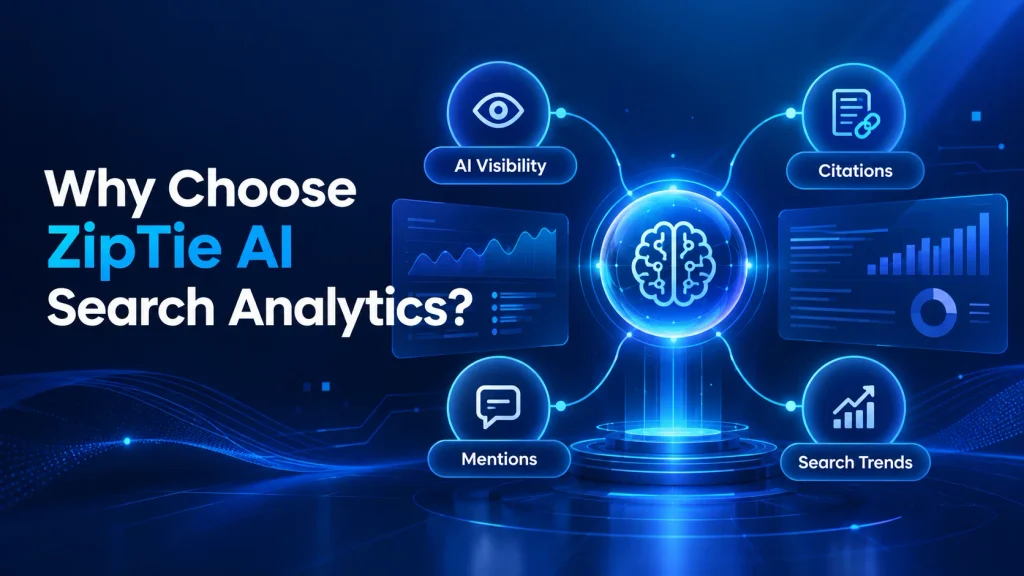
ZipTie is built around three signals, captured every time it checks a tracked prompt. Citations count how often your pages get used as a source in an AI answer. Mentions count how often your brand gets named inside the answer itself, sourced or not. Sentiment records whether that mention reads positive, neutral, or negative. Those three roll up into one AI Success Score from zero to a hundred per prompt, so a team can sort a long list of tracked queries by what actually needs attention instead of reading every answer by hand.
The workflow itself is three steps. A setup wizard reads your site and proposes the prompts your customers are likely asking AI engines, whether that’s a category question, a comparison, or your brand by name. ZipTie then checks those prompts on whatever schedule you set, daily, weekly, or monthly, across however many of the seven supported engines your plan covers: ChatGPT, Google AI Overviews, Perplexity, Google AI Mode, Microsoft Copilot, Bing AI Overview, and Google Gemini. Results land in an action queue ranked by what to fix next, each item linked straight to the screen where you’d actually do the work.
What it actually costs
There are no flat subscription tiers here. Price is built from two things you control: how many prompts you’re monitoring and how many engines you’re running them on. No seat fees, no project fees, and a workspace holds unlimited teammates and unlimited brands. Per ZipTie’s own pricing page, plans start at 42.75 dollars a month, with a discount for longer commitments: five percent off at three months, ten percent off at six, twenty percent off if you pay annually.
Three add ons sit outside that base price. Public API and Model Context Protocol access is a flat 10 dollars a month, letting tools like Claude Code, Cursor, or a custom agent query your ZipTie data directly. Content Generation runs 20 dollars a month per content slot, and each slot adds a set number of briefs and drafted pieces to your monthly pool. UGC Impact Analysis works differently: it multiplies your entire prompts and engines subtotal by 1.8 times, which makes it the single biggest lever on your bill by far, so budget for it on purpose rather than clicking it on as an afterthought.
One thing worth knowing if you’ve read about ZipTie somewhere else already: the product recently moved from a platform at ziptie.dev to a new one at ziptie.ai, same team. Older reviews mentioning a 69 dollar starter tier, a 14 day trial, or coverage capped at three engines are describing that earlier version, not this one. Right now the trial is 7 days, no card required, covering 25 daily monitored prompts across ChatGPT, Google AI Overviews, and Perplexity. The other four engines, plus API access, unlock once you’re on a paid plan.
Who this is actually built for
ZipTie fits teams that already treat AI answers as a real referral channel worth measuring, not something to worry about later. In practice that’s in house SEO teams at mid size and larger companies, and marketing or SEO agencies running several client brands at once. The unlimited seats and projects setup matters more for that second group, since an agency can run every client’s monitoring inside one workspace instead of paying a separate license per account, which is a real cost advantage over tools priced per project.
It’s a worse fit if you’re a solo site owner watching one brand with a handful of terms that matter. At that scale, a cheaper entry level tool in the same category will likely cover what you need without you paying for capacity you’ll never use.
If your team is still working out whether AI visibility belongs in your reporting at all, our guide on creating an AI strategy for your business is a reasonable starting point before you shortlist a specific tool.
What ZipTie is honest about, and what to watch for
Two details buried in ZipTie’s own FAQ deserve more attention than fine print usually gets. First, AI answers aren’t fixed. The same prompt can come back differently from one cycle to the next, so a single check is a sample, not a fact. ZipTie handles this reasonably well by building trends across repeated checks instead of treating one answer as gospel, but that also means a new project needs a few cycles before the data actually means anything. Second, ZipTie can’t see what an AI engine said before you started tracking a prompt. There’s no historical backfill beyond Google Search Console’s own 30 day window, so switching tools late, or starting late, costs you real history you can’t get back.
On privacy, ZipTie states plainly that it doesn’t train AI models on customer data and doesn’t share captured responses with third parties for training. That’s a reasonable baseline to expect from any vendor sitting on your competitive data, and it’s genuinely good that they say so outright instead of burying it in a policy nobody reads.
How ZipTie compares with the rest of the category
ZipTie isn’t the only tool built for tracking AI search visibility, a category some people call generative engine optimization and others call answer engine optimization. Real alternatives worth a look: Otterly.ai, generally the cheapest entry point in the category; Profound and Scrunch AI, both aimed at larger enterprise teams with broader engine coverage; Peec AI, a lighter option built around prompt tracking and multiple languages; AthenaHQ, which leans toward data driven recommendations at a price closer to the enterprise tools; and the AI visibility add ons Semrush and Ahrefs have built into their existing suites, for teams who’d rather extend something they already pay for than adopt a new standalone tool.
None of these is the universal right answer, ZipTie included. The honest move is to take the questions below and run them against ZipTie and at least one alternative before you sign anything.
Questions worth asking before you commit
- Do the AI engines you actually care about match what your plan covers? Coverage isn’t identical across all seven engines on every tier.
- How does the monthly cost move as your prompt count grows? Usage based pricing can climb fast once monitoring outgrows a pilot.
- What happens to your historical data if you cancel, and can you actually export it in a format you’d reuse?
- If you manage multiple brands or clients, does the pricing genuinely reward that, or does an add on quietly bring per project costs back in?
- Do you need content generation or UGC analysis on day one, or can you start on core monitoring and add them once you actually need them?
Turning AI visibility data into an actual content and SEO plan is usually where teams get stuck after buying a monitoring tool. That connective work, not just picking software, is what our SEO services team helps clients with.
The bottom line on why choose ZipTie AI search analytics
Choose it if you need real, engine by engine visibility tracking, a workflow that turns that tracking into a ranked to do list, and pricing that doesn’t punish you for managing more than one brand. Skip it, or at least shop around first, if you’re tracking a single small brand, since a cheaper tool will do the same job for less, or if the add on costs (especially UGC Impact Analysis at 1.8 times your base bill) push the total past what the visibility data is actually worth to you.
Frequently Asked Questions
What is ZipTie AI Search Analytics?
ZipTie is a platform that tracks how a brand is mentioned, cited, and portrayed inside AI generated answers from ChatGPT, Google AI Overviews, Perplexity, Copilot, Gemini, and other engines, then scores that performance and recommends what to fix.
How much does ZipTie AI Search Analytics cost?
As of September 2026, ZipTie uses usage based pricing built from the number of prompts monitored and the engines tracked, with plans starting at 42.75 dollars a month. There are no seat fees or project fees. The API, content generation, and UGC analysis add ons are priced separately.
Is ZipTie the same as ZipTie.dev?
They’re the same company. ZipTie moved from ziptie.dev to a new platform at ziptie.ai, and older reviews mentioning ziptie.dev’s earlier 69 dollar tier or 14 day trial are describing the previous version, not this one.
What are alternatives to ZipTie for AI visibility tracking?
Named alternatives in this category include Otterly.ai, Profound, Scrunch AI, Peec AI, AthenaHQ, Semrush’s AI Visibility Toolkit, and Ahrefs Brand Radar, each fitting a different budget and team size.
Is ZipTie a good fit for agencies managing multiple client brands?
Yes, more so than most tools in the category. ZipTie doesn’t charge per seat or per project, so an agency can run monitoring for several client brands inside one workspace without a per client license fee