Quick answer
Agentic AI is AI that works toward a goal on its own. It plans the steps, uses tools like your email or CRM, checks its results and asks a person when it is unsure. An autonomous agent is one system that does this work. Gartner’s 2026 survey found that only 17% of organizations have deployed AI agents so far, while more than 60% expect to within two years. Interest is high, but real use is still early.
What is agentic AI?
Agentic AI is software that works toward a goal instead of answering one prompt at a time. You give it an objective, such as “reply to every new lead within five minutes.” It decides the steps, uses the tools it can reach, checks its own work and keeps going until the job is done or it needs a person.
A chatbot waits for each instruction. An agentic system carries a task across many steps.
What are autonomous agents?
An autonomous agent is a single AI system that acts on its own inside limits you set. “Agentic AI” is the approach, and the agent is the thing you put to work.
“Autonomous” is a sliding scale. Most useful business agents still pause for approval before important actions.
Is it an AI agent or just a workflow?
Anthropic’s engineering team draws a clear line. A workflow follows steps written in advance. An agent decides its own steps and tools as it goes. Their advice is to use the simplest solution that works, which may mean not building an agent at all.
| Automation | AI workflow | AI agent | |
|---|---|---|---|
| Chooses its own steps | No | No | Yes |
| Handles unexpected input | Poorly | Moderately | Better |
| Predictable | Very | Mostly | Less |
| Cost to run | Low | Medium | Highest |
Here is a marketing example. An email that goes out 24 hours after a form fill is automation. A system that reads the lead’s message, checks your CRM, writes a fitting reply, books a call and flags unusual requests for a person is much closer to an agent.
How do AI agents work?
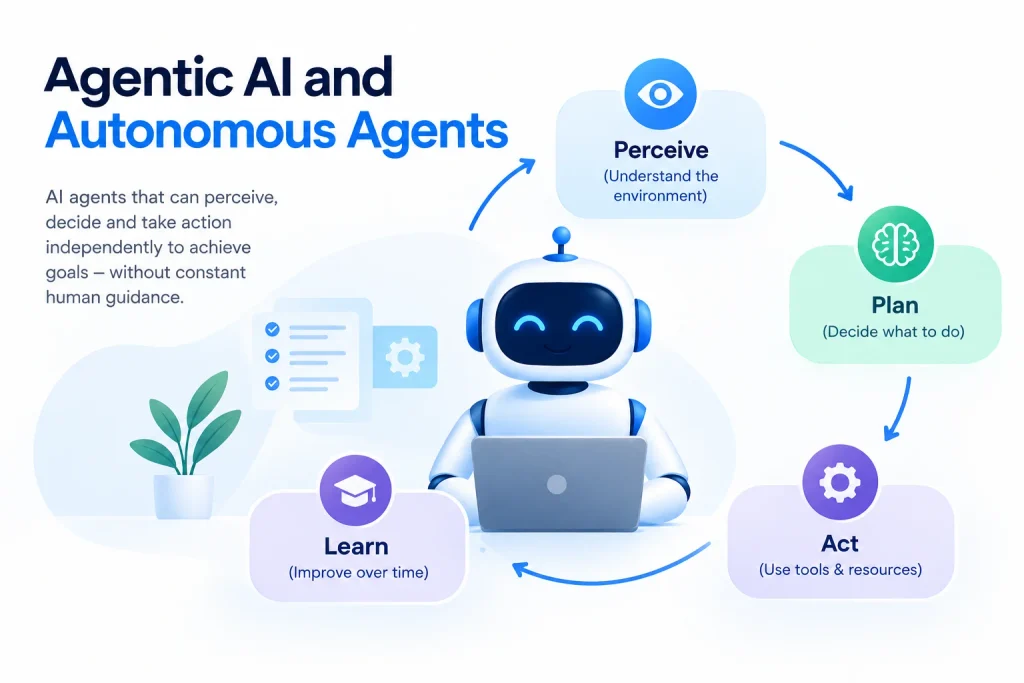
Most agents run the same loop:
- Goal: you define what a good result looks like.
- Perceive: the agent reads emails, forms, analytics or tickets.
- Plan: it breaks the goal into smaller steps.
- Act: it uses tools like your CRM, calendar or ad account.
- Check: it reviews the result and corrects itself.
- Finish or escalate: it completes the task, or hands it to a person when unsure.
The last step matters most. A good agent knows when to stop and ask.
What is inside an AI agent?
- A language model that reasons and decides
- Tools and connections to your email, CRM and calendar
- Memory, so it remembers earlier conversations and your business rules
- Guardrails and permissions that limit what it can see and do
- Logs, so you can review every action
How much freedom should an agent have?
We use a simple four level model to decide how much control to hand over. It is our own framework, not an industry standard.
| Level | What the agent does | Who decides |
|---|---|---|
| 1. Suggest | Recommends actions | A person does the work |
| 2. Draft | Prepares the work | A person approves each item |
| 3. Act within limits | Handles low risk tasks alone and reports back | A person reviews weekly |
| 4. Act broadly | Handles most tasks, including some high impact ones | A person audits samples |
For anything customers see, most small businesses should stay at Level 2 or 3.
Where does agentic AI help in marketing?
Choose tasks that repeat often, involve a lot of text and cause little harm if the agent gets something wrong. McKinsey’s 2026 survey found that revenue gains from AI are most often reported in marketing and sales, so this is a sensible place to start.
- Lead response: qualify inquiries, draft replies and route hot leads to sales, then connect the follow up to your email marketing.
- Reporting: pull numbers from analytics and ad accounts into a weekly summary that flags anything unusual.
- Content support: research topics and build outlines, with an editor approving everything. This supports your content marketing but does not replace it.
- Ad monitoring: watch spend and flag cost jumps or broken tracking in your PPC campaigns.
- Social inboxes: sort comments and messages and flag complaints for your social media marketing team.
When should you skip the agent?
Stay with a simple workflow when the steps never change, when a mistake is costly or hard to undo, when your data is messy, or when nobody on your team can explain the process in plain steps.
What do the 2026 numbers mean for a small business?
According to McKinsey’s 2026 State of AI survey, 40% of large organizations are now scaling AI agents, up from 27% a year ago. Smaller organizations stayed flat at 22%. McKinsey counts anything under $1 billion in revenue as smaller, so most local businesses sit well below that line.
Two more findings matter for you. Only 37% of respondents say AI has added to company profit, even though most say it makes them personally more productive. And about one in five organizations say operating costs have limited their AI use.
The lesson is simple. Saving an hour only helps if that hour goes into work that earns money, and cost needs watching from day one.
Why do so many agent projects fail?
Gartner predicts that over 40% of agentic AI projects will be canceled by the end of 2027 because of rising costs, unclear value and weak risk controls. It also warns about “agent washing,” where vendors relabel chatbots and basic automation as agents. Gartner estimates only about 130 of the thousands of vendors are real.
Pilots often look better than real use. They run on clean data, a narrow scope and heavy review. Real operations bring messy inputs and odd edge cases.
What are the security risks?
Agents act instead of only talking, so a mistake or an attack has real consequences. The OWASP Top 10 for Agentic Applications, published in December 2025, lists ten risk categories for agents. The most common one is goal hijack, where an attacker redirects the agent through content it reads, such as a poisoned email or web page.
Simple safeguards go a long way:
- Give each agent only the access it needs.
- Treat anything it reads from outside as untrusted.
- Require human approval for payments, deletions, public posts and customer promises.
- Keep a log of every action.
How much does it cost, and how do you measure return?
Agents usually cost more to run than fixed workflows because they make more model calls and need more review. Track cost per completed task, not just the monthly tool fee.
Monthly net value = (tasks per month × minutes saved ÷ 60 × hourly cost) minus (tool fees, plus review hours × hourly cost, plus estimated cost of errors)
Here is an illustration with made up numbers. An agent handles 400 lead replies a month and saves 6 minutes each. That is 40 hours, worth $1,200 at $30 an hour. Subtract $150 in tool fees, $300 for 10 hours of review and $100 for error cleanup. The net value is $650 a month. If your own numbers land near zero, you have saved yourself a bad project.
How do you start?
- Pick one process that is frequent, easy to describe and low risk.
- Write the steps down. If your team cannot explain them, an agent cannot follow them.
- Start as a workflow, then add freedom only where fixed rules fall short.
- Run a small pilot at Level 2 and compare it against how you work today.
- Measure for 30 days: time saved, error rate, cost per task and customer response.
- Decide: scale what works and stop what does not.
Quick readiness check. Give yourself one point for each yes. Can you describe the process in 10 steps or fewer? Do you have one number that shows success? Is your data accurate and in one place? Is a mistake cheap to fix? Does one person own the result? Can you limit the agent’s access? Can you see a log of its actions? Do you know what you will do by hand if it fails? A score of 7 or 8 means you are ready for a pilot. A score of 4 to 6 means fix the gaps first. Below 4, stay with a simple workflow for now.
How do AI search tools find your business?
As more people ask AI tools for answers, your pages need to be clear and easy to trust. Google says there are no special requirements for its AI features beyond normal SEO fundamentals. Research from Princeton found that adding statistics, quotations and named sources raised visibility in AI answers by over 40% in tests, while keyword stuffing did not help.
What to do on your site:
- Put a short, direct answer under each question heading.
- Back claims with named, dated sources.
- Show a real author and an update date.
- Keep your business name, address and phone number the same everywhere.
- Keep pages fast, crawlable and marked up with schema.
Strong SEO services and a clean website build cover most of this.
Key takeaways
- Agentic AI plans, acts and adapts. A workflow follows a fixed path.
- Use the simplest tool that solves the problem.
- Most projects stall on cost, unclear value and weak controls.
- Start at Level 2, limit access and track cost per task.
- Clear, well structured pages help you show up in AI answers and normal search.
Conclusion
Agentic AI is a real shift, but it rewards patience over hype. Start with one process, measure honestly and grow only when your numbers support it.
If you want help connecting AI ready content, tracking and lead generation, talk to the NK Marketing Solutions team. You can also read more on our blog.
FAQs
What is agentic AI in simple terms?
AI that takes a goal, plans the steps, uses tools and adjusts to results with limited supervision.
What is the difference between agentic AI and generative AI?
Generative AI creates content from a prompt. Agentic AI uses that ability to decide and then act toward a goal.
Are AI agents safe for small businesses?
They can be if you limit access, treat outside content as untrusted and have a person approve sensitive actions.
Will AI agents replace employees?
Expectations are rising, but results are smaller than predictions. In McKinsey’s 2026 survey, 39% expected AI to reduce headcount in the coming year, yet only 14% said it had reduced workforce size in the past year. For most small teams, agents help with repetitive tasks.
Where should a small business start?
Try lead response, reporting or routine support at Level 2 with a person reviewing the output. Expand only after you have measured results.