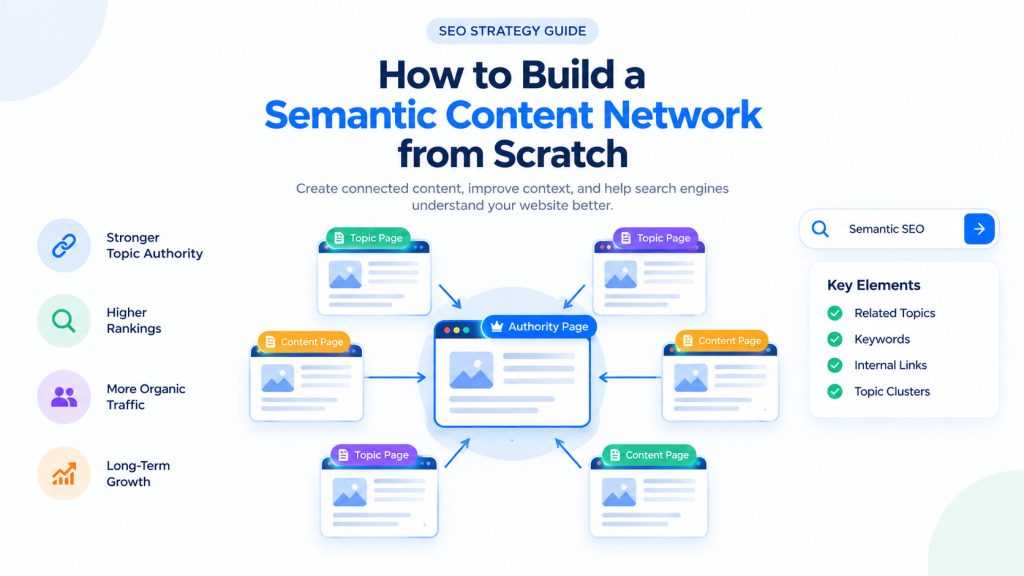
A semantic content network connects pages around a central subject, its attributes, related entities, and the questions readers need answered.
To build one, define your central entity, map its relationships, group user questions by intent, assign each question to the right page, and connect those pages through useful internal links. The network should help readers move from understanding a subject to evaluating options and taking an appropriate action.
This guide uses home coffee brewing as a practical example.
What Is a Semantic Content Network?
A semantic content network is a group of connected pages organized around related entities, attributes, relationships, and user questions.
For example, a home coffee website may include pages about French presses, coffee grinders, beans, brewing methods, grind size, and troubleshooting. Each page has a different purpose, but all pages contribute to the central subject of home coffee brewing.
| Component | Example | Purpose |
|---|---|---|
| Central entity | Home coffee brewing | Defines the main subject |
| Supporting entity | French press | Represents a related subject |
| Attribute | Brewing method | Describes an entity |
| Value | Immersion | Specifies the attribute |
| Relationship | A grinder processes coffee beans | Connects entities |
| User question | How do I use a French press? | Defines a content need |
| Page | French press brewing guide | Answers the question |
| Internal link | Brewing guide to grind-size guide | Connects useful information |
A semantic content network is part of broader content architecture. Its purpose is to make coverage clear, connected, and useful.
Step 1 — Define Your Central Entity, Audience, and Scope
The central entity establishes what the website explains and which topics belong inside its content network.
Write a purpose statement before collecting article ideas:
This website helps [audience] accomplish [goal] through information about [central entity].
For the example website:
This website helps beginner home coffee drinkers choose equipment, learn manual brewing methods, and troubleshoot their results.
This statement defines the network:
| Planning decision | Example |
|---|---|
| Central entity | Home coffee brewing |
| Primary audience | Beginners brewing coffee at home |
| Initial scope | Manual brewing, equipment, and troubleshooting |
A page about French press brewing fits this scope. A page about café payroll management does not.
Evaluate every proposed topic with three questions:
- Does it help the defined audience?
- Can its relationship to the central entity be explained?
- Can the website provide an accurate and useful answer?
Topics that meet these conditions may belong in the network. Topics with only a distant connection should be deferred.
Step 2 — Map Entities, Attributes, and Relationships
An entity map records the subjects, properties, values, and connections that the website needs to explain.
| Entity | Attribute | Example value | Possible question |
|---|---|---|---|
| French press | Brewing method | Immersion | How does immersion brewing work? |
| Coffee grinder | Grinding mechanism | Burr | How does a burr grinder work? |
| Coffee beans | Roast level | Light | How do roast levels differ? |
| Paper filter | Material | Paper | Which filter fits this brewer? |
Now record the relationships:
| Subject | Relationship | Object |
|---|---|---|
| Coffee grinder | Processes | Coffee beans |
| French press | Uses | Ground coffee |
| Brewing guide | Explains | Brewing equipment |
| Grind size | Affects | Brewing results |
An entity–attribute–value record describes a property and its value. A subject–predicate–object statement describes a relationship between entities. Both are useful planning methods, but they do not represent exactly the same type of data.
Do not turn every entity into a separate article. Some entities need only a definition or a short explanation within another page.
Step 3 — Research Questions and Search Intent
User questions turn the entity map into a practical content plan.
Collect questions from customer conversations, search results, relevant communities, and existing website data. Then group them according to the reader’s task.
| Reader task | Example question | Suitable format |
|---|---|---|
| Understand | What is immersion brewing? | Explanation |
| Perform | How do I use a French press? | Tutorial |
| Compare | French press or pour-over? | Comparison |
| Choose | Which grinder suits my method? | Selection guide |
| Troubleshoot | Why does my coffee taste bitter? | Diagnostic guide |
Questions with the same purpose can usually share one page. Different tasks may require separate pages.
| Situation | Content decision |
|---|---|
| Same answer with different wording | Use one page |
| Short supporting question | Add a section |
| Distinct task with substantial detail | Create a separate page |
| Existing page already answers it | Improve or link to that page |
| Outside the website’s scope | Exclude or defer |
Step 4 — Build a Topical Map with Clear Page Purposes
A topical map assigns every important reader task to a suitable page.
| Page | Primary purpose | Scope boundary |
|---|---|---|
| Home coffee brewing guide | Introduce methods and equipment | Does not duplicate full tutorials |
| French press brewing guide | Teach the brewing process | Keeps detailed cleaning separate |
| Coffee grinder guide | Explain grinder types and selection | Links to grind-size guidance |
| Coffee grind-size guide | Explain grind size across methods | Does not duplicate complete recipes |
| Bitter coffee troubleshooting | Diagnose unwanted results | Explains possible causes |
| French press cleaning guide | Explain routine cleaning | Focuses on care rather than brewing |
Start with pages that create a complete reader journey. For this example, begin with the overview, French press guide, and grind-size guide. Add troubleshooting and cleaning pages next.
Internal links connect pages where readers need further information. They also help search engines discover related pages and understand how the website’s content is organized.
For businesses building this structure as part of a wider SEO strategy, an internal content network can support both organic visibility and user navigation.
| Source page | Destination page | Linking reason |
|---|---|---|
| Brewing overview | French press guide | Reader chooses a method |
| French press guide | Grind-size guide | Reader needs grind guidance |
| French press guide | Bitter coffee guide | Reader experiences a problem |
| French press guide | Cleaning guide | Reader reaches the maintenance stage |
Use descriptive anchor text such as “French press cleaning guide” or “choosing a suitable grind size.” Google recommends crawlable links and concise, relevant anchor text for internal links. Google’s link best-practices guide explains how anchor text helps users and search engines understand the destination.
For websites that need help planning connected pages, NK Marketing Solutions’ SEO services include content structure, on-page optimization, and broader search strategy.
Step 6 — Create a Content Brief for Each Page
A content brief defines the page’s main question, entities, attributes, evidence, structure, and internal links.
For a French press guide, the brief could include:
| Brief field | Instruction |
|---|---|
| Main question | How does a beginner brew coffee with a French press? |
| Primary entity | French press |
| Reader outcome | Complete the brewing process |
| Supporting entities | Beans, grinder, water, scale, timer |
| Required coverage | Equipment, preparation, brewing, serving, cleanup |
| Internal links | Grind-size, troubleshooting, and cleaning guides |
| Scope boundary | Keep grinder comparisons on the grinder page |
Each heading should answer a specific question. Explain the supporting entities only when they help the reader understand or complete the task.
Step 7 — Write, Check, and Publish Connected Pages
Publication requires accurate answers, clear terminology, working links, and accessible navigation.
Before publishing, confirm that:
- The page answers its primary question.
- Each section supports the page purpose.
- Relevant entities are explained naturally.
- Factual claims have suitable evidence.
- Internal links lead to useful destinations.
- Similar pages have clear boundaries.
- The page gives readers a useful next step.
Step 8 — Measure Results and Expand from Useful Gaps
Performance reviews guide improvements and future content expansion.
| Observation | What to investigate | Possible action |
|---|---|---|
| Page is not indexed | Crawl access and internal discovery | Resolve the identified technical issue |
| Page gets impressions but few clicks | Title, position, and search intent | Improve clarity and alignment |
| Two pages serve similar queries | Purpose and content overlap | Clarify or consolidate |
| Readers ask the same follow-up question | Missing or unclear information | Add a section or supporting page |
| Useful page has few connections | Navigation and contextual links | Add relevant links |
| Content loses traffic | Outdated information or changed intent | Investigate before rewriting |
Expand the network when existing pages reveal a useful unanswered question.
Advanced Entity Salience Framework for Semantic SEO
Entity salience describes how clearly a page establishes the importance of its main entity and its relationship to the reader’s question.
Salience comes from context, placement, relationships, consistency, and completeness. It does not come from repeating an entity name or increasing keyword density.
For this article, the central entity is semantic content network. Supporting entities include semantic SEO, entity mapping, topical maps, internal links, search intent, content briefs, and conversion pages.
Core Entity Signals
A page makes its central entity clear when several signals support the same interpretation.
| Signal | Application | Example |
|---|---|---|
| Title | State the main subject and purpose | How to Build a Semantic Content Network from Scratch |
| H1 | Confirm the central topic | How to Build a Semantic Content Network from Scratch |
| Opening answer | Define the entity early | A semantic content network connects related pages |
| Headings | Organize attributes and processes | Entity mapping and internal linking |
| Related terminology | Explain connected concepts | Attributes, relationships, page purpose |
| Examples | Show how the concept works | Home coffee brewing network |
| Internal links | Connect supporting explanations | Link to entity mapping or content briefs |
| Consistent terminology | Prevent entity confusion | Use one clear name for the network |
| Structured attributes | Explain the entity’s properties | Audience, scope, relationships |
| Evidence | Support important claims | Explain decisions with examples or sources |
An overview page should introduce the central entity and its main relationships. A comparison page should define the alternatives and evaluation attributes. A conversion page should connect the entity to a clear action.
Use this review sequence:
- Identify the main entity.
- State the reader’s task.
- List the attributes needed to complete that task.
- Explain the relationships between entities.
- Connect the page to the next useful resource.
Understanding Entity Relationships
Entity relationships explain how subjects interact, depend on one another, or belong to a broader category.
In the coffee example:
- A grinder processes coffee beans.
- Grind size affects brewing results.
- A French press uses ground coffee and water.
- A brewing tutorial explains how to use equipment.
- A troubleshooting guide diagnoses an unwanted result.
Each relationship can become a section, page, or internal link. The required format depends on the depth of the question.
| Relationship | Example | Content decision |
|---|---|---|
| Category to member | Brewing equipment → French press | Add to overview |
| Entity to attribute | French press → brewing method | Explain in entity guide |
| Entity to process | Grinder → processes beans | Explain in tutorial |
| Cause to result | Fine grind → slower extraction | Explain in troubleshooting |
| Comparison | French press ↔ pour-over | Create comparison page |
| Journey relationship | Guide → service decision | Link to evaluation or conversion page |
A relationship does not automatically require a new article. Keep it on the current page when the explanation is short. Create a separate page when it serves a distinct task and requires meaningful detail.
Semantic Coverage Principle
Semantic coverage means answering the important questions and explaining the necessary relationships around a topic.
Coverage should be measured by usefulness and completeness, not by the number of related terms included.
Build coverage around four layers:
| Layer | Main question | Example |
|---|---|---|
| Definition | What is it? | What is a semantic content network? |
| Attributes | What are its properties? | Scope, entities, relationships |
| Process | How does it work? | Mapping questions and pages |
| Decisions | How should it be applied? | Section or separate page? |
Use a question matrix before publishing:
| Question | Covered where? | Status |
|---|---|---|
| What is a semantic content network? | Definition section | Complete |
| How do you choose a central entity? | Step 1 | Complete |
| How do entities become pages? | Step 2 and Step 4 | Complete |
| How do internal links support the network? | Step 5 | Complete |
| How does content support conversion? | Section 12 | Complete |
| How should the network be maintained? | Step 8 | Complete |
A question with no clear location may indicate a content gap. A question repeated in several sections may indicate unnecessary overlap.
Section 12 — Semantic Content Networks and Customer Journey Mapping
A semantic content network becomes commercially useful when its pages support the customer journey from understanding a problem to taking an appropriate action.
Mapping Content to Search Intent Stages
Different search intents require different page purposes and next steps.
| Journey stage | Reader’s question | Search intent | Suitable page | Next step |
|---|---|---|---|---|
| Knowledge | What is this? | Informational | Definition or guide | Read related content |
| Trust | Can I rely on this? | Informational with credibility needs | Evidence page or case study | Review proof or methodology |
| Evaluation | Which option is best? | Comparative or commercial | Comparison or buying guide | Compare choices |
| Conversion | How do I start? | Transactional | Service or product page | Book, buy, contact, or submit |
| Retention | How do I use it? | Support | Tutorial or help page | Return for assistance |
A reader may move between stages more than once. Someone may read a comparison, return to an educational page, and then visit a service page.
Connecting Knowledge, Trust, Evaluation, and Conversion
A knowledge page explains the subject. A trust page provides evidence and credibility. An evaluation page helps readers compare relevant options. A conversion page gives them a direct way to act.
For example:
- What is a burr grinder?
- How was the grinder tested?
- Conical burr versus flat burr grinder.
- Choose a commercial coffee grinder.
- How to clean and calibrate the grinder.
Each link should match the reader’s current question.
Knowledge pages can link to evaluation guides. Evaluation pages can link to conversion pages when the reader has enough information to decide. Retention pages can link back to relevant guides and support resources.
Match the call to action to the journey stage
- Knowledge pages can suggest a related explanation.
- Trust pages can link to author information, evidence, or methodology.
- Evaluation pages can offer a comparison tool or specification guide.
- Conversion pages can display the form, checkout, booking, or contact action.
- Retention pages can provide support and follow-up resources.
A research page should not depend on an immediate purchase. A conversion page should make the action easy to find.
Add journey stages to the topical map
| Page | Main entity | Intent | Journey stage | Next page |
|---|---|---|---|---|
| Semantic content network guide | Semantic content network | Informational | Knowledge | Entity mapping guide |
| Entity mapping guide | Entity relationships | Informational | Knowledge | Content brief template |
| Content network case study | Network implementation | Trust | Trust | Strategy comparison |
| Content architecture comparison | Content architecture | Commercial investigation | Evaluation | Consulting service |
| Semantic SEO consulting | SEO service | Transactional | Conversion | Contact page |
A website with many educational pages but no evaluation or conversion path may have broad semantic coverage but weak customer journey support.
Supporting Concepts: Topic Clusters, Knowledge Graphs, and Structured Data
A topic cluster groups related pages around a broad subject. A knowledge graph represents entities and their relationships. A semantic content network organizes connected website content around entities and user questions.
Structured data describes applicable page information in a machine-readable format. It may help search engines interpret content, but it does not guarantee a particular search appearance.
Common Mistakes
Common mistakes include:
- Creating a separate article for every keyword variation.
- Adding unrelated entities merely to increase coverage.
- Giving several pages the same purpose.
- Using irrelevant internal links.
- Expanding before improving existing content.
- Treating entity repetition as semantic quality.
- Creating conversion pages without trust or evaluation content.
- Creating informational pages without a useful next step.
Frequently Asked Questions
How many pages should a semantic content network have?
There is no fixed number. Begin with enough pages to support a coherent reader journey.
Should every entity have its own page?
No. Create a separate page only when the entity supports a distinct task and needs enough detail to be independently useful.
Do all pages need to link to one another?
No. Links should follow reader needs and meaningful relationships.
Can an existing website become a semantic content network?
Yes. Audit current pages, identify their purposes, remove overlap, and add meaningful connections.
Can a semantic content network guarantee rankings?
No. It provides a structured method for planning useful content, but search performance depends on multiple factors.
A strong semantic content network begins with one clear entity, expands through meaningful relationships, covers the questions readers actually ask, and guides them from knowledge to trust, evaluation, conversion, and ongoing support.