

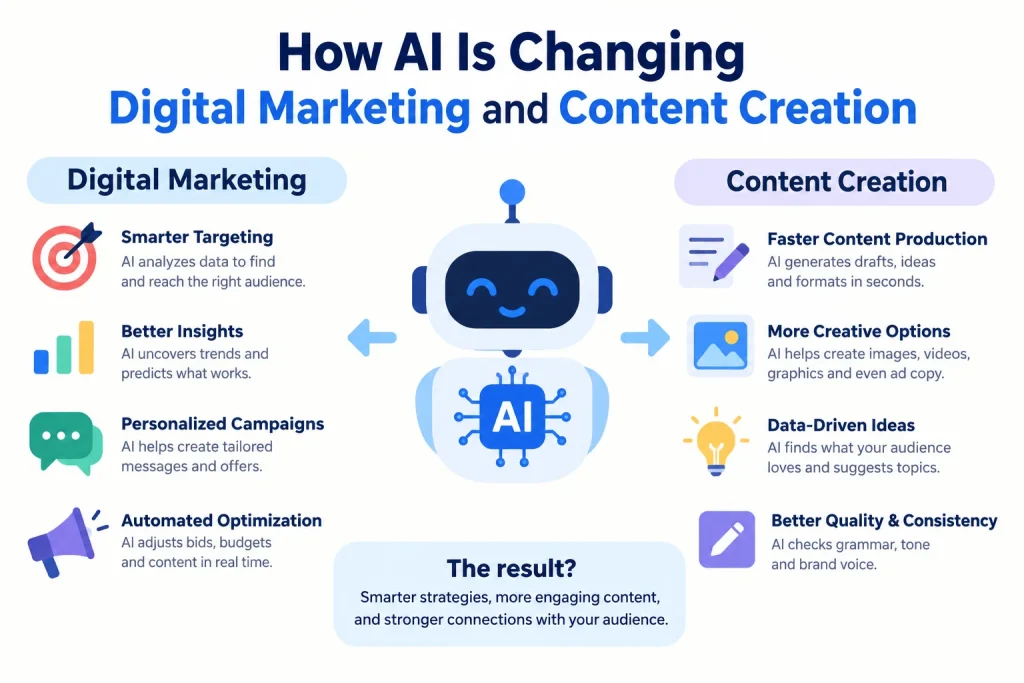
AI is changing digital marketing by helping teams move from research and ideas to draft content and campaign decisions more quickly. It can organize information, generate creative variations, and automate selected advertising tasks. Marketers still need to decide what to communicate, verify the information, and measure whether the work helps the business.
For a small-business owner, this might mean turning approved product details into an email and several social posts. For a content writer, it could mean organizing research before drafting an article. For an advertiser, it may involve using automated bidding toward a defined conversion goal.
The change becomes clearer when we look at the process: what people previously handled manually, where AI now assists, and what still requires human judgment.
The Growing Role of AI in Digital Marketing
Marketing involves a series of connected decisions: understanding customers, planning messages, producing content, distributing it, and evaluating results. AI can assist at different stages, but it does not perform every stage equally well.
How AI Changes the Marketing Workflow
In a fully manual workflow, a marketer reviews source material, develops an outline, writes individual assets, and prepares each version for publication. With AI assistance, some of that initial organization and drafting can happen together.
For example, approved product information can provide a shared starting point for a blog outline, an email draft, and social captions. The marketer then checks each version for accuracy, relevance, and tone.
The following table illustrates possible workflow changes rather than measured results:
| Task | Fully manual approach | AI-assisted approach | Human responsibility |
|---|---|---|---|
| Content planning | Read notes and organize topics | Generate a proposed structure from supplied notes | Select useful topics and identify missing evidence |
| Drafting | Write each version individually | Produce initial variations from an approved brief | Check facts, language, and brand voice |
| Repurposing | Adapt an article separately for each channel | Draft several formats from reviewed material | Preserve meaning and suit each format |
| Campaign reporting | Review figures and write a summary | Generate a draft summary from supplied data | Verify calculations and challenge explanations |
Generative AI creates content such as text and images. Marketing automation may instead make decisions within a configured system, such as adjusting advertising bids. These are different capabilities and should be evaluated separately.
What Research Shows About AI-Assisted Writing
A 2023 experiment by Shakked Noy and Whitney Zhang involved 453 college-educated professionals completing occupation-related writing assignments. The researchers reported a 40% reduction in average completion time and an 18% improvement in assessed output quality after introducing ChatGPT.
The experiment used GPT-3.5 and short tasks such as emails and press releases. It did not measure search rankings, advertising conversions, or long-term business growth.
The practical implication is to test writing assistance on a defined task. Measure the entire process, including editing and approval, rather than assuming a faster draft means an equally large overall saving.
Source: Noy and Zhang’s research manuscript.
AI and Social Media Content
AI changes social media production by making it easier to explore several versions of a message before choosing one. The marketer’s work shifts toward providing a useful brief, selecting ideas, and checking the finished content.
How a Product Brief Becomes Social Media Content
Consider a hypothetical clothing retailer preparing posts about a new cotton shirt.
In a manual process, the marketer would read the product details, develop post ideas, and write each caption and script separately. An AI-assisted process could work like this:
- Prepare verified information: Supply the fabric composition, care instructions, available sizes, and approved product claims.
- Define the audience: Explain who the post is for and which question it should answer.
- Request distinct formats: Ask for a care carousel outline, a short demonstration script, and caption options.
- Review the output: Check that every instruction matches the product information and that no benefits were invented.
- Publish and evaluate: Review preparation time and relevant audience actions, such as product-page visits or inquiries.
The potential benefit is less time spent drafting variations. The limitation is that inaccurate input—or an unchecked addition—can spread across several posts.
Building a Useful Content Calendar
A content calendar should connect posts to audience questions and business priorities.
For example, a fashion publisher planning content about Chrome Hearts could collect reader questions about styling, design details, or brand history. AI could help organize those questions into an initial calendar, while a writer researches and verifies the answers.
This is a hypothetical planning example, not evidence that the brand uses AI.
For local businesses, our social media guide for California small businesses explains how to connect platform choices and content ideas to customer needs.
Adapting One Message for Different Channels
A reviewed article can provide the source material for several shorter assets. However, the purpose of each asset should remain clear.
A carousel might explain a process visually. A video needs spoken language and a demonstration. An email marketing campaign might introduce the reader’s problem and link to the full explanation.
AI can draft these adaptations, but each one needs review. Shortening a passage can remove a qualification or make a careful statement sound like a promise.
AI-Powered Content Writing
AI changes writing by providing a draft that the writer can assess, reorganize, and improve. That is most useful when the writer already has reliable source material and a clear understanding of the reader’s question.
From Research Notes to a Reviewed Article
Suppose a business wants to publish a guide answering common customer questions.
Without AI assistance, the writer reviews the notes, groups the questions, prepares an outline, and writes the first draft. With AI assistance, the process can begin with the same evidence:
- Collect sources: Gather approved facts, customer questions, and relevant primary research.
- Create a brief: Define the audience, article purpose, main question, and intended tone.
- Organize the material: Ask AI to propose an outline based on those sources and flag gaps.
- Draft individual sections: Keep claims tied to the supplied evidence.
- Edit for usefulness: Add clear explanations, remove repetition, and resolve unanswered questions.
- Verify before publication: Check statistics, quotations, links, and brand-specific claims.
This connects AI-assisted writing to a broader content marketing strategy, where each article serves a defined audience and purpose.
The strongest contribution from the writer may be the material that makes the article distinctive: an interview, a documented observation, or an explanation grounded in actual experience.
Why Fact-Checking Remains Essential
NIST identifies confabulation—confidently presented false or erroneous content—as a generative AI risk. A fluent paragraph therefore needs the same scrutiny as any other unsupported draft.
Open the source and check whether it supports the exact claim. Confirm the date, population, measurement, and limitations.
For example, a study showing faster completion of short writing tasks does not establish that AI-written articles produce more sales. Keeping that distinction clear improves the usefulness and credibility of the finished content.
AI and SEO
AI can help organize search data and improve a draft’s coverage. It does not establish search demand simply by suggesting a list of keywords.
The practical change is that a marketer can use AI to assist with sorting and drafting after collecting relevant evidence.
How Search Queries Can Guide Content Improvements
Google Search Console reports search queries, clicks, impressions, click-through rate, and average position for a website’s Google Search performance. These are observations about the site, not a complete measure of market-wide demand.
A practical workflow is:
- Review a relevant page’s queries: Look for questions and terms connected to the article’s intended audience.
- Group related questions: AI can propose groups from the supplied query list.
- Check the grouping: Remove unrelated terms and distinguish different reader needs.
- Compare questions with the article: Identify where an explanation is missing, unclear, or difficult to find.
- Improve the relevant section: Add a verified answer, example, or clearer heading.
- Monitor performance: Review later results while considering other changes that may affect traffic.
For example, an article about AI marketing might mention time savings without explaining how to measure them. If relevant query data reveals interest in that question, a section on total drafting and review time could make the page more useful.
This example illustrates a process; it does not promise a ranking increase.
Matching Keywords to Search Intent
Someone searching “how AI is changing digital marketing” wants an explanation of the change, practical examples, and an understanding of its consequences.
Terms such as generative AI, content creation, marketing automation, and campaign measurement fit because they help explain that topic. They should appear where the reader needs them.
Google’s SEO Starter Guide explains that its language-matching systems can understand related queries without every exact variation appearing on the page. It also recommends useful, readable content and descriptive links.
Businesses needing implementation support can review our SEO services, including keyword research and on-page optimization.
How AI Search Affects Content Presentation
Clear answers and identifiable sources help readers evaluate an article. They are useful editorial choices for content that may also appear in AI-assisted search.
Google states that AI Overviews and AI Mode use foundational SEO practices, with no special AI markup required. Eligibility requires an indexed page that can appear with a search snippet, but inclusion is not guaranteed.
For an introduction to a product used to monitor AI search visibility, see our review of ZipTie AI Search Analytics. Monitoring visibility is a separate activity from proving that a particular content edit caused a change.
AI for Business Growth
AI can support business growth by improving specific tasks, but efficiency and revenue are different outcomes. Saving time on content production does not automatically mean gaining customers.
The useful question is which part of the workflow improves and whether that improvement contributes to the business objective.
How AI Changes Paid Advertising Decisions
With manual bidding, an advertiser directly manages bids. Google Ads Smart Bidding uses AI to optimize bids for conversions or conversion value at auction time.
The advertiser still defines the business objective and evaluates the results:
- Choose the outcome: Decide whether the campaign should pursue purchases, suitable inquiries, or another meaningful action.
- Check measurement: Confirm that the recorded conversions represent the intended outcome.
- Select an appropriate bidding approach: Target CPA uses a desired average cost per conversion; Target ROAS uses conversion value and a return target.
- Review business quality: Examine whether the resulting inquiries or purchases justify the cost.
A service business may receive more forms without receiving more suitable customers. That is why lead quality matters alongside conversion counts.
Our PPC advertising services explain how targeting, creative development, and reporting fit into campaign management.
Case Study: How Klarna Changed Marketing Production
Klarna’s Q1 2024 results provide a company-reported example of AI-supported marketing efficiency. Published on May 30, 2024, the report stated that sales and marketing spending fell 11% while marketing activity increased. Klarna attributed 37% of the savings to AI, equivalent to approximately $10 million on an annualized basis.
Its announcement, reproduced by Raptor Group, described using generative AI for image creation, followed by adjustments and checks for brand consistency, image quality, and legal compliance.
| Measure | Klarna’s reported result |
|---|---|
| AI-generated images | More than 1,000 during the first three months of 2024 |
| Image development cycle | Reduced from six weeks to seven days |
| Image production savings | $1.5 million in Q1 2024 |
The faster process supported more frequent updates to website and app imagery for seasonal retail events. The change involved the production workflow, including review—not just generating an image.
These figures are historical company claims, not findings from an independent controlled experiment. The $10 million figure is annualized, and 37% refers to AI’s attributed share of the savings, not the entire marketing budget.
For smaller businesses, the relevant lesson is to identify one costly or slow production task and test whether AI assistance improves it without lowering standards. Klarna’s figures are not a forecast for another business.
Sources: Klarna Q1 2024 results, page 4 and Klarna’s announcement reproduced by Raptor Group.
Measuring Whether AI Is Actually Helping
Before changing a workflow, record its current performance. Compare similar work after introducing AI assistance.
| Business question | What to measure |
|---|---|
| Are we producing content more efficiently? | Total research, drafting, editing, and approval time |
| Is quality being maintained? | Factual corrections, substantial revisions, and rejected drafts |
| Is the process less expensive? | Staff time, tool costs, and external production costs |
| Is marketing contributing to growth? | Qualified inquiries, purchases, or another defined business outcome |
Avoid attributing every improvement to AI. Pricing, promotions, seasonality, targeting, and other changes may also influence results.
Why Human Creativity Still Matters
AI changes how creative options are produced, but people still decide which options are meaningful, accurate, and appropriate for the brand.
For example, a writer preparing an editorial feature about A.presse could use AI to organize research questions or explore article structures. The writer would still need to verify the details and develop a perspective supported by evidence.
This is a hypothetical use case, not a claim that the brand uses AI or has experienced increased search interest.
Human contribution becomes especially valuable when it adds information a general draft lacks: a real interview, a customer’s specific concern, a documented experiment, or a first-hand observation.
Where Human Review Adds the Most Value
Review should focus on decisions that affect the reader:
- Does the content answer the intended question?
- Are product descriptions and instructions accurate?
- Does each source support the claim beside it?
- Is the example real, hypothetical, or company-reported?
- Does the language reflect the brand without misleading the audience?
Teams also need to decide what information is appropriate to share with a tool. NIST identifies data privacy and information integrity among generative AI risk areas, reinforcing the need to review both inputs and outputs.
The Future of Digital Marketing
The practical shift is toward workflows in which AI assists with selected production and optimization tasks while people retain responsibility for objectives, evidence, and quality.
For a small business, the next step does not need to be a complete marketing overhaul. Choose one repeatable task, supply reliable information, assign a reviewer, and compare the outcome with the existing process.
Expand the approach when the results justify it. If faster drafting creates more corrections or weaker messaging, improve the brief or reconsider the task.
AI can make marketing faster, but valuable ideas, reliable information, authentic storytelling, and a strong understanding of people will continue to make marketing effective.
If you need help connecting content, search, and advertising to your business objectives, discuss your marketing goals with NK Marketing Solutions.
Frequently Asked Questions
How is AI changing digital marketing in practical terms?
AI can help teams organize research, draft creative variations, adapt content for different channels, and automate selected advertising decisions. The main workflow change is that marketers can review and refine an initial output instead of completing every production task manually.
How can a small business start using AI for content creation?
Start with one task using approved information, such as drafting social captions from a product sheet. Define the audience, review every claim, and compare total preparation time and finished quality with the previous process.
Does AI-generated content automatically harm SEO?
No. Google recognizes useful applications of generative AI, including research and content organization. Its guidance warns against creating pages at scale without adding value for users.
Can AI replace human content writers?
The research discussed here supports improvements in selected writing tasks. It does not establish that AI can replace every responsibility involved in research, interviewing, fact-checking, brand communication, and editorial accountability.
Does faster content production mean better marketing results?
Not necessarily. Faster production is an efficiency outcome. Better marketing requires evidence that the content reaches relevant people, answers their needs, and contributes to an appropriate business objective.