
Google Search is no longer built only around a list of blue links. With AI Mode, users can ask longer, more specific questions, explore follow-up queries, and receive AI-generated responses supported by information from across the web. This shift changes how people discover content, but it does not make SEO irrelevant.
In 2026, SEO is becoming less about optimizing one page for one exact keyword and more about building useful, trustworthy content that can support different stages of a search journey. Rankings still matter, but visibility can now also come through AI-generated answers, supporting links, citations, and related follow-up searches.
For SEO professionals and website owners, the real question is not whether AI Mode will replace SEO. The important question is how SEO strategies need to adapt as Google changes the way it finds, combines, and presents information.
This guide explains how SEO will look in Google AI Mode in 2026, what is actually changing, which traditional SEO practices still matter, and what marketers should focus on to stay visible in both AI-powered and traditional search results.
What Is Google AI Mode?
Google AI Mode is an AI-powered search experience that helps users explore complex questions in a more conversational way. Instead of relying only on a standard results page, it can generate a detailed response, surface relevant web sources, and let users continue with follow-up questions.
AI Mode uses Google’s Gemini models alongside its existing Search systems to understand longer, more specific, and sometimes multimodal queries. Users can search with text, images, files, videos, and other inputs depending on the available Search features.
The main difference is how the search journey develops. A user does not always need to enter several separate queries. AI Mode can explore different parts of a question, connect related information, and present useful sources within the same search experience.
For SEO, this means websites are competing for visibility not only in traditional organic listings but also across AI-generated responses and the supporting links users see while exploring a topic.
How Does Google AI Mode Find and Build Answers?
Google AI Mode does more than match a query with a single page. It can break a complex question into related searches, retrieve relevant information from Google’s Search index, and combine that information into a grounded response. Google uses its existing ranking systems as part of this process, which means relevance, quality, and accessibility still influence which sources can surface.
Retrieval-Augmented Generation and Grounding
AI Mode uses retrieval-augmented generation, or RAG, to connect AI-generated responses with current information from the web. Instead of relying only on what an AI model already knows, Google can retrieve relevant pages from its Search index and use specific information from those pages to support an answer.
This grounding process helps Google improve the accuracy and freshness of AI responses while also displaying clickable links to relevant sources. For publishers, this creates another opportunity to earn visibility when their content provides useful information that directly supports a user’s question.
Query Fan-Out
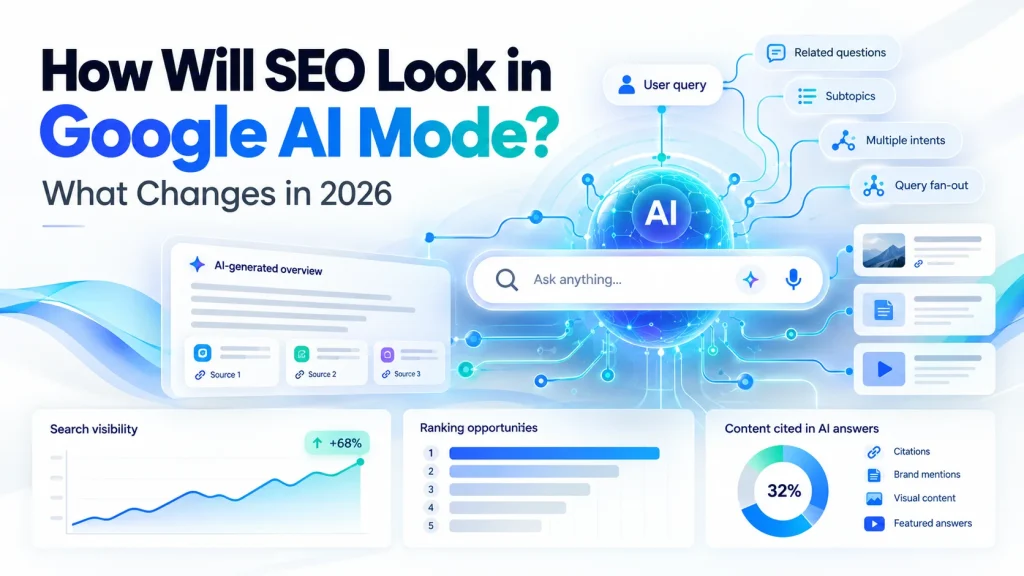
AI Mode can also use query fan-out, where Google generates several related searches from one original question. Each subquery explores a different part of the user’s intent and helps the system retrieve a broader set of relevant information.
For example, someone searching for “What is the best CRM for a small ecommerce business?” may have several underlying needs. AI Mode could explore CRM pricing, ecommerce integrations, automation features, ease of use, and suitability for small teams before building its response.
This changes the SEO opportunity. A page does not need to repeat every possible keyword variation. It needs to cover the relevant topic clearly enough to answer meaningful parts of the wider search journey.
Google Search Index and Ranking Systems Still Matter
AI Mode does not operate separately from Google Search. Google states that its generative AI features use core Search ranking systems to retrieve relevant and up-to-date web pages from the Search index.
That makes traditional SEO fundamentals important even in an AI-driven search experience. Google still needs to crawl, understand, index, and evaluate a page before that content can become a useful source within Search.
The major change is therefore not the disappearance of SEO. It is the way Google can retrieve and present information from multiple relevant sources across a more complex search journey.
So, How Will SEO Look in Google AI Mode?
SEO in Google AI Mode will look broader than traditional keyword-to-ranking optimization. Websites will still need strong organic foundations, but visibility will increasingly depend on how well content supports complex questions, related subtopics, and follow-up searches.
The biggest shift is from optimizing for a single search result to optimizing for a wider search journey.
Traditional SEO often followed a simple path:
keyword → page → ranking → click
In AI Mode, that journey can become more complex:
question → related subqueries → AI-generated response → supporting sources → follow-up questions → click or conversion
This changes what success can look like. A page may still earn a traditional organic ranking, but it can also appear as a supporting source within an AI-generated response or become relevant to one of the related searches created through query fan-out.
Several SEO priorities will therefore evolve in 2026:
- Rankings will remain important, but they will not represent the full picture of search visibility.
- Keyword research will expand toward search intent, related questions, entities, and topic relationships.
- Content will need to provide original value instead of simply repeating information that AI can summarize easily.
- Technical SEO will remain essential because Google still needs to crawl, index, and understand a page before it can surface it.
- AI citations and supporting links will create additional visibility opportunities alongside traditional organic results.
- SEO measurement will need to consider both classic search performance and visibility within Google’s generative search experiences.
The core principle does not change: Google still wants to connect users with useful, relevant, and trustworthy information. What changes is the number of ways that information can be discovered and presented.
For SEO professionals, this means the goal is no longer simply to rank a page for one target keyword. The stronger strategy is to create content that can remain relevant across the wider set of questions and search paths that surround a topic.
SEO Will Still Matter—But Rankings Will No Longer Tell the Whole Story
Google AI Mode does not remove the need for SEO. In 2026, Google still relies on core Search systems, indexing, relevance, and quality signals to find useful web content for its generative search experiences. Google’s own guidance continues to treat established SEO best practices as the foundation for visibility in AI-powered Search.
What changes is the way visibility can appear.
Traditional SEO often focuses heavily on where a page ranks for a target keyword. That metric still matters, but it no longer shows the complete picture. A useful page can now gain exposure through several surfaces, including traditional organic listings, AI-generated responses, supporting links, and related search journeys.
This means a page can contribute value even when it is not the first blue link for the original query. If its content answers a specific part of a broader question, Google may surface it during a related subquery or within an AI-supported search experience.
The practical shift looks like this:
Old focus:
ranking position → click → traffic
Broader 2026 focus:
ranking visibility → AI visibility → supporting-source exposure → engagement → conversion
This does not mean SEOs should stop tracking rankings. Rankings still help measure organic competitiveness, search demand, and page-level performance. The mistake would be treating them as the only measure of success.
Google has also expanded Search Console reporting around AI and multimodal search experiences during 2026, which reflects this wider definition of search visibility.
The stronger SEO strategy is therefore not to choose between traditional rankings and AI visibility. It is to build pages that can perform across both.
Keyword SEO Will Shift Toward Search Intent and Query Journeys
Keywords will still matter in Google AI Mode, but SEOs will need to think beyond matching one page to one exact phrase. AI-powered search can explore several related questions at once, which makes the broader search intent around a topic more important.
Traditional keyword optimization often followed a narrow model:
one keyword → one page → one ranking opportunity
AI Mode can create a wider journey:
main query → related subqueries → supporting topics → follow-up questions → refined intent
Google describes this process as query fan-out. The system can generate multiple related searches to gather enough information for a more complete response.
For SEO, this means keyword research should help identify the language people use, but content planning should also examine the questions, entities, comparisons, and decisions connected to that search.
For example, a page targeting “best CRM for small businesses” may also need to address closely related concerns such as pricing, integrations, automation, ease of use, team size, and implementation. The goal is not to insert every variation as a keyword. The goal is to understand the complete problem behind the search.
This also makes topical relationships more important. A strong page should explain the main subject clearly and connect relevant subtopics where they genuinely help the reader. That gives Google more useful context while improving the experience for users who arrive with slightly different needs.
However, SEOs should not respond to query fan-out by creating hundreds of thin pages for every possible variation. Google explicitly warns against producing separate content for large numbers of query variations when the main purpose is to manipulate Search or generative AI visibility.
The better strategy is to build comprehensive content around real user intent. Use keywords to understand demand, then use semantic relationships and search journeys to decide what the page actually needs to answer.
Content Will Need to Be More Useful Than the AI Summary Itself
As Google AI Mode becomes better at summarizing common information, generic content will have less reason to stand out. A page that simply repeats definitions, combines obvious points, or rewrites information already available across the web may offer little additional value.
In 2026, stronger SEO content will need to contribute something that an AI-generated summary cannot easily replace.
That can include:
- original research or proprietary data
- first-hand experience
- expert analysis
- unique examples
- case studies
- practical comparisons
- custom tools or calculators
- original images, videos, or demonstrations
- updated information that improves on existing search results
Google’s current guidance places particular emphasis on non-commodity content—information that adds real value instead of reproducing what many other pages already say. Google also evaluates qualities such as originality, effort, accuracy, and whether a page provides information beyond the obvious.
For example, an article about Google AI Mode would offer limited value if it only explains that AI is changing search. A stronger page could compare how AI Mode changes keyword research, show how query fan-out affects content planning, reference current Google documentation, and explain what SEOs should change in their workflow.
This is also where experience and expertise should appear naturally. Publishers do not need to force credibility signals into every paragraph. Instead, they should support important claims, provide accurate examples, show where conclusions come from, and add insights that reflect real understanding of the topic.
Google’s people-first content guidance follows the same principle: content should provide original information, substantial analysis, and clear additional value rather than simply summarizing what other sources already say.
The practical SEO shift is simple: do not create content merely because a keyword exists. Create content because you can provide a better, clearer, more useful answer than what is already available.
AI Citations Will Add a New Layer to Search Visibility
AI citations will become another important form of search visibility in 2026, but they will not replace traditional rankings. Instead, they add another path through which users can discover a website inside Google’s AI-generated search experience.
When AI Mode builds a response, it can surface supporting links from relevant web pages. These links give users a way to verify information, explore a topic in more detail, or continue their search on the original source.
For publishers, that creates a new visibility opportunity:
organic ranking + AI citation + supporting-link exposure
However, citation visibility should not be treated as a separate shortcut around SEO. Research from Semrush found that domains with stronger traditional organic visibility were also more likely to appear in AI citations, although correlation does not prove that rankings directly cause citations.
The page that earns an AI citation may also differ from the page that ranks highest for the original query. AI Mode can explore several related subqueries, so Google may select different pages from the same domain depending on which part of the user’s question it needs to support.
This makes page-level usefulness more important. A strong page should clearly answer a specific need, provide reliable information, and add enough context for Google to understand where that content fits within a broader topic.
SEOs should also distinguish between a citation and a brand mention. A page can appear as a source link without the AI response prominently naming the brand. Recent Semrush research found that many AI citations do not automatically translate into explicit brand mentions, so the two should be measured separately.
Google has also expanded its Preferred Sources feature into AI Mode and AI Overviews. When users select a publication as a preferred source, content from that site can receive additional prominence within supported AI search experiences.
The practical lesson is not to chase citations as an isolated metric. The stronger approach is to create content that can earn visibility across traditional rankings, AI-generated answers, supporting links, and branded discovery at the same time.
Technical SEO Will Remain the Foundation
Google AI Mode may change how search results appear, but it does not remove the technical requirements behind search visibility. Google still needs to discover, crawl, render, and index a page before that content can appear across its generative search experiences.
Google’s current guidance confirms that existing technical SEO best practices continue to matter for AI Mode and other generative Search features. A page must meet Google Search’s technical requirements, be indexed, and remain eligible to show a snippet before it can appear in these experiences.
That keeps several technical priorities important in 2026:
- clear crawlable site architecture
- accurate internal linking
- indexable pages
- correct canonical signals
- accessible JavaScript content
- useful page titles and metadata
- mobile-friendly layouts
- strong page experience
- properly implemented robots directives
The practical point is simple: strong content cannot earn AI visibility if Google cannot reliably access or understand it.
Technical SEO also helps Google connect related pages across a site. Clear internal links, logical category structures, and consistent page relationships make it easier for Search systems to understand which content belongs together and which page best answers a specific need.
Site owners should also avoid blocking important content from Googlebot unless they intentionally want to prevent that content from appearing in Search. Google’s documentation continues to recommend using Search Console and the URL Inspection tool to check how Google crawls and renders pages.
So while AI Mode introduces new search interfaces, the underlying requirement remains familiar: make useful content easy for Google to access, process, and index.
Structured Data Will Help Search—But There Is No “AI Mode Schema”
Structured data will still support SEO in 2026, but website owners should not treat it as a special shortcut for Google AI Mode.
Google uses structured data to better understand page content and determine eligibility for supported search features. For example, Article, Product, LocalBusiness, VideoObject, and other supported schema types can give Google clearer information about what a page contains.
However, there is no separate structured data type required for AI Mode. Google’s 2026 guidance does not ask publishers to add an “AI schema,” special generative-search markup, or any similar code to become eligible for AI-powered search experiences.
The correct approach is simpler: use structured data when it accurately represents content that already exists on the page.
For an informational article, that may include appropriate Article or BlogPosting markup with details such as the headline, author, publication date, modified date, and relevant images. Structured data can help Google interpret those elements more clearly, but it does not guarantee rankings, citations, or inclusion in an AI-generated answer.
Site owners should also avoid following outdated schema advice. Google removed FAQ rich results from Search in May 2026, so adding FAQ markup purely to gain that old search appearance no longer provides the same benefit.
The practical rule is to use schema for accurate content classification and supported Search features—not as a separate AI Mode optimization tactic.
Brand Authority Will Matter Alongside Page-Level Relevance
In Google AI Mode, strong page-level relevance will remain essential, but publishers should also pay attention to the wider credibility of their brand and content ecosystem.
A useful page should answer the user’s question clearly. At the same time, Google needs enough context to understand who created the content, whether the information is reliable, and how that source fits within the broader web.
This is where credibility signals should appear naturally.
Publishers can strengthen that credibility by:
- showing clear authorship where it adds value
- supporting important claims with reliable sources
- keeping factual information accurate and updated
- publishing original analysis or first-hand insights
- earning genuine references from relevant websites
- maintaining consistent information about the brand across the web
- building a recognizable body of useful content within the same subject area
Google’s guidance continues to emphasize original, helpful, reliable content rather than content created primarily to attract search traffic. Its ranking systems also use multiple signals to identify qualities associated with experience, expertise, authority, and trust rather than relying on one single metric.
For example, a page about Google AI Mode becomes more credible when it references current Google documentation, distinguishes confirmed changes from speculation, and adds useful analysis instead of repeating unsupported predictions from other blogs.
Backlinks can still contribute to broader SEO authority, but SEOs should avoid turning this into a hunt for artificial mentions. A brand mention is not automatically proof of authority, and Google has not confirmed that unlinked mentions act as a direct AI Mode ranking factor.
The safer approach is to build authority through useful content, relevant digital PR, expert contributions, real customer or audience engagement, and third-party references that exist because the brand genuinely deserves to be cited.
Search Traffic and SEO Success Metrics Will Change
AI Mode changes not only how people search but also how SEOs should measure visibility. Rankings and organic clicks will still matter in 2026, but they will no longer provide a complete view of how content performs across Google Search.
A page may appear inside an AI-generated experience even when the user does not immediately click through to the website. That makes search visibility an important metric alongside traffic.
Google introduced dedicated Generative AI performance reports in Search Console in June 2026 and expanded them to all websites worldwide by August 31, 2026. These reports cover visibility in generative AI features such as AI Overviews and AI Mode.
The reports currently help site owners analyze:
- impressions within generative AI search features
- pages that appear in those experiences
- visibility by country
- device data for Search
- performance trends over time
Google has also indicated that it may add more metrics as these reports evolve.
This creates a broader SEO measurement framework.
Traditional SEO metrics:
rankings → impressions → clicks → organic traffic
AI-era SEO metrics:
traditional rankings → generative AI impressions → supporting-source visibility → site engagement → conversions
This does not mean SEOs should replace traffic metrics with AI impressions. Visibility without meaningful engagement or business results can create a misleading picture of performance. A page that appears frequently in AI Mode but generates no qualified visits, leads, subscriptions, or sales may still need improvement.
The stronger approach is to connect Search Console visibility with website analytics and conversion data. Search Console can show whether Google surfaces a site within generative AI experiences, while analytics can show what users do after they reach the website.
Google itself recommends using the Generative AI performance report to understand how users discover content through AI-powered Search rather than relying only on third-party visibility estimates.
In 2026, successful SEO measurement therefore moves beyond the question “Where does this page rank?” A better question is: “Where is this content being discovered, and does that visibility produce meaningful engagement or business value?”
Does Google Penalize AI-Generated Content in 2026?
Google does not penalize content simply because AI helped create it. The issue is not whether a human or an AI tool produced the first draft. The issue is whether the final content is useful, original, accurate, and created primarily for people rather than to manipulate Search.
AI can support tasks such as research, outlining, summarizing source material, improving structure, or speeding up production. However, publishing large volumes of low-value pages with little originality can violate Google’s scaled content abuse policy, regardless of whether AI, automation, or humans produced that content.
For publishers, the safer approach is to treat AI as a production tool rather than a substitute for editorial judgment. Before publishing, content should be checked for:
- factual accuracy
- original value
- clear search intent
- useful examples or analysis
- reliable sourcing
- unnecessary repetition
- outdated or unsupported claims
Google also recommends giving users appropriate context about AI or automation when that information would reasonably help them understand how the content was created.
The same standard applies to content designed for AI Mode. Creating hundreds of pages around fan-out queries, keyword variations, or AI-generated questions will not create a sustainable visibility advantage if those pages add little value. Google’s 2026 guidance specifically warns against producing large numbers of pages primarily to influence rankings or generative AI responses.
Do SEOs Need AEO or GEO for Google AI Mode?
SEOs do not need to replace SEO with a completely separate optimization system for Google AI Mode. Terms such as Answer Engine Optimization (AEO) and Generative Engine Optimization (GEO) are useful for describing changes in search behavior, but Google’s current guidance still treats established SEO practices as the foundation for visibility in generative AI Search.
That means the core work remains familiar:
- create useful, original content
- satisfy search intent
- maintain strong technical SEO
- make pages easy to crawl and index
- build clear topical relationships
- earn genuine authority
- measure search visibility and user outcomes
The mistake would be assuming that AI Mode requires a separate set of technical tricks.
Google specifically says publishers do not need special AI markup, a separate AI schema, artificial content “chunking,” or rewritten content designed only for generative search. Google also states that llms.txt files do not improve or reduce visibility or rankings in Google Search.
This does not mean AEO or GEO concepts have no value. They can help SEOs think more clearly about answer-focused content, conversational queries, AI citations, and how information may surface inside generated responses.
The important distinction is between strategy and hacks.
Useful AEO/GEO thinking may include:
clear answers → strong topical context → trustworthy sourcing → original information → AI and organic visibility
Unsupported tactics may include:
special AI files → forced content chunking → fake mentions → hundreds of pages for query variations → AI-only rewriting
Google’s 2026 guidance explicitly recommends focusing on effective SEO rather than chasing these kinds of “AEO/GEO hacks.”
For practical SEO in 2026, the better approach is not to abandon SEO for a new label. It is to expand SEO so that content can perform across traditional results, AI-generated answers, supporting links, and more complex search journeys.
What Are the New SEO Priorities for 2026?
SEO priorities in 2026 are becoming broader because Google AI Mode can evaluate content across different queries, subtopics, and search paths. The strongest strategy is not to optimize harder for one keyword. It is to make content easier to discover, understand, trust, and use across both traditional and AI-powered Search.
The main priorities are:
1. Keep Content Crawlable and Indexable
Technical accessibility still comes first. Google cannot surface content in organic results or AI experiences if it cannot reliably crawl, render, and index the page.
2. Match the Full Search Intent
A page should answer the main query and address the related questions that genuinely matter to the user. This helps content remain relevant across conversational searches, follow-up questions, and query fan-out.
3. Build Topic Depth, Not Keyword Variations
Instead of creating separate pages for every phrase, SEOs should organize content around clear topics, entities, and meaningful subtopics. This creates stronger semantic relationships without producing thin or repetitive pages.
4. Publish Original, Non-Commodity Information
Content that simply repeats what already exists is easier for AI systems to summarize. Original research, expert interpretation, first-hand experience, unique examples, and useful comparisons can give a page more reason to stand out.
5. Strengthen Trust and Source Quality
Important claims should be accurate, current, and supported where necessary. Clear authorship, reliable references, transparent updates, and consistent subject expertise help build confidence in the information.
6. Use Multiple Content Formats Where They Add Value
Text will remain important, but images, videos, charts, demonstrations, and other useful formats can make complex topics easier to understand. The goal is not to add media for decoration, but to improve the quality of the answer.
7. Measure Visibility Beyond Rankings
SEOs should continue tracking rankings and clicks, but they should also monitor generative AI visibility, supporting-source exposure, engagement, and conversions. The goal is to understand whether search visibility produces meaningful results, not simply whether a page appears.
What Will an SEO Workflow Look Like in the AI Mode Era?
The SEO workflow in 2026 will become more connected. Instead of moving directly from keyword research to content creation, SEOs will need to understand the full search journey, build stronger topical coverage, and measure visibility across both traditional and AI-powered Search.
A practical workflow can look like this:
Audience problem → search intent → keyword and topic research → related entities and subtopics → original content → technical optimization → AI and organic visibility → engagement and conversion analysis → content improvement
Start With the User Problem
Keyword research should begin with the problem the user wants to solve. This helps SEOs understand why someone is searching, what information they need, and what questions may appear later in the journey.
Expand From Keywords Into Topics and Entities
Keywords still reveal search demand, but they should not define the entire content strategy. SEOs should also identify related concepts, entities, comparisons, and supporting questions that help explain the topic completely.
This approach aligns better with AI Mode, where Google can explore multiple related searches through query fan-out.
Create Original, People-First Content
The next step is not simply to cover more subtopics. The page should add useful information that improves on what already exists.
That may involve original examples, first-hand experience, expert interpretation, fresh data, practical frameworks, or clearer explanations. Google continues to recommend content that provides original information, substantial analysis, and clear value rather than pages created mainly to attract search traffic.
Optimize the Page for Search Accessibility
Once the content is strong, technical SEO helps Google access and understand it. SEOs should check crawlability, indexing, internal links, canonical signals, page structure, mobile usability, and other relevant technical elements.
This stage supports both traditional rankings and visibility in generative Search.
Measure Organic and AI Search Visibility
Performance analysis should no longer stop at rankings and clicks. Search Console now provides more visibility into generative AI and multimodal Search performance, giving site owners a broader view of how users discover their content.
The goal is to connect that visibility with meaningful outcomes such as qualified traffic, engagement, leads, subscriptions, or sales.
Improve Content Based on Real Performance
The final step is continuous improvement.
SEOs should review which pages gain visibility, which queries bring useful users, where content underperforms, and whether important information has become outdated. Updates should improve the page because users need better information—not simply to make the content appear fresh.
Google explicitly warns against changing dates or publishing unnecessary updates purely to create the appearance of freshness.
In the AI Mode era, the strongest SEO workflow will therefore connect user needs, semantic relevance, original value, technical accessibility, search visibility, and business outcomes instead of treating rankings as the final objective.
Will Google AI Mode Replace Traditional SEO?
Google AI Mode will not replace traditional SEO in 2026. It changes how Google presents information and how users move through Search, but the underlying need for relevant, accessible, high-quality content remains.
Google’s own 2026 guidance reinforces this point. Its generative AI features still depend on established Search systems, and Google continues to recommend standard SEO best practices for visibility in AI-powered results. (developers.google.com)
What changes is the role of SEO within the search journey.
Traditional SEO often focused on earning a strong position for a specific query. AI Mode expands that journey by allowing Google to explore related questions, generate responses, surface supporting sources, and guide users through follow-up searches.
That means SEOs now need to optimize for more than one outcome.
A strong page may:
- rank in traditional organic results
- appear as a supporting source in AI Mode
- contribute to a related subquery
- gain visibility through a follow-up search
- attract users who want deeper information than the AI response provides
The fundamentals therefore remain important: crawlability, indexing, relevance, useful content, page experience, internal linking, and trustworthy information. Google continues to state that its core ranking systems reward helpful content and strong overall page experience. (developers.google.com)
The real change is strategic.
SEO is moving from:
“How do we rank this page for this keyword?”
toward:
“How do we make this source useful and discoverable across the full search journey?”
So Google AI Mode does not signal the end of SEO. It expands the number of places where strong SEO can create visibility.
Final Takeaway
SEO in Google AI Mode is not becoming a completely different discipline. It is becoming broader.
Traditional ranking factors, crawlability, indexing, search intent, content quality, and authority still matter. What changes in 2026 is how Google discovers, combines, and presents information across AI-generated answers, supporting links, follow-up searches, and traditional organic results.
The strongest SEO strategy now focuses on more than a single keyword or ranking position. It connects:
search intent → semantic relevance → original value → technical accessibility → trustworthy information → organic and AI visibility → meaningful user outcomes
Publishers that rely on thin, repetitive, or easily summarized content may find it harder to stand out. Those that provide original insight, clear expertise, useful examples, accurate sourcing, and genuinely helpful information have more ways to earn visibility across the evolving search experience.
Frequently Asked Questions About SEO and Google AI Mode
What are the new rules of SEO for 2026?
SEO in 2026 focuses on useful content, search intent, technical accessibility, topic depth, and visibility across both traditional and AI-powered Search.
Does Google penalize AI content in 2026?
No. Google does not penalize content just because AI helped create it. Low-value, unoriginal, or manipulative content can still violate Google’s spam policies.
What changes with Google’s AI search?
Google AI Mode can explore related queries, generate answers, show supporting sources, and handle follow-up questions. This expands SEO beyond traditional blue-link rankings.
What are the best AI SEO tools for 2026?
Google Search Console is essential for measuring Google visibility. Semrush and Ahrefs can support keyword research, competitor analysis, backlinks, and AI visibility tracking.