

If you have used tools like Midjourney, DALL-E 3, Adobe Firefly, or Figma AI recently, you have likely watched complex visual concepts render across your screen in seconds. For freelancers, agency owners, design students, and corporate creative leads, it is entirely natural to feel a wave of uncertainty. Questions about job security, shrinking client budgets, and the long-term value of traditional design training have moved from fringe internet forums to daily studio conversations.
So, let’s skip the panic, bypass the exaggerated tech hype, and cut straight to the core question: Will AI replace graphic designers?
Key Takeaway
No, AI will not replace graphic designers. However, it is permanently dismantling traditional design workflows. Generative AI is automating low-tier, repetitive execution such as background removal, batch asset resizing, and basic layout variations. At the same time, it is elevating strategic brand thinkers. The reality of today’s market is simple: AI will not take your job, but a designer who leverages AI as a co-pilot will.
What the Labor Data Actually Says
To understand where the creative job market is going, we have to look past dramatic social media headlines and analyze official labor and industry metrics.
According to data from the U.S. Bureau of Labor Statistics (BLS), traditional graphic design employment is projected to maintain steady performance with a modest 2% to 3% growth rate through 2034. This represents roughly 20,000 to 22,800 open roles each year, primarily driven by industry turnover, promotions, and evolving digital media needs.
Meanwhile, specialized digital roles—such as Web and Digital Interface Designers (UX/UI)—are projected to grow by 7%, commanding significantly higher median salaries ($98,090 compared to $61,300 for traditional static designers). Rather than collapsing, the field is undergoing a massive structural re-alignment.
Key Industry Statistics
- 88% of Businesses Use AI in Creative Work: Industry research from Clutch shows that nearly nine out of ten businesses utilize AI design tools in some capacity.
- Only 18% Report Headcount Reductions: Despite heavy AI adoption, less than a fifth of companies report reducing their design staff due to automation. Most businesses use AI to increase their overall creative volume rather than fire staff.
- 32% Automation Focus on Basic Tasks: Businesses report that AI has primarily replaced simple, repetitive execution—like basic formatting, image cleanup, and stock photo manipulation—leaving core brand identity and higher-level strategy firmly human-led.
- The Rise of AI Requirements in Job Listings: A significant portion of creative job postings now list AI tool fluency (such as Midjourney prompting, Adobe Generative Fill, or Figma AI) as a core requirement.
The data tells a clear story: companies are not abandoning design investments. In fact, overall design budgets are holding steady or expanding, but the definition of a designer’s daily job has fundamentally changed.
What AI Does Well vs. What It Fails At
To figure out where your design career fits, it helps to understand the divide between what machines excel at and what strictly requires a human mind.
Think of AI as a hyper-fast production assistant: fantastic at heavy lifting and repetitive speed, but completely lost without your creative direction, domain knowledge, and emotional judgmen
Where AI Wins: Speed & Repetitive Execution
AI design engines act like hyper-fast production assistants:
- Instant Concept Ideation: Need 30 visual directions for a client discovery call? Tools like Midjourney or DALL-E 3 can generate distinct visual territories in minutes, saving days of manual search for stock references.
- Automating Tedious Labor: Generative fill, vectorization, background removal, color palette swapping, and asset formatting—tasks that used to consume hours—now happen in two clicks.
- Low-Cost Content Scaling: Small businesses can generate basic social templates and simple graphics without hiring an agency for every minor asset edit.
Where AI Fails: The “Human Layer”
While an AI can create a visually impressive image, it lacks judgment, intention, and real-world understanding. Here is where human designers remain irreplaceable:
1. Strategic Problem Solving
Clients rarely arrive with a perfect design brief. They come with business problems: “Our conversion rate dropped,” “Our brand feels outdated,” or “We are entering a new consumer market.” An AI cannot run a discovery workshop, ask probing questions, or align visual outputs with business economics. Human designers diagnose problems before prescribing visual solutions.
2. Systemic Brand Consistency
A logo is not a brand. A true brand identity is a living, interconnected system—typography hierarchies, grid ratios, interaction states, motion patterns, packaging dielines, and tone of voice. AI tools treat every prompt as an isolated image, struggling to maintain strict visual rules across 50 different customer touchpoints.
3. Cultural Context & Emotional Resonance
AI operates on mathematical probability derived from past training data. It does not live in the physical world, understand localized humor, or feel human empathy. It cannot craft nuanced visuals that genuinely move people or navigate complex cultural sensitivities
The Legal Elephant in the Room: Copyright & IP Vulnerability
One major reason enterprise brands are cautious about replacing human design teams with unrefined AI generation is legal liability:
- Lack of Copyright Protection: According to rulings from the U.S. Copyright Office and global legal precedents, pure AI-generated artwork cannot be copyrighted. If a business creates its primary visual identity or product packaging using an unedited AI prompt, competitors can legally copy those visual assets without infringement penalties.
- Intellectual Property (IP) Risks: Generative models are trained on vast datasets scraped from the web. Corporate legal teams are wary of potential copyright lawsuits caused by AI outputs that unintentionally mirror protected artist styles or brand trademarks too closely.
Human designers serve as a critical legal and creative shield. They take initial AI concepts and manually edit, vectorize, refine, and transform them into original, legally defendable visual property.
The Market Divide: Production Workers vs. Creative Strategists
The creative industry is splitting into two clear tiers based on the nature of value a designer delivers
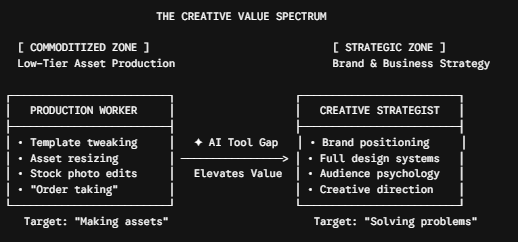
Tier 1: The Production Worker (Under Fee Pressure)
If your primary service involves executing simple visual requests (“Put this text on a blue banner”) or making minor tweaks to pre-made templates, your margins are shrinking.
Because clients can now access basic visuals through low-cost subscription tools, paying high hourly rates for basic asset creation is getting harder to justify. Competing purely on execution speed is a losing battle against software.
Tier 2: The Creative Strategist (In High Demand)
Designers who act as creative directors, brand strategists, and experience architects are thriving. They treat AI as an efficiency engine that lets them execute visual ideas in half the time.
Because they focus on business outcomes—such as increasing user sign-ups, building brand equity, or improving ad conversion rates—they command premium pricing. They don’t sell JPEGs; they sell business transformation.
Step-by-Step Roadmap: How Designers Can Future-Proof Their Careers
To build an irreplaceable career, focus on developing a future-ready skill stack:Step 1: Adopt AI as Your Junior Designer
Stop viewing AI tools as competitors. Integrate tools like Adobe Firefly, Photoshop Generative Fill, Midjourney, and Figma AI into your daily stack. Let AI handle background cleanups, layout variations, and initial discovery moodboards so you can spend your energy on high-level direction.
Step 2: Shift from “Graphic Artist” to “Brand Strategist”
Start asking clients business-focused questions: “Who is your primary customer?”, “What makes your product different?”, and “What metric defines success for this project?” Learn the basics of conversion rate optimization (CRO), consumer psychology, and brand positioning. When you solve business problems, you move far beyond commoditized asset creation.
Step 3: Refine Your “Taste” and Curation Ability
When anyone can generate a polished graphic in 5 seconds, the market value shifts from raw production capability to taste, curation, and editing. Develop an expert eye for spotting AI visual artifacts, fixing awkward compositions, correcting typography hierarchy, and ensuring that final deliverables strictly adhere to brand guidelines.
Step 4: Expand into Specialized, High-Touch Disciplines
Diversify into fields that require physical, spatial, or complex interactive execution:
Packaging & Physical Print Systems: Creating 3D product packaging, understanding print finishes (embossing, die-lines, foils), and managing eco-friendly material specs.
UI/UX & Design Systems: Building accessible software interfaces, interactive prototypes, and scalable Figma design systems.
Motion Graphics & Kinetic Typography: Adding dynamic motion to brand identities for digital ads and social media.
Final Verdict: The Future Belongs to Hybrid Creatives
Artificial intelligence is not the end of graphic design—it is the end of tedious, manual visual labor.
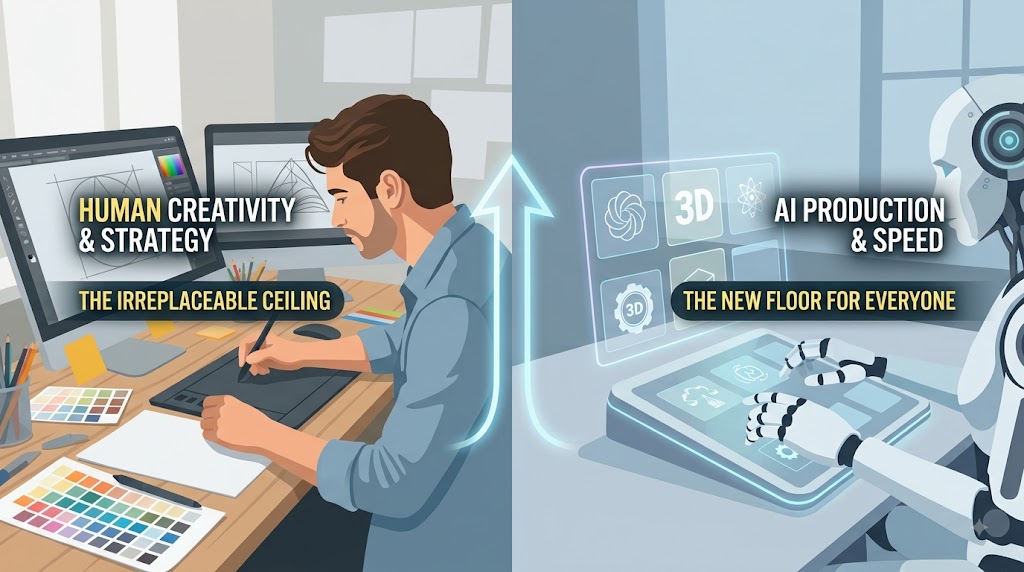
Just as desktop publishing software (Photoshop, Illustrator, and InDesign) transformed the design landscape in the 1990s, Generative AI is raising the baseline for speed and efficiency. Raising the floor only emphasizes the value of the ceiling: human empathy, strategic thinking, storytelling, cultural fluency, and creative direction.
AI gives you speed and volume. You supply the direction, context, and purpose