

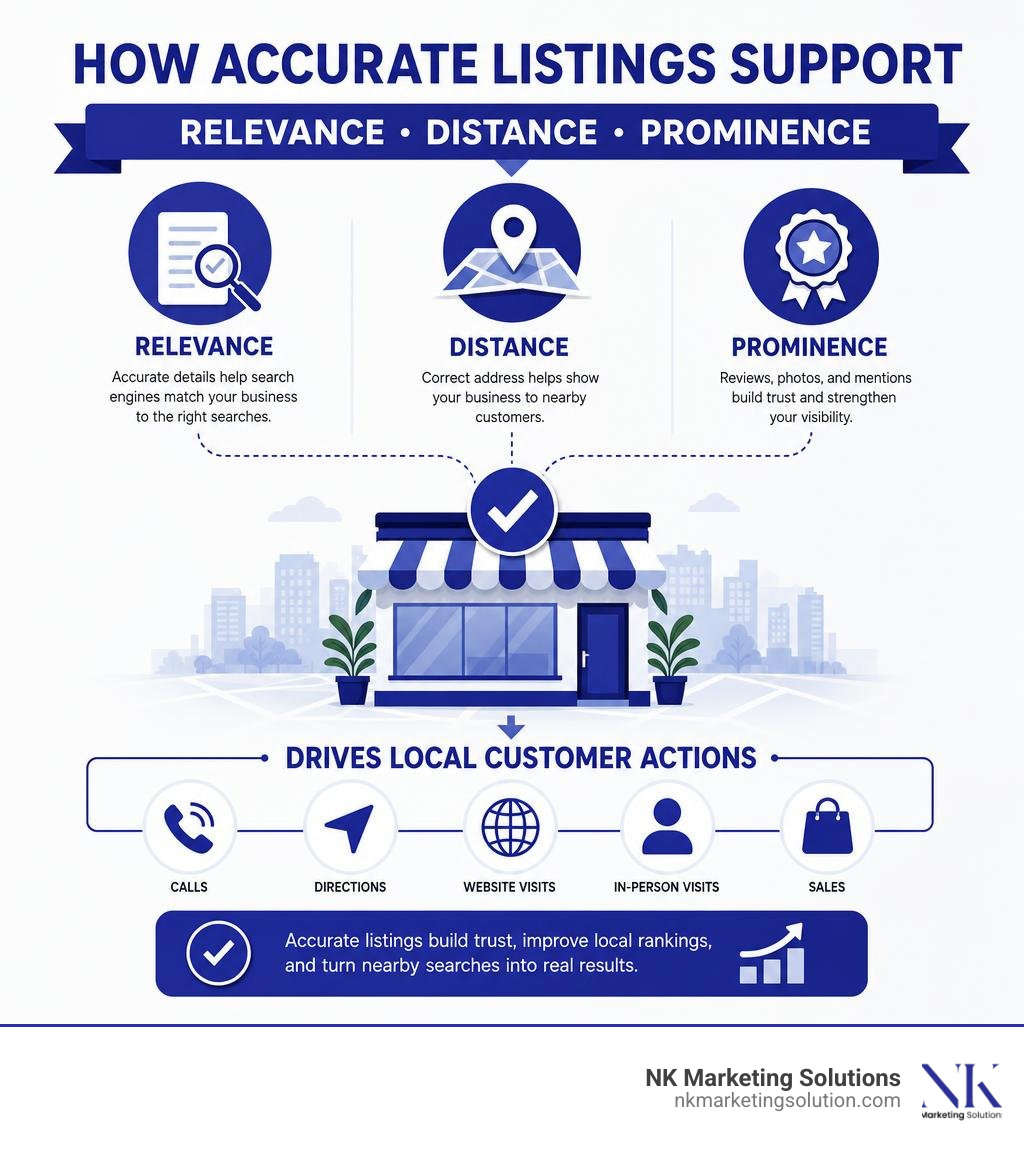
Local SEO and business listings help search engines and customers confirm that your business is real, relevant, nearby, and trusted. To improve local visibility, claim and verify your Google Business Profile, keep your name, address, phone number, hours, and categories accurate everywhere, and build a steady flow of genuine customer reviews.
This matters because Google ranks local results around three core ideas: relevance, distance, and prominence. Complete listings make it easier to match your business to the right searches. Consistent details reduce confusion. Reviews, photos, website links, and mentions help establish credibility.
For a California business owner, this is not just a Maps ranking task. Accurate listings can drive calls, direction requests, website visits, and in-person sales when customers are ready to act. It also supports visibility in AI-powered search tools, which depend on clear, verifiable business information across the web.
Understanding the Interconnection of Local SEO and Business Listings
Local SEO is the specialized practice of optimizing your brand’s digital footprint so nearby consumers discover your services when searching online. Online business listings—often referred to as digital citations—serve as the structural foundation of this entire process. Think of directories as modern, interactive yellow pages enriched with customer reviews, real-time operating hours, and turn-by-turn navigation data.
When search engines crawl the web, they look for verifiable signals to construct a factual Knowledge Graph about your business entity. Every time your company’s Name, Address, and Phone number (NAP) are accurately published on reputable directories, mapping apps, and data aggregators, search algorithms gain confidence that your business operates legitimately at its stated location.
Managing these signals efficiently requires the best local SEO tools to track directory placements, monitor citation health, and ensure that search algorithms receive unambiguous data across every touchpoint.
Algorithmic Ranking Factors: Relevance, Distance, and Prominence
Search engines rely on a specific three-pillar framework when determining which businesses earn top placement in local map packs and organic search results. Official guidance in Tips to improve your local ranking on Google outlines these fundamental factors:
- Relevance: How well your business profile matches what the user is searching for. Comprehensive listings that include detailed service menus, complete business categories, and accurate attribute tags allow search engines to match your listing to specific, high-intent user queries.
- Distance: How far your physical location or service territory is from the searcher. If a user doesn’t explicitly share their geographic coordinates, search engines estimate their proximity based on device location signals.
- Prominence: How well-known, reputable, and established your business is offline and online. Prominence calculations pull heavily from directory citation counts, organic backlink profiles, article mentions, and review ratings.
The Impact of AI Search Engines on Directory Discovery
The local discovery landscape is evolving rapidly in 2026. Approximately 46% of all Google searches carry local intent, while AI Overviews now appear on roughly 48% of all tracked Google queries. Furthermore, 45% of consumers now use AI search tools for local service discovery, up from just 6% a year ago.
Generative discovery engines like ChatGPT, Perplexity, and Google Gemini do not treat local recommendations the same way traditional map packs do. ChatGPT relies heavily on integrations with Mapbox and Bing Places, Perplexity performs live retrieval across web citations, and Gemini reasons directly over structured Knowledge Graphs.
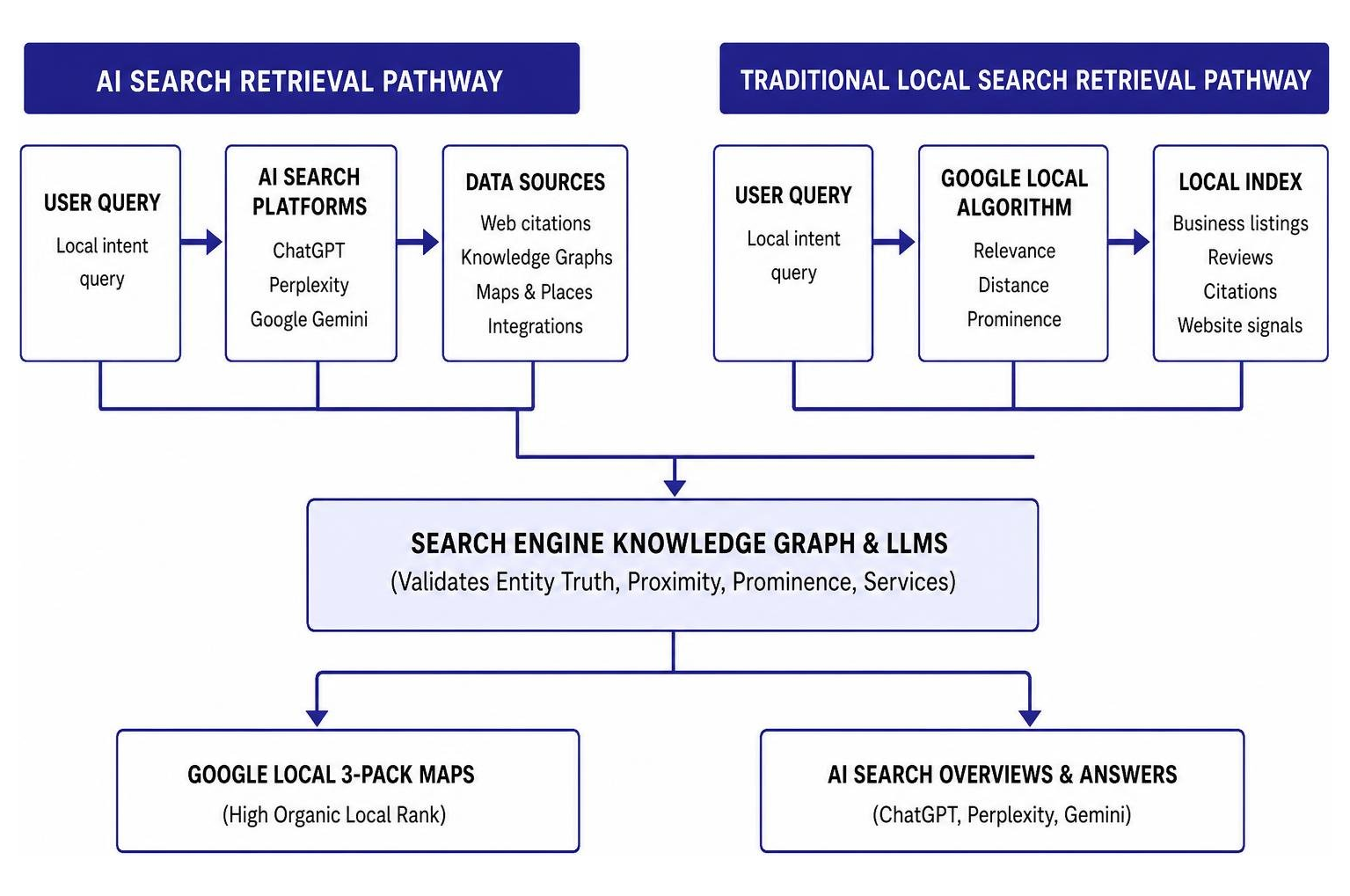
Because AI tools apply stricter filtering criteria, earning a recommendation is significantly more competitive: ChatGPT recommends only 1.2% of local business locations, Perplexity 7.4%, and Gemini 11%, compared to a 35.9% visibility rate in Google’s traditional local three-pack. Mastering how to write content that ranks in AI generated answers ensures your brand provides the structured facts these LLMs require to cite you as the premier local choice.
5 Critical Ways Business Listings Fuel Local Search Performance
Understanding how long does SEO take to show results in 2026 often comes down to how effectively you manage your core digital assets. Directory listings directly influence visibility, trust, and conversion rates across every stage of the local customer journey.

1. Maximizing Google Business Profile Authority and Map Pack Presence
Your Google Business Profile (GBP) is the cornerstone of local visibility, with profile signals accounting for roughly 32% of local three-pack ranking factors. An unverified or incomplete profile leaves money on the table, whereas an optimized listing converts local intent into paying customers. In fact, research reveals that accurate business hours and complete metadata alone can increase weekday call volume by up to 94%.
To optimize your Google Business Profile:
- Complete Business Identity: Ensure your exact business name matches your legal signage, and double-check your primary phone number and website URL.
- Select Precise Categories: Your primary category carries the heaviest algorithmic weight. Choose the most specific option available (e.g., “Plumber” rather than “Contractor”), followed by relevant secondary categories.
- Showcase High-Quality Visual Media: Profiles with photos receive 42% more requests for driving directions and 35% more website click-throughs. Upload authentic storefront imagery, staff photos, and product snapshots.
- Publish In-Store Products and Services: Add descriptive items directly to your profile. If you run a retail or service storefront, listing inventory helps capture nearby shoppers looking for immediate availability.
If your profile fails to appear on maps despite complete setup, troubleshooting why is my Google Business Profile not showing will help identify common visibility blockers such as verification issues or category conflicts.
2. Establishing Unbreakable NAP Consistency Across Core Directories
Inconsistent citations confuse search engines and dilute your local search authority. If one directory lists your address with an old suite number and another uses an outdated phone line, search engines cannot verify your operational reality with certainty.
Achieving a 95%+ stable consistency rate across the web creates an unshakeable trust signal for algorithms. Prioritize authoritative directories and major data aggregators (such as Data Axle and Neustar Localeze) that syndicate information across thousands of smaller apps.
| Directory Platform | Primary Authority Value | Primary Search & AI Impact | Key Profile Features |
|---|---|---|---|
| Google Business Profile | High | Powers Google Search, Google Maps, and AI Overviews | Products, services, booking links, reviews, posts |
| Apple Business Connect | High | Powers Apple Maps, Siri voice search, iOS discovery | Action buttons, showcases, operating hours, photos |
| Bing Places for Business | High | Feeds Microsoft Copilot, Bing Search, ChatGPT search | NAP data, photos, multi-location import |
| Yelp | High | Feeds Apple Maps reviews, third-party LLM sentiment | Customer reviews, portfolios, quote requests |
| Better Business Bureau | High | Supplies heavy prominence and trust validation | Accreditation badges, business history, reviews |
| Foursquare | Medium | Syndicates location data across major mobile apps | Proximity mapping, geo-checkins, venue tags |
3. Driving Social Proof Through Active Review Generation and Management
Customer reviews directly influence both search engine rankings and consumer conversion rates. Research indicates that 97% of consumers read online reviews for local businesses, with 41% stating they “always” check reviews before making a buying decision. Review signals account for approximately 15.44% of local pack ranking factors.
To build a robust review profile:
- Ask Directly Without Gating: Encourage every satisfied customer to leave feedback via direct links sent through SMS or email post-transaction. Never practice review gating (filtering unhappy customers away from public profiles), as this violates search engine policies.
- Maintain a Rapid Response Cadence: Respond to all incoming reviews—both positive and negative—within 24 to 48 hours. This signals to search engines and potential buyers that you actively engage with your clientele.
- Handle Negative Feedback Professionally: When addressing critical feedback, remain calm and professional. Acknowledge the issue and provide a private direct email or phone line to resolve it, especially in regulated industries where disclosing client information is prohibited.
4. Feeding Generative AI Models with Verifiable Structured Data
As highlighted in Local SEO in the AI Era: The Complete Guide for 2026 | SwingIntel, optimizing your local presence now requires catering to AI search agents alongside traditional algorithms. AI-recommended businesses experience between four and twenty-three times higher call conversion rates than traditional organic search results because AI platforms deliver high-confidence, conversational recommendations.
Generative AI models parse directories and landing pages looking for clean, machine-readable structured data. Implementing schema markup helps LLMs extract verified facts about your business without ambiguity:
- LocalBusiness Schema: Embed JSON-LD markup on your website defining your canonical business name, physical coordinates, geo-radius, telephone, opening hours, and accepted payment methods.
- FAQPage Schema: Add schema-validated FAQs answering specific local pricing, timing, and service questions. FAQPage schema delivers the highest citation probability for AI engines.
- Mitigate the Citation Cliff: AI search tools favor fresh information. Updating your metadata, hours, and service descriptions at least once every 90 days prevents your listings from falling off AI recommendation radars.
5. Strengthening Hyperlocal Signals for Dedicated Location Pages
Your external business listings must link to intent-matched, high-performance location landing pages rather than dumping every user onto a generic homepage. Linking individual directory listings directly to localized pages bridges the gap between directory authority and on-page topical depth.
Investing in high quality content on page SEO for every location page provides substantial ranking lifts:
- Include Hyperlocal Context: Incorporate verifiable local references within a two-mile radius, such as nearby transit stations, commercial hubs, or distinct neighborhoods you serve. Research shows genuine hyperlocal content provides a 107% lift in rankings compared to templated pages.
- Add Localized Photography: Feature authentic photos of your physical building, local team, and completed neighborhood projects. Real local imagery yields an average 75% increase in visual photo engagement.
- Enable Mobile Action Pathways: Since 76% of mobile users searching for something nearby visit a business within 24 hours, ensure every location page features click-to-call buttons and deep-linked map directions.
Best Practices to Scale Local Strategy Across Multiple Locations
Scaling local SEO across multiple branches or service territories presents serious organizational hurdles. Without clear governance, multi-location enterprises quickly suffer from data decay, duplicate listings, and cannibalized search rankings. Studies show that 94% of high-performing multi-location brands maintain a dedicated local marketing strategy, compared to just 60% of average performers.

Implementing NAP Discipline for Local SEO and Business Listings
The most effective multi-location operating framework pairs centralized technical governance with localized on-the-ground execution. Establishing an internal canonical business record prevents local staff from accidentally publishing unauthorized phone numbers or naming variations.
To scale smoothly:
- Adopt a Tiered Directory Rollout: Segment your locations into operational tiers. Focus first on Tier A locations (high-competition flagship branches), rolling out to secondary (Tier B) and tertiary (Tier C) markets over a structured 90-day onboarding timeline.
- Consolidate Verification: Utilize bulk verification tools within Google Business Profile and Apple Business Connect to verify enterprise locations simultaneously.
- Future-Proof Location Data: Consult our guide on how to future proof your content strategy for AI and the future of SEO to ensure your multi-location data architecture remains easily parsable by evolving AI web agents.
Creating High-Performing Hyperlocal Landing Pages
A major pitfall in multi-location SEO is deploying cookie-cutter pages that simply swap city names across identical text blocks. Search engines flag these as thin doorway pages, degrading their visibility.
- Maintain 60% to 70% Unique Content: Every location landing page must feature distinct service descriptions, local project portfolios, specific parking/transit instructions, and regional customer testimonials.
- Clean URL Architecture: Structure URLs logically and descriptively using hyphens (e.g.,
/locations/san-jose-marketing-services) without special characters or numbers. - Local Schema Implementation: Assign specific
LocalBusinessstructured data tags unique to each physical address and coordinate set.
Avoiding Common Pitfalls in Local Business Listing Management
Maintaining local listings requires ongoing quality control. Stale directory data, broken tracking links, and algorithmic policy violations can quickly undermine months of hard work.
If your rankings drop unexpectedly, our breakdown on why is your site not ranking on Google 2026 provides a step-by-step framework to audit underlying technical issues.
Overcoming Operational Pitfalls in Local SEO and Business Listings
- Eliminate Duplicate Listings: Duplicate records on Google Maps or Yelp split your review equity and confuse search crawlers. Conduct bi-annual listing audits and request immediate merges or deletions for redundant records.
- Avoid Name Keyword Stuffing: Adding geographic tags or descriptive services to your official business name (e.g., “Main Street Bakery – Best Cupcakes Coffee Downtown”) violates Google guidelines and risks immediate profile suspension. Stick strictly to your real-world brand name.
- Update Holiday Hours Proactively: Forgetting to update holiday or seasonal hours leads to frustrated consumers arriving at closed doors. Unhappy customers leave negative reviews, which directly drags down local prominence scores.
- Fix Broken Destination URLs: Ensure directory profile buttons link to live, mobile-friendly landing pages. Periodic site redesigns can inadvertently generate 404 errors on legacy citation links, breaking your customer conversion funnels.
- Debunking Unverified Tactics: Avoid wasting time on unproven local SEO gimmicks such as EXIF image geotagging. Search platforms strip image coordinate metadata upon upload; focus instead on producing clear, high-resolution visual content.
Frequently Asked Questions About Local Business Listings
Which Online Directories Should a Business Prioritize First?
Every business should establish and verify its core baseline profiles on Google Business Profile, Apple Business Connect, Bing Places for Business, Yelp, and the Better Business Bureau (BBB). Once your primary listings are fully verified and consistent, expand into industry-specific directories (such as Avvo for legal services or Houzz for home improvement) and regional chambers of commerce.
How Long Does It Take for Business Listings to Impact Local Rankings?
Most businesses begin noticing initial local ranking movement and increased directory discovery within 4 to 12 weeks after achieving widespread NAP consistency and claiming their primary profiles. However, building substantial local prominence through ongoing customer reviews, high-tier local citations, and localized on-page content typically takes 3 to 6 months of continuous effort.
Can Paid Directory Submissions Guarantee a Local 3-Pack Ranking?
No legitimate tool or agency can guarantee a local three-pack ranking. Google’s local ranking algorithms evaluate organic factors—relevance, distance, and prominence—confidential to ensure fair results. Directory submission platforms simply automate the syndication and maintenance of your operational business data across external sites.
Maximize Your Local Search Authority with NK Marketing Solutions
Winning in local search requires an active, data-driven approach. From establishing unbreakable NAP consistency across high-authority directories to crafting AI-ready location pages and driving authentic customer reviews, keeping your business visible across modern search platforms demands ongoing technical execution.
At NK Marketing Solutions, we help businesses across California and beyond dominate local search results. As a full-service digital marketing agency, we specialize in ROI-focused, transparent strategies spanning local search optimization, pay-per-click advertising, web development, and content creation—all backed by clear performance reporting with no long-term contracts.
Ready to elevate your local visibility, outrank nearby competitors, and capture high-intent customers in your neighborhood? Explore our comprehensive SEO services and let our expert team build a customized local growth engine for your brand today.