
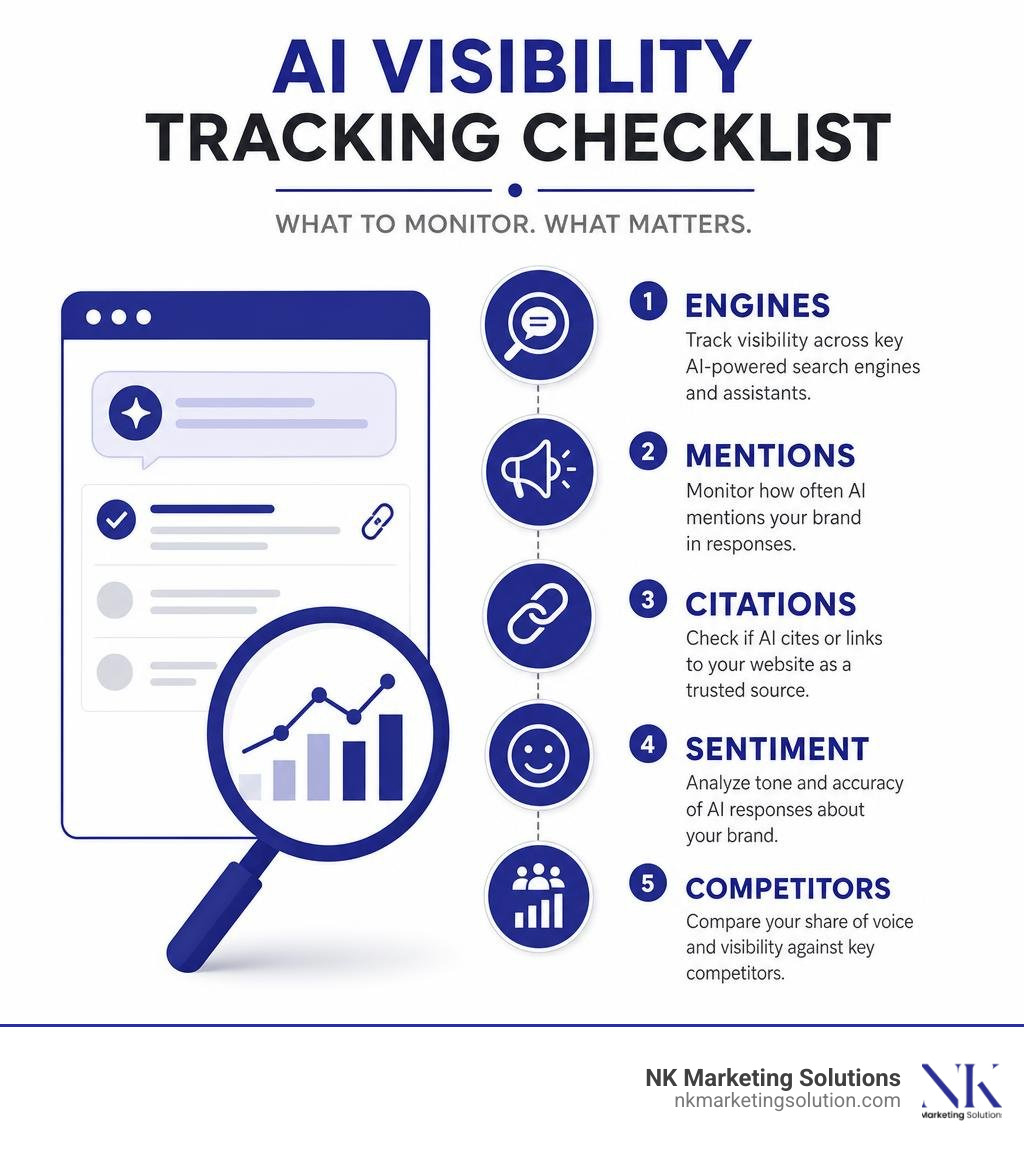
The best tools for monitoring AI search visibility in SEO in 2025-2026 track whether ChatGPT, Perplexity, Google AI Overviews, Gemini, and similar tools mention, recommend, or cite your business. For a small business, start by monitoring your highest-intent customer questions, then compare:
- Brand mentions – Does the AI name your business?
- Citations – Does it link to your website or rely on another source?
- Share of voice – How often do you appear compared with competitors?
- Sentiment and accuracy – Does the answer describe your services, prices, and reputation correctly?
Traditional rank tracking still matters. But it cannot tell you whether an AI assistant recommends a competitor when someone asks, “Who is the best provider near me?” AI answers often give people a shortlist before they ever visit Google results or click a website.
That matters in a zero-click search world. Google AI Overviews appear in a large share of searches, while ChatGPT and Perplexity are becoming common tools for research, comparisons, and buying decisions. A strong AI visibility tool turns those shifting answers into usable data: which prompts matter, which sources AI trusts, and what content or reputation gaps to fix next.
Why Monitoring AI Search Visibility is Critical for Modern SEO
Search behavior has shifted dramatically. ChatGPT handles over 2.5 billion queries every month and reached over 800 million weekly active users, while Google AI Overviews appear in nearly half of all search queries. Furthermore, in the US, roughly 68% of Google searches now end without a traditional click. Consumers are reading direct conversational summaries and making purchasing decisions on the spot.
When potential clients ask conversational questions, Large Language Models (LLMs) do not simply display a list of ten links. Instead, they synthesize multiple sources across the web to recommend specific brands. If you are wondering why is your site not ranking on google 2026, the answer might be that search engines are answering user questions before anyone ever reaches the standard organic list.
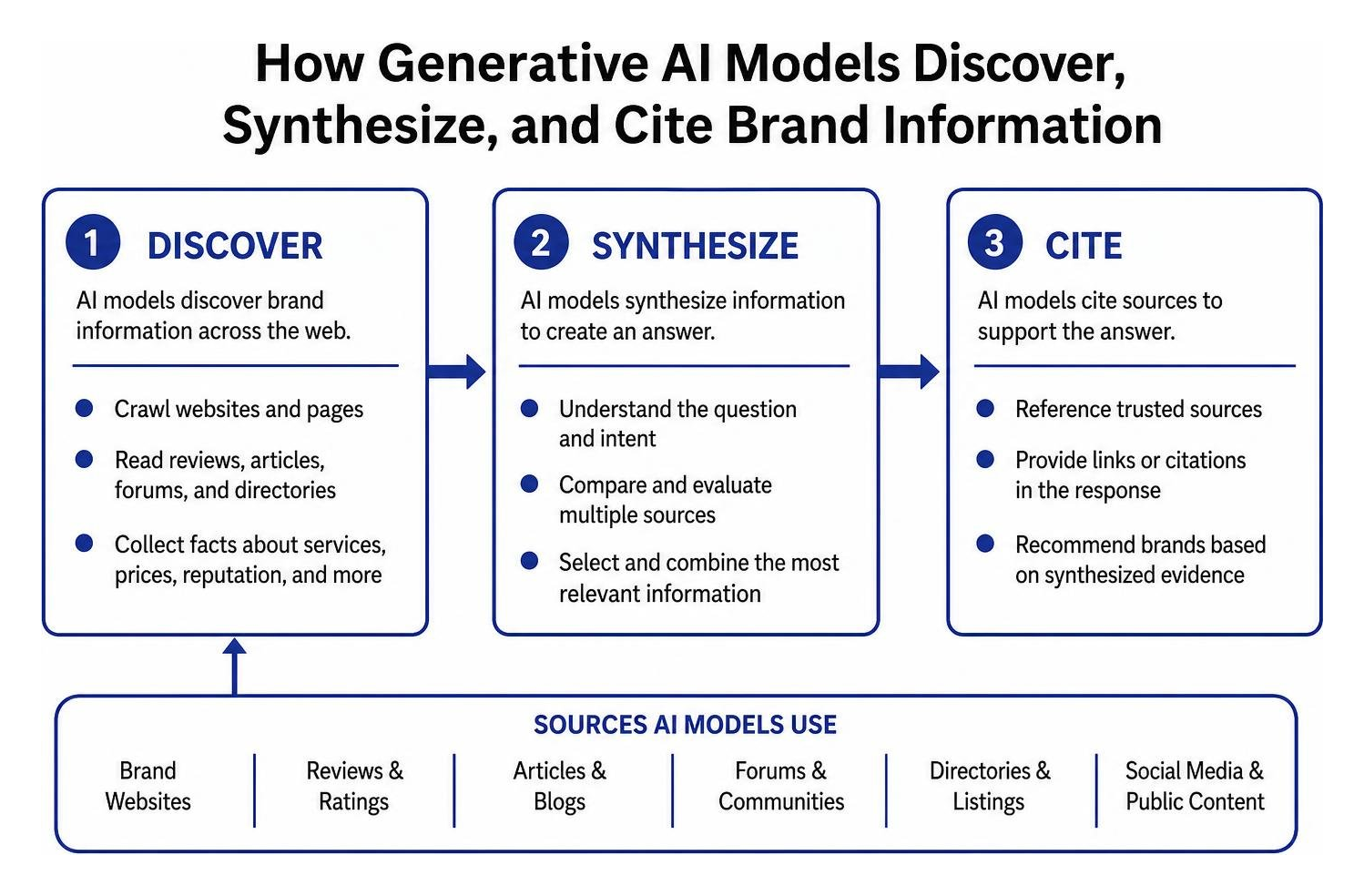
Research shows that visitors referred by conversational AI engines convert roughly three times more often than visitors from standard organic search links. Monitoring your brand’s AI search visibility allows you to track entity synthesis, check bot crawler logs, safeguard your brand reputation against hallucinations, and optimize your recommendation frequency.
Traditional Rank Tracking vs. Generative Engine Optimization (GEO)
Traditional SEO rank trackers measure static positions for specific keywords on search engine results pages. However, Generative Engine Optimization (GEO) and Answer Engine Optimization (AEO) evaluate how LLMs understand concepts and recommend entities.
Understanding this distinction is just as vital as knowing how is ranking different ppc vs seo. In generative search, traditional ranking does not guarantee visibility. In fact, studies show that only about 12% of URLs cited by conversational AI assistants rank within Google’s top 10 organic positions.
- Traditional Rank Tracking: Measures SERP positions, organic clicks, and domain keyword distribution.
- Generative Engine Optimization (GEO): Monitors prompt-level visibility, source attribution, unlinked brand mentions, citation frequency, and sentiment accuracy.
Core Features in the Best Tools for Monitoring AI Search Visibility SEO 2025 2026
When evaluating software to track your generative search presence, look for specific features that handle the fluid nature of conversational AI:
- Multi-Engine Coverage: The ability to query ChatGPT, Perplexity, Gemini, Claude, and Google AI Overviews simultaneously.
- Prompt Discovery and Funnel Mapping: Tools that convert static keywords into conversational, multi-turn prompt variations across awareness, consideration, and purchase phases.
- Crawler Log Analytics: Real-time detection of AI bot visits (such as GPTBot, ClaudeBot, and PerplexityBot) on your web server.
- Sentiment and Hallucination Scoring: Automated sentiment detection to verify whether models accurately portray your pricing, features, and brand reputation.
- Actionable Remediation Layers: Connecting monitoring data to automated execution, such as generating content briefs, schema, or structured playbooks, as detailed in our ai marketing automation guide 2026.
The Best Tools for Monitoring AI Search Visibility SEO 2025 2026
The software landscape for tracking AI visibility includes dedicated prompt trackers, all-in-one GEO suites, and open-source stacks. Choosing the right platform depends on your operational workflow, data requirements, and marketing budget.
| Tool | Engine Coverage | Key Strengths | Best For | Pricing Model |
|---|---|---|---|---|
| Rankflo | ChatGPT, Claude, Gemini, Perplexity | Server crawler log tracking & UI-based citation data | Technical SEOs & mid-market brands | Tiered SaaS plans |
| optiseo | ChatGPT, Claude, Gemini, Perplexity | Daily prompt queries, consensus scoring & llms.txt builder | Growth teams & SMBs | Monthly volume-based |
| SEObolt | ChatGPT, Claude, Perplexity, Gemini, DeepSeek | GEO score audits, live slideout editor & 26 SEO tools | Content marketers & consultants | Self-serve starting at $29/mo |
| GeoRank | ChatGPT, Perplexity, Gemini, Claude, Grok | Real-time sentiment, GEO visibility scores & webhooks | Agencies & performance marketers | Free tier to $249/mo Agency |
| Canonry | Gemini, ChatGPT, Claude, Perplexity | Self-hosted, local DuckDB data & MCP integration | Developers & technical agencies | Open-source / API costs |
A comprehensive platform like AI Search Visibility & SEO Platform | SEObolt integrates both traditional ranking tools and multi-model AI citation scoring, giving you a complete view of how generative engines interpret your site structure.
Dedicated GEO Platforms and Prompt Trackers
Dedicated prompt trackers focus specifically on real-time conversational testing and share-of-voice reporting.
Platforms like The #1 AI Search Visibility Tool for Tracking & Optimizing | Rankflo bridge the gap between backend bot crawls and front-end conversational citations. By monitoring server logs every 72 hours, Rankflo shows you exactly when LLM bots crawl your pages before synthesizing recommendations.
Similarly, the Ai Visibility Dashboard – optiseo simplifies prompt management by querying major models daily. It highlights competitor citation gaps, provides statistical consensus scores to account for prompt variability, and generates prioritized action lists to correct inaccurate brand summaries.
Open-Source and Technical Visibility Stacks
For technical marketing teams that require full data ownership, open-source and developer-focused stacks provide powerful customization.
Canonry/canonry offers a self-hosted, agent-first AI visibility framework. Built with Model Context Protocol (MCP) support, Canonry allows coding assistants to diagnose technical site health, conduct API-based LLM sweeps across OpenAI, Anthropic, and Google, and query local Common Crawl backlink data using DuckDB.
For straightforward multi-model benchmarking, GeoRank — SEO for the AI Era | GeoRank delivers continuous prompt tracking across models like ChatGPT, Perplexity, and Grok. It automatically calculates a standardized GEO Score (from 0 to 100) based on mention prominence, while sending instant Slack and webhook alerts whenever a competitor displaces your brand.
How the Best Tools for Monitoring AI Search Visibility SEO 2025 2026 Measure Share of Voice
Because LLMs are non-deterministic, running a single query rarely gives a full picture. The best tools for monitoring ai search visibility seo 2025 2026 run automated simulations across multiple runs to establish statistical consensus scoring.
If you are evaluating how to pick the best ai for seo without wasting your budget, ensure your tracking tool measures these four core dimensions:
- Mention Share: How frequently your brand is named across 100+ category variations.
- Citation Share: Whether the engine provides a direct, clickable link to your domain.
- Sentiment Distribution: Evaluating whether the LLM recommends your brand positively, neutrally, or unfavorably.
- Factual Accuracy: Detecting hallucinated pricing, outdated service descriptions, or misattributed features.
How to Turn AI Visibility Tracking Data into Higher Rankings
Gathering tracking data is only the first step. To improve your visibility, you must systematically update your site content to make it easy for AI engines to extract and cite.
Begin by auditing the exact prompts where competitors are recommended over your brand. To learn more about modern content structuring, read our comprehensive guide on how to future-proof your content strategy for ai and the future of seo.
- Deploy
llms.txt: Create a clean Markdown file at your root domain (/llms.txt) summarizing your core offerings, key URLs, and factual data for AI crawlers. - Implement Structured Schema: Use FAQPage, Organization, and Product schemas to help AI models parse your structured data.
- Modular Content Blocks: Format your website copy with clear H2 and H3 headings, bullet points, and self-contained answer blocks that LLMs can extract easily.
Optimizing for ChatGPT and Perplexity Citations
ChatGPT and Perplexity pull information using distinct citation patterns. On average, ChatGPT cites around 8 sources per response, while Perplexity cites roughly 22 sources.
When conducting research using the best keyword research tools 2026, turn target keywords into clear, natural language questions and structure your pages accordingly:
- Direct Answer Introductions: Answer the primary question in the first 2-3 sentences directly beneath your header.
- Inline Statistics & Case Studies: Research shows that adding verifiable statistics can increase AI visibility by up to 40%.
- Structured Comparison Tables: Present feature comparisons and pricing cleanly so synthesis bots can parse competitive differences without error.
- Third-Party Authority Building: AI engines frequently cite platforms like Reddit, LinkedIn, YouTube transcripts, and authoritative industry directories. Maintain active digital PR to earn citations on the third-party platforms that LLMs trust.
Measuring AI Traffic and Conversion Impact
Tracking your AI search performance requires connecting prompt visibility data with your web analytics.
Following updates like the march 2026 google core update, search engines increasingly favor authoritative, helpful content. Use Google Analytics 4 (GA4) to create custom referral segments that track visitors coming from domains such as chatgpt.com, perplexity.ai, and android-app://com.openai.chat.
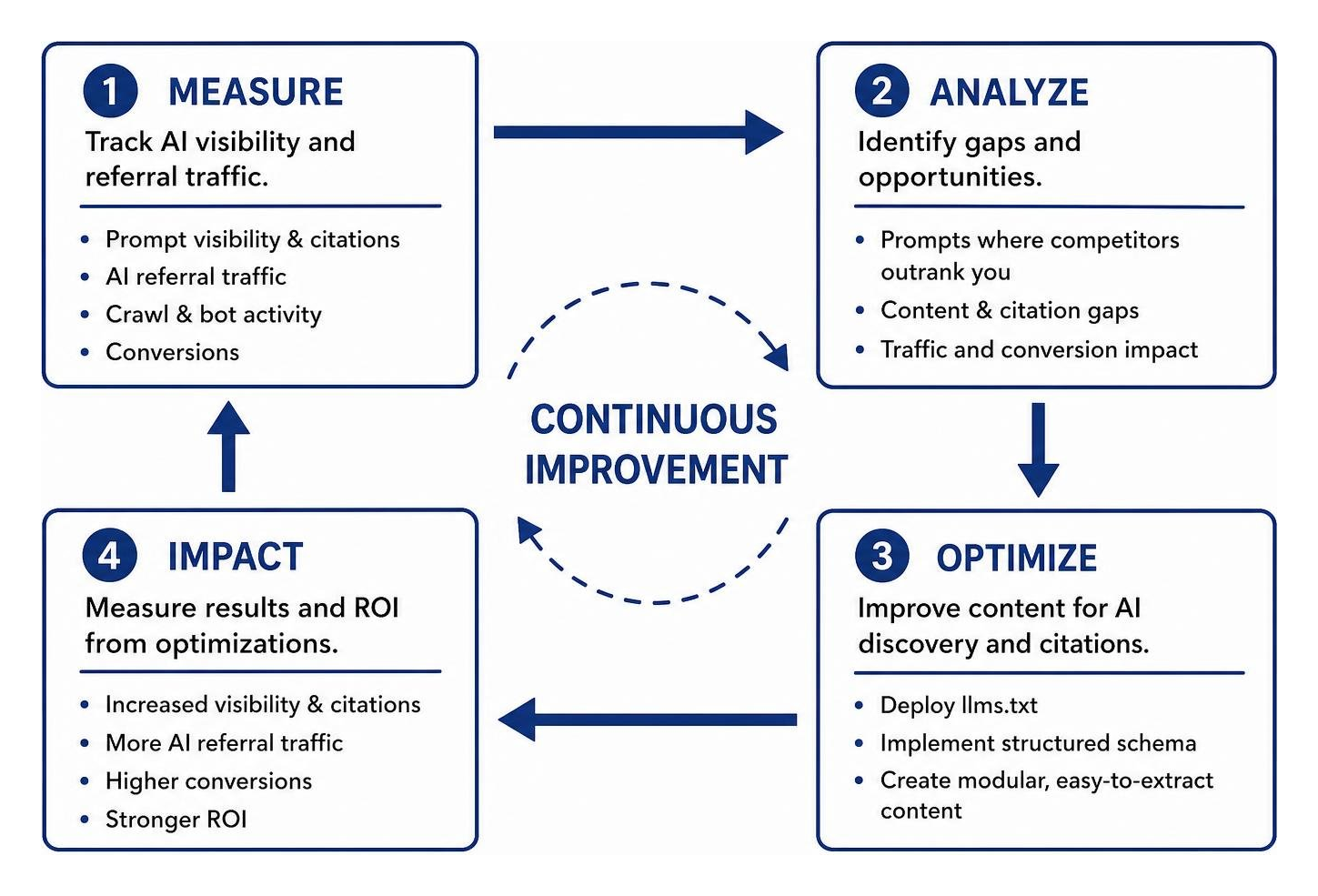
By monitoring your AI referral traffic, conversion rates, and bot crawl patterns simultaneously, you can calculate the exact return on investment from your generative search optimization efforts.
Frequently Asked Questions about AI Search Visibility
How does AI search tracking differ from traditional Google rank tracking?
Traditional rank tracking measures static numerical positions (e.g., position 3 on page 1) for specific keywords. AI search tracking evaluates conversational responses from non-deterministic language models. It measures whether an engine mentions your brand, links to your URL as an authoritative citation source, describes your services accurately, and maintains positive sentiment across multi-turn user prompts.
Which generative search engines should my tracking tool support?
A comprehensive AI visibility stack should track at least ChatGPT, Perplexity, Google AI Overviews, Gemini, and Claude. Engines like DeepSeek and Grok are also valuable additions depending on your industry and audience.
How quickly can you improve brand visibility in AI answers?
Most brands notice initial shifts in AI mention frequency and citation inclusion within 30 to 45 days after publishing optimized, structured content and earning authoritative third-party references. LLMs that use real-time retrieval-augmented generation (RAG) update their citations much faster than models relying strictly on periodic base training runs.
Conclusion
The shift toward generative search engines has transformed organic discovery. As zero-click searches increase and consumers turn to conversational assistants for purchasing guidance, monitoring your brand’s presence in ChatGPT, Perplexity, and Google AI Overviews is essential for modern SEO.
At NK Marketing Solutions, we help small businesses navigate this evolving landscape with data-driven, ROI-focused digital marketing strategies and transparent reporting without long-term contracts.
To start optimizing your content for generative models, explore our detailed guide on how to write content that ranks in ai generated answers and begin building your brand’s authority across every major AI platform.